

**Updated with information from released October 2026 PSAT scores as of November 16.**
If you’d like, jump right to the Compass Projections and State Explorer and then come back for the commentary.
The junior-year PSAT is also the National Merit Scholarship Qualifying Test (NMSQT). Each year, National Merit recognizes the top 55,000 test takers. To be included in that group, students must be among the top 4% of the 1.3 million eligible students who take the PSAT. Of that elite group, approximately 16,500 are recognized as Semifinalists for having the highest scores within their states. Semifinalists have the opportunity to continue in the program to become Finalists and, potentially, scholarship recipients. Some colleges provide significant scholarships and even full rides for Finalists. The remaining 39,000 students are recognized as Commended Students. More information can be found in our National Merit Explained post. If you are looking for Compass’s archived report on the class of 2027 results, find it here.
Calculating the Selection Index
National Merit uses the Selection Index (SI), found on the PSAT score report, to rank students. The Selection Index is calculated by doubling the Reading & Writing score (RW), adding the Math score (M), and dividing that sum by 10. For example, a student with a 720 RW score and a 700 M score has a Selection Index of 214: (720 x 2 + 700) ÷ 10. A student with a 700 RW and 720 M has a Selection Index of 212. The highest SI a student can receive is 228 (760 RW and 760 M). The weighting of the index means that not all students with the same Total Score have the same SI. “Will a 1450 qualify?” is not the right question. Instead, ask whether a student with a 750 RW and 700 M will qualify.
How Semifinalist cutoffs are set in each state
NMSC allocates a target number of Semifinalists to states based on their population of high school graduates, not all of whom take the PSAT. If Texas is allocated 1,500 Semifinalists based on its population of high school graduates, then NMSC works down from a perfect 228 Selection Index until it gets as close as possible to that target. In the class of 2027, 1,462 students scored at or above the cutoff of 219. A cutoff of 220 would have produced too few Semifinalists. A cutoff of 218 would have gone over the allocation. As scores go lower, more and more students occupy each level, and where the crowd forms does not stay consistent from year to year. It is easy for cutoffs to move up or down a point even when there is minimal change in testing behavior or performance. All students at or above a cutoff qualify.
Predicting scores for the class of 2028
The journey to National Merit is a long one. Semifinalists aren’t notified until September 2027, and Finalists might not hear until February 2028. Compass’s research aims to fill in some of the gaps during the long wait.
College Board only summarizes PSAT scores in broad ranges. The top range of 1400 to 1520 has proved to be an excellent indicator of the Commended cutoff and the overall trend in Semifinalist cutoffs.
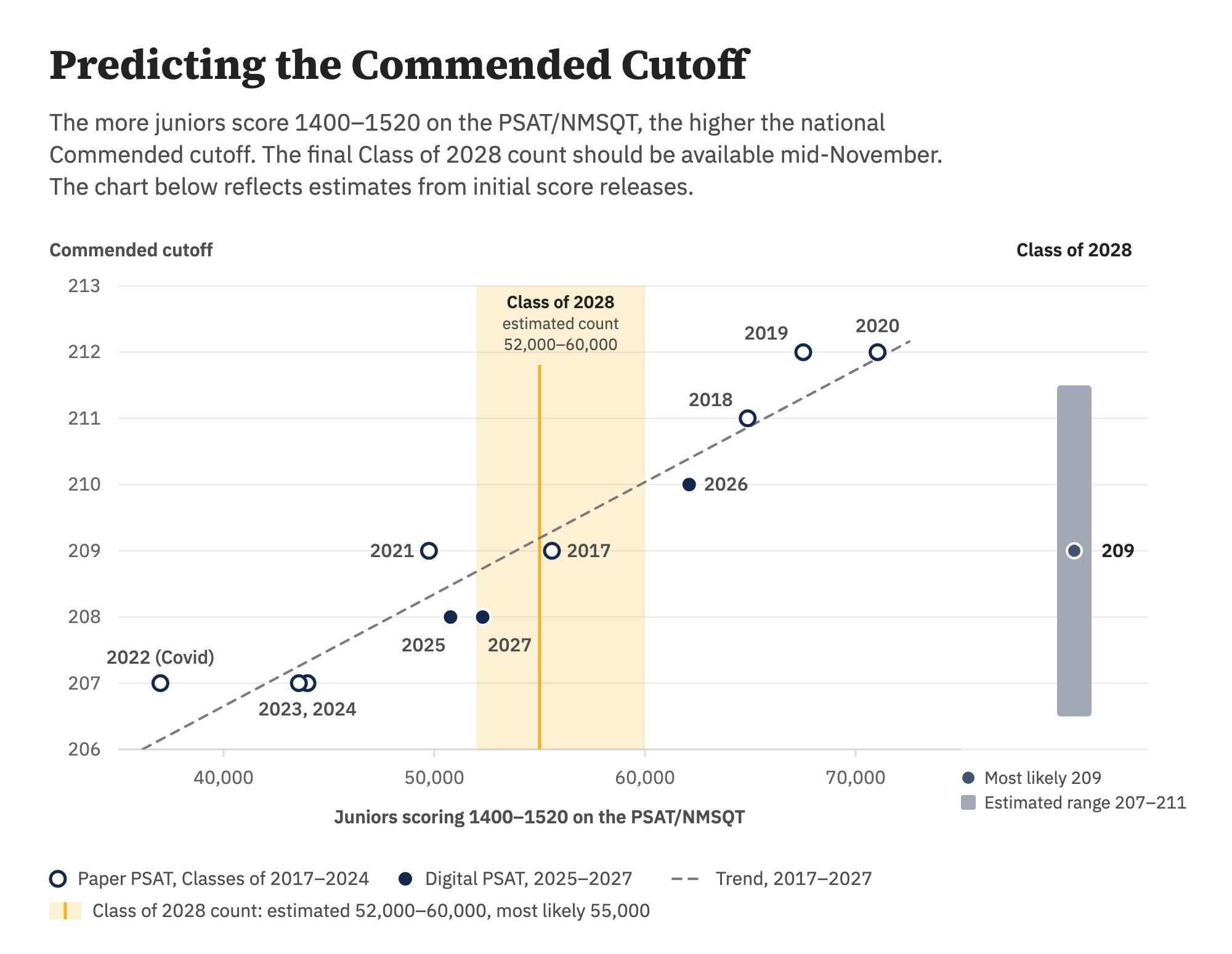
In the class of 2028, 54,000 students reached 1400 and above. That’s only modestly above the 52,300 in the class of 2027, which is why Compass projects this year’s most likely Commended figure to be 209 (with a chance that it remains at 208).
Comparing RW and Math scores also suggests moderation this year
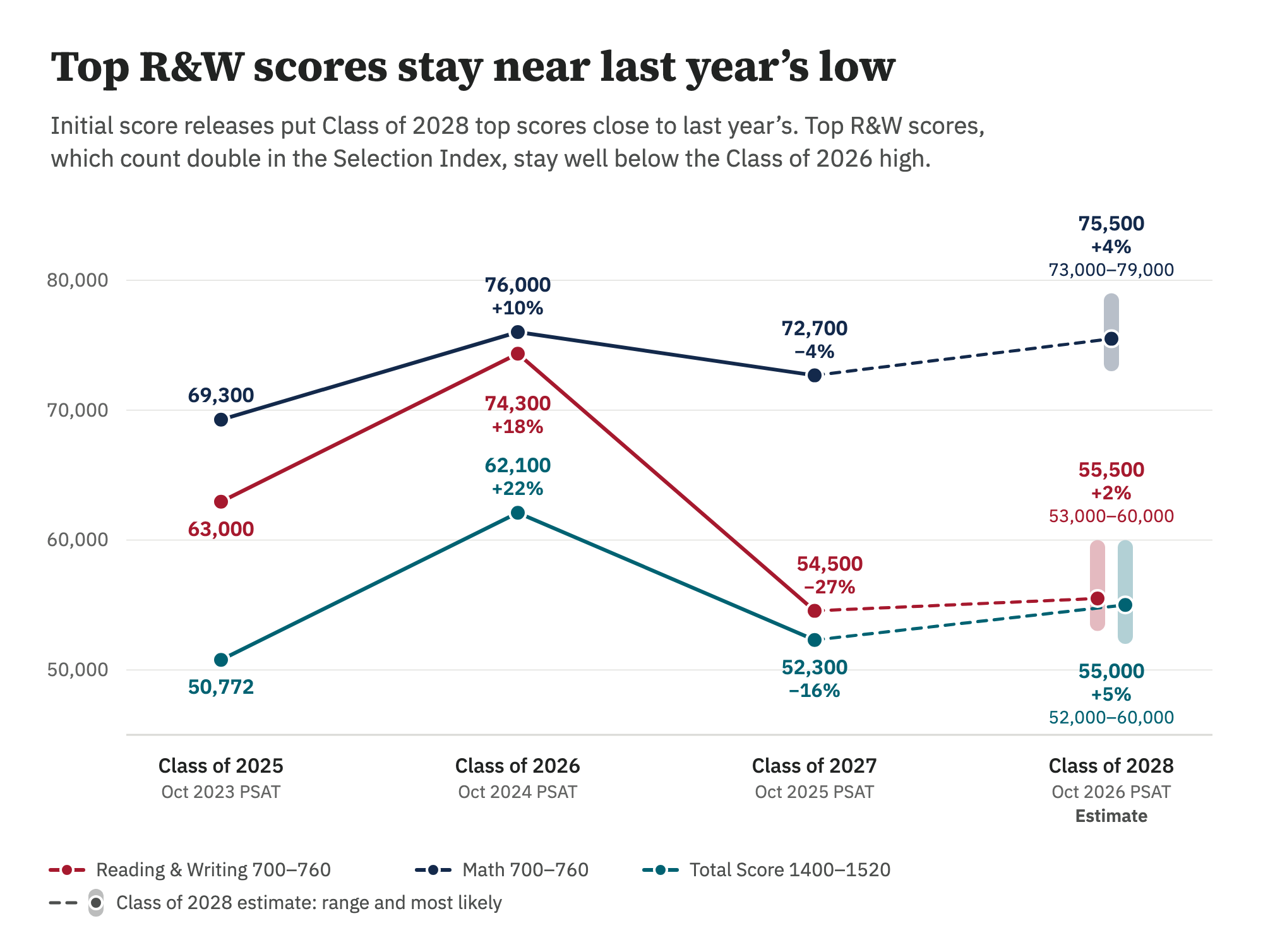
Students considering their odds of qualifying as National Merit Semifinalists often look in horror at the class of 2026 cutoffs, which were among the highest recorded since the revised PSAT was introduced for the class of 2017. Compass has shown that those high cutoffs can likely be attributed to poor scaling of the RW section on the 2024 PSAT. Because RW receives double weight in the Selection Index, the scaling problem had an outsized impact on cutoffs, with New Jersey’s reaching 225. The good news is that this year’s results look more like those from the classes of 2025 and 2027 than they do those from the class of 2026. There are more high Math scores than RW scores (about a 1.33 to 1 ratio), which should keep the highest cutoffs in check. On average, Semifinalist cutoffs may see some upward movement, but there is no evidence of a spike.
Below is a chart of RW, Math, and Total scores over the most recent 4 class years. The number of 700-760 RW scores increased only 3%, and the number of top Math scores increased 6%.
Did I make it?
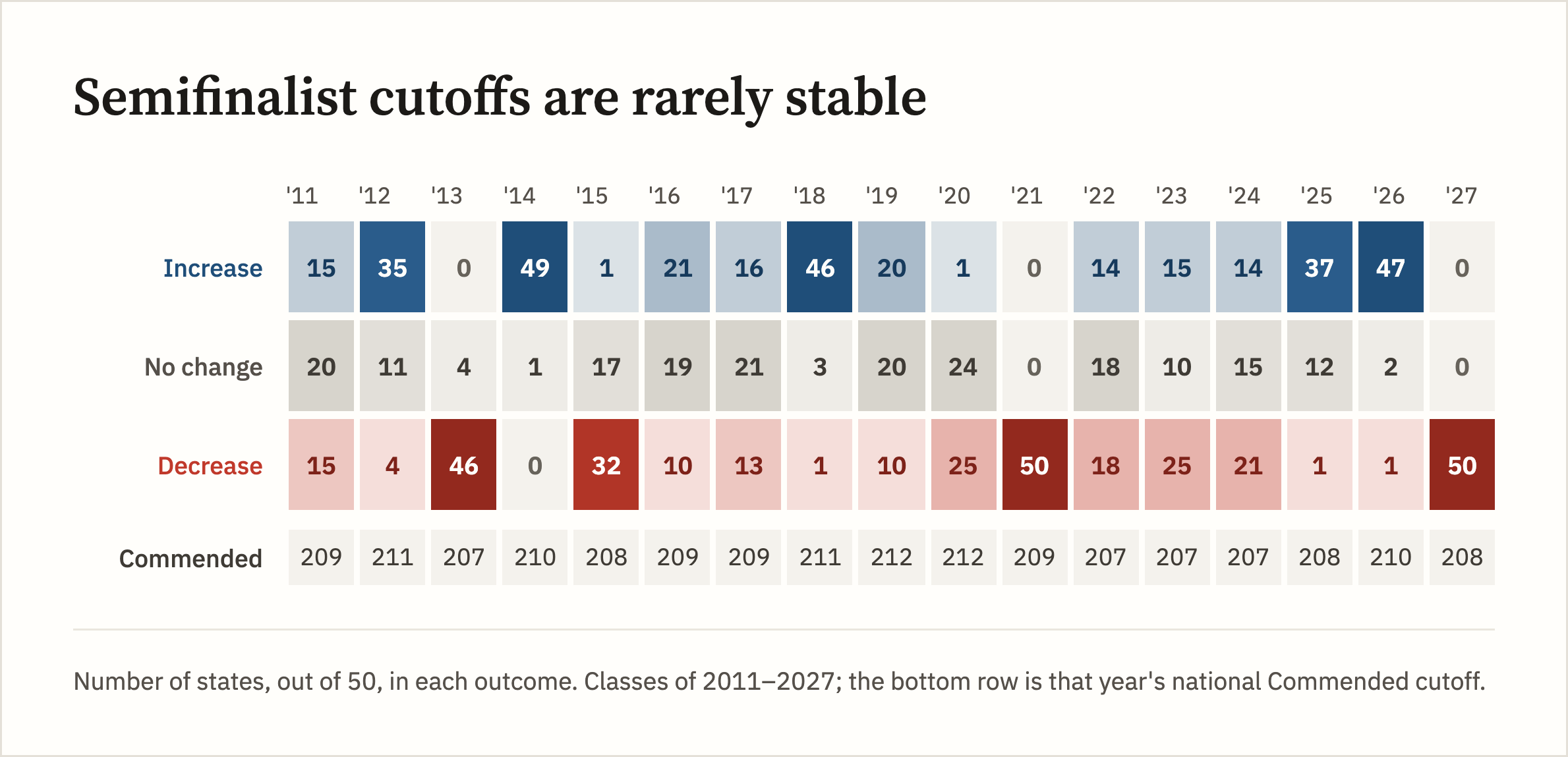
A student’s natural instinct is to look at the prior year’s cutoff and ask, “Did I make it?” The historical record shows the shortcomings of that strategy. From the class of 2011 to the class of 2027, there has never been a year in which even half of the state cutoffs remained unchanged. Even with the added insight of national results, students should consider the likely range of cutoffs rather than focusing on a single score.
Semifinalist trends over time
In October 2015, the PSAT moved to a 320–1520 scale, which was set to provide vertical alignment with the SAT’s 400–1600 scale. The class of 2017 was the first group of students taking the redesigned PSAT/NMSQT, so the fairest comparisons are among the last eleven graduating classes.
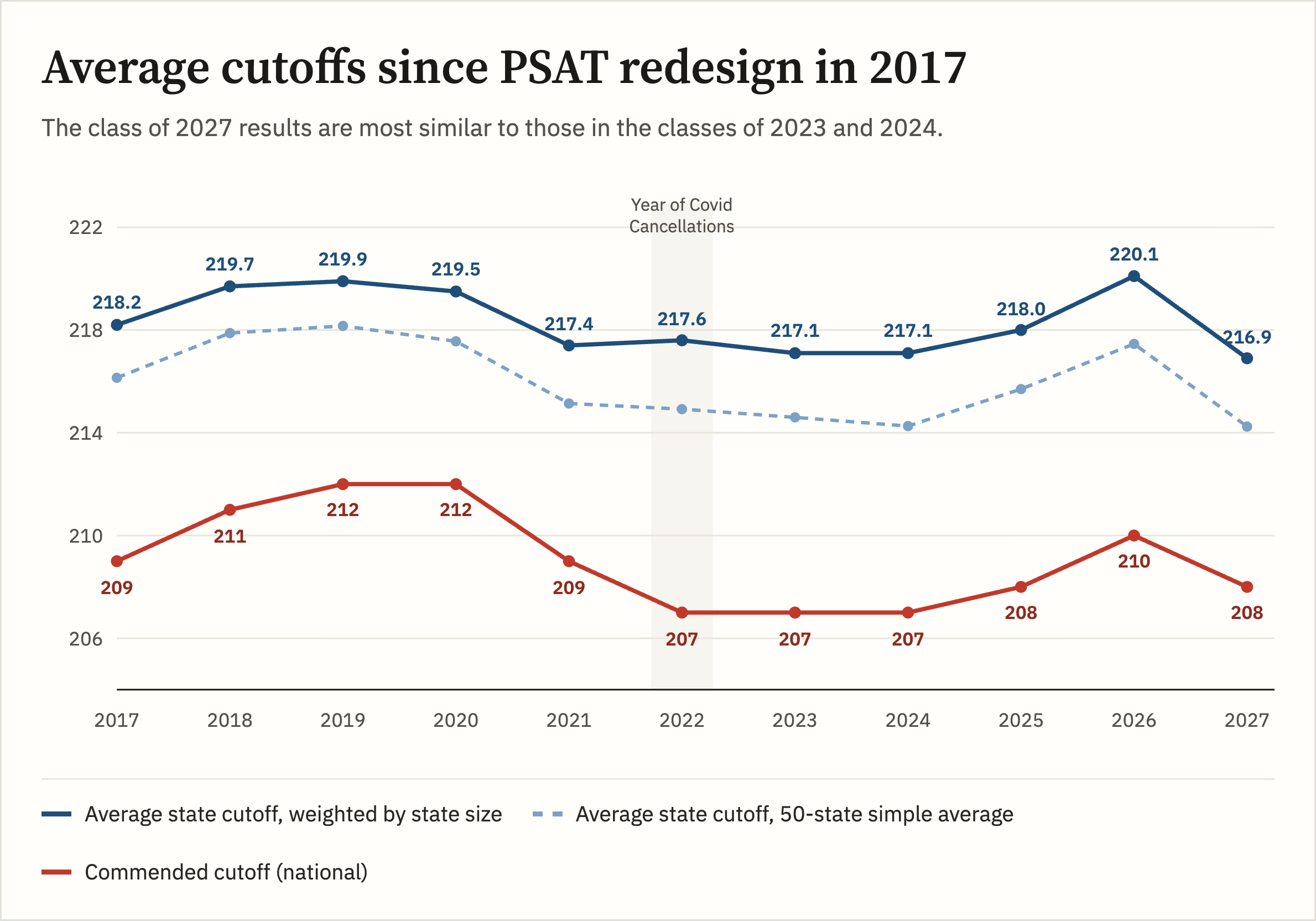
Note how the Commended cutoff and state averages tend to track one another in the chart above. The chart below shows that there is more volatility in individual states, and more volatility in smaller states, but few states move against a rise or fall in the Commended level. We cannot assume, however, that the magnitude of the change will always be the same. We have an estimate of the Commended cutoff — a suspected 1-point increase — but won’t have confirmation until April.
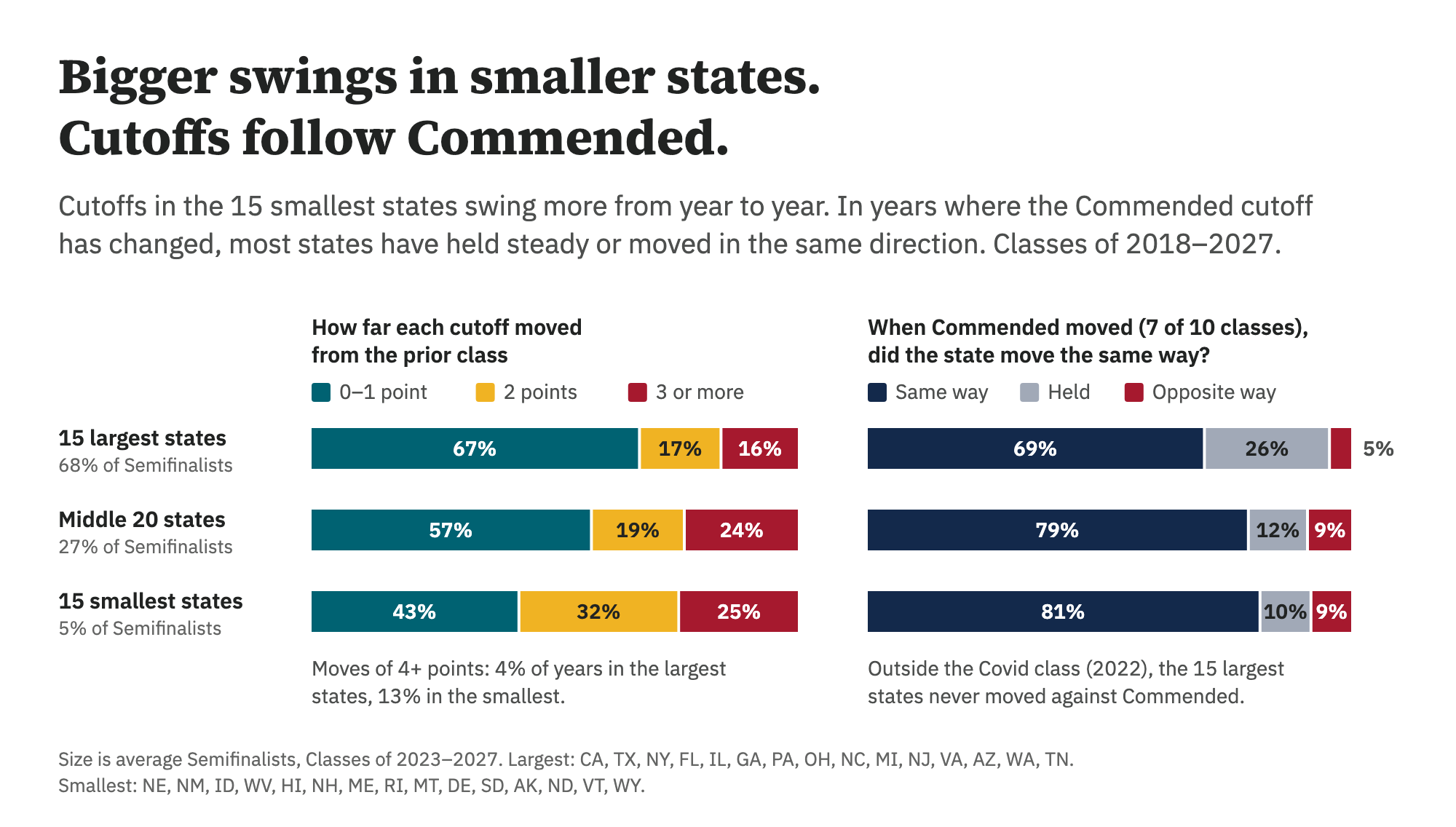
Projections for the class of 2028: Consider the ranges.
In addition to our 50-state cutoff projections, Compass provides a deep dive into each state. Enter your own Selection Index or section scores to see how you stack up historically. The estimates consider state size, prior cutoffs and volatility, and Commended values.
As of 11/16/26, forecasted ranges combine historical data with final PSAT score counts. The Commended cutoff will be confirmed in April.
Class of 2028 estimates by state
| State | Class of 2028 estimate | Past cutoffs | |||
|---|---|---|---|---|---|
| Most likely | Estimated range | 2027 | 2026 | 2025 | |
| Alabama | 211 | 209–214 | 210 | 214 | 212 |
| Alaska | 211 | 208–213 | 208 | 215 | 214 |
| Arizona | 216 | 214–218 | 215 | 218 | 217 |
| Arkansas | 211 | 209–214 | 210 | 215 | 213 |
| California | 221 | 220–223 | 220 | 224 | 221 |
| Colorado | 217 | 215–219 | 217 | 219 | 218 |
| Connecticut | 221 | 219–223 | 220 | 223 | 221 |
| Delaware | 219 | 216–221 | 219 | 220 | 219 |
| District of Columbia | 223 | 221–224 | 223 | 225 | 223 |
| Florida | 217 | 215–218 | 216 | 219 | 217 |
| Georgia | 218 | 216–220 | 217 | 220 | 218 |
| Hawaii | 217 | 215–219 | 218 | 219 | 217 |
| Idaho | 212 | 210–215 | 211 | 215 | 213 |
| Illinois | 219 | 218–221 | 218 | 222 | 220 |
| Indiana | 216 | 214–218 | 215 | 218 | 217 |
| Iowa | 211 | 209–214 | 210 | 214 | 212 |
| Kansas | 214 | 212–216 | 212 | 216 | 215 |
| Kentucky | 212 | 210–214 | 211 | 214 | 213 |
| Louisiana | 213 | 211–215 | 211 | 216 | 214 |
| Maine | 214 | 212–217 | 214 | 217 | 214 |
| Maryland | 222 | 220–223 | 221 | 224 | 222 |
| Massachusetts | 222 | 221–224 | 221 | 225 | 223 |
| Michigan | 217 | 215–219 | 216 | 220 | 218 |
| Minnesota | 216 | 214–218 | 214 | 219 | 217 |
| Mississippi | 211 | 208–213 | 211 | 213 | 212 |
| Missouri | 214 | 212–216 | 214 | 217 | 215 |
| Montana | 209 | 208–212 | 208 | 213 | 209 |
| Nebraska | 212 | 209–214 | 212 | 214 | 211 |
| Nevada | 212 | 210–214 | 211 | 214 | 214 |
| New Hampshire | 216 | 213–218 | 215 | 219 | 217 |
| New Jersey | 223 | 221–224 | 223 | 225 | 223 |
| New Mexico | 209 | 208–212 | 209 | 210 | 211 |
| New York | 220 | 219–222 | 220 | 223 | 220 |
| North Carolina | 218 | 216–219 | 217 | 220 | 218 |
| North Dakota | 209 | 208–211 | 208 | 210 | 210 |
| Ohio | 216 | 215–218 | 216 | 219 | 217 |
| Oklahoma | 210 | 208–212 | 210 | 212 | 211 |
| Oregon | 217 | 215–219 | 216 | 219 | 216 |
| Pennsylvania | 219 | 217–221 | 219 | 221 | 219 |
| Rhode Island | 215 | 213–218 | 213 | 219 | 217 |
| South Carolina | 212 | 210–214 | 212 | 215 | 214 |
| South Dakota | 210 | 208–212 | 210 | 211 | 208 |
| Tennessee | 216 | 214–218 | 214 | 219 | 217 |
| Texas | 219 | 218–221 | 219 | 222 | 219 |
| Utah | 211 | 208–213 | 209 | 213 | 211 |
| Vermont | 213 | 210–216 | 212 | 216 | 215 |
| Virginia | 221 | 220–223 | 221 | 224 | 222 |
| Washington | 221 | 220–223 | 221 | 224 | 222 |
| West Virginia | 209 | 208–210 | 208 | 210 | 209 |
| Wisconsin | 213 | 211–215 | 212 | 215 | 214 |
| Wyoming | 209 | 208–210 | 208 | 210 | 209 |
| U.S. Students Abroad | 223 | 221–224 | 223 | 225 | 223 |
| U.S. Territories | 209 | 208–210 | 208 | 210 | 208 |
| Commended (national) | 209 | 208–210 | 208 | 210 | 208 |
Below are three of the most popular (and controversial) questions I get asked about the National Merit Scholarship Program. A couple of less controversial questions follow. Additional information can be found in our National Merit FAQ.
Why does each state have its own Semifinalist cutoff if the program is NATIONAL Merit?
This is always a hot-button question. NMSC allocates the approximately 16,500 Semifinalists among states based on the number of high school graduates. That way, students across the nation are represented. It also means that there are very different qualifying standards from state to state. A Massachusetts student with a 220 might miss out on being a Semifinalist. If she lived just 10 miles away in New Hampshire, she would qualify.
No Semifinalist cutoff can be lower than the national Commended level. Cutoffs for the District of Columbia and for U.S. students studying abroad are set at the highest state cutoff (typically New Jersey). The cutoff for students in U.S. territories and possessions falls at the Commended level each year. Boarding schools are grouped by region. The cutoff for a given region is the highest state cutoff within the region.
NMSC feels that the allocation method is the best way of ensuring truly national representation. That’s important, because without national representation, the program would likely not exist. National Merit requires participation from corporations and universities across the country. It constantly works to foster investment. The pitch to sponsors would be more difficult if Semifinalists were clustered in a smaller footprint. That doesn’t make the frustration any less real for the students who miss out.
When are National Merit Semifinalists announced? Why does it take so long?
The lists of Semifinalists will not be distributed to high schools until the end of August 2027. With the exception of homeschoolers, students do not receive direct notification. NMSC asks that schools not share the results publicly until the end of the press embargo in mid-September, but schools are allowed to notify students privately before that date. NMSC does not send Commended Student letters to high schools until mid-September. Compass will keep students updated on developments as the dates approach.
NMSC is an organization that values consistency — maybe sometimes to excess. The Semifinalist, Finalist, and Scholar cycle is little changed from what it was 60 years ago. Originally the NMSQT was in the spring of junior year, and email and the internet didn’t exist. Once the PSAT and NMSQT merged into a single exam, testing moved to the fall of junior year. The notification calendar never changed. During the winter and spring, NMSC is busy working with Finalist and Scholar selections. And counselors are busy getting seniors into college! In April and May, schools need to sign off on student eligibility. NMSC has always worked through schools for Semifinalist notifications, so September provides the next logical window. It’s slow and secretive, but it eventually works.
The schedule is hardest on students hoping to get one of the large scholarships offered by a limited number of universities. Key planning gets put on hold. I’d also like to see NMSC modernize its notification process. In the age of Bluebook, there is no excuse not to notify students directly and avoid the uncomfortable rollout of information. Colleges have long learned how to operate this way and build enthusiasm. The days of National Merit students being written up by the local newspaper are long gone, so why not let Instagram and TikTok take over?
Why is RW given twice the weight of Math?
There are many wrong answers to this question floating around the internet. It’s not because the PSAT had separate Reading and Writing sections during the SAT’s 2400 period. The weighting existed decades before that version of the exam. It’s not to favor one demographic over another. It dates back to the very creation of the test. In fact, the current method is more balanced than the original!
The National Merit Scholarship Qualifying Test (just the SQT in 1956 and 1957) was originally a separate test offered in the spring of junior year. The test was developed from the Iowa Testing Programs that also gave birth to the ACT. In fact, the NMSQT looked a lot like the original ACT. It had sections for English, Mathematics, Social Studies (Reading), Natural Sciences (Reading), and Vocabulary. Each section was scored 1-36, and the Selection Index was the sum of the five section scores. So 80% of the original Selection Index came from sections testing verbal skills. In 1971, NMSC merged the NMSQT with the College Entrance Examination Board’s PSAT, written by ETS. The PSAT and SAT only had Verbal and Mathematics scores (20-80 on the PSAT and 200-800 on the SAT). In order to keep a similar balance to the original NMSQT, the Verbal score was doubled to form the Selection Index.
The decision remains controversial, but its roots are 70 years old. As mentioned previously, NMSC likes continuity.
Do state and national percentiles indicate whether a student will be a National Merit Semifinalist?
No! Approximately 1% of test takers qualify as Semifinalists each year, so it is tempting to view a 99th percentile score as indicating a high enough score — especially now that College Board provides students with percentiles by state. There are several flaws in using percentiles as a quick way of determining National Merit status.
- Percentiles are based on section scores or total score, not Selection Index
- Percentiles are rounded. There is a large difference, from a National Merit perspective, between the top 0.51% and the top 1.49%
- Percentiles reveal the percentage of students at or below a certain score, but the “at” part is important when NMSC is determining cutoffs.
- The number of Semifinalists is based on the number of high school graduates in a state, not the number of PSAT takers. Percentiles are based on PSAT takers. States have widely varying participation rates.
- Most definitive of all: Percentiles do not reflect the current year’s scores! They are based on the prior 3 years’ performance. They are set even before the test is given. And if you are going to use prior history, why not use the record of prior National Merit cutoffs rather than the highly suspect percentiles?
When my score report says “Eligible for National Merit,” does that mean I qualify?
Eligibility means entering the program; qualifying comes later. Your PSAT/NMSQT score report tells you whether you meet the eligibility requirements for the NMSP. In general, juniors taking the October PSAT are eligible. If you have an asterisk next to your Selection Index, it means that your answers to the entrance questions have made you ineligible. Your answers are conveniently noted on your score report. If you think there is an error, you will also find instructions on how to contact NMSC. Meeting the eligibility requirements simply means that your score will be considered. Approximately 1.3 million students from the 1.4 million PSAT takers enter the competition each year. Only about 55,000 students will be named as Commended Students, Semifinalists, Finalists, or Scholars. See National Merit Explained for more information.

I got a 221 in NJ. i know the estimate is 222-225 for 2027. but how do you determine that the cutoff is 1 point lower than class of 2025’s (223). How much harder was the 2027 PSAT test compared to 2025’s. will a 221 in NJ do?
dw,
NJ has been on top for a number of years now, and I expect that it will again tie for the highest cutoff in the country. Since the test changed to its new scoring with the class of 2017, we’ve seen the top score hit 222 twice, but never drop to 221. The only scores I have visibility over are the ones I’ve cited — how many students nationally got 1400 and above and how many students got 700 and above in RW and M. That leaves a couple of obvious holes. I don’t know how NJ students did and I don’t know, for example, how many of those students got 730s or 740s etc. Based on the national performance, I think it’s unlikely NJ will drop to 221. [I would hope that you disagree with me!] The weak RW scores are the wildcard, because RW has twice the weight of M scores.
let’s see. maybe i’ll get to prove you wrong in september 😉
Hello Art
Is there a reasonable chance that Indiana could return to 216.? Our daughter kept her 760M from last year, but dropped 20 RW to 700.
Thanks
Timothy,
I expect that we’ll see many cutoffs settle back down this year, so 216 is definitely a possibility in Indiana. I’ll reevaluate once we know the Commended cutoff, but I can virtually guarantee that 216 will remain in the range of possibilities.
Hi Art
Thanks for the insightful predictions. I have a question regarding the cut off for commended students, since there is a predicted drop in the selection index overall compared to previous years why should nt the cut off for commended drop even further?. I suspect there will be students with scores over 1400 but perhaps with selection index less than 208 or even 207
Nithya,
Yes, because the the weak RW scores, we could see a 207/208 Commended cutoff. Unfortunately, I don’t have detailed score breakdowns for all prior years.
Art,
Thanks for all of this amazing information. Do you know how they handle this for students that live in one state but go to school in another state? We live in Nevada, but my child goes to school in California (we live on the border). From your tables, it is clear that the cutoff is quite a bit lower in Nevada. If my child takes the test next year at her school in CA but lives in NV, will the score be counted towards the semi-finalist allocation for Nevada or California students? If it is the latter, are we better off using the alternate entry option than taking it through her school?
Sorry for the delayed response. National Merit uses the location of the school, so your student would be competing in California. I believe that even for alternate entry, the student’s school determines the state.
It is fascinating to see Art’s post from 11/16/2025. I’m a parent who went through the bizarro results and stress from the C2024 test takers only 3 short months ago.
The first key takeaway is that Art’s intellectual vitality and curiosity is an incredible help to parents. NMSF is a high-stakes single event that would be strangely opaque if not for Art. There’s really no place else on the Web that does this, and the corporation cloaks everything secrecy. Compare that to hundreds of web sites for athletics that assess kids’s prospects for full rides to college.
Anyway, my key takeaway from the 11/16 post is this quote: “The RW on the digital PSAT is truncated to 54 questions over 64 minutes.” If a kid answered one question a minute in 2023, they’d have had 4 extra minutes to review their work (on 91 questions); kids in 2024 would have had 10 extra minutes (on only 54 questions). That’s huge.
I just checked with my in-house 2024 test taker:
“Hey, did you have time to review your work on the RW PSAT in 2024?”
“Yes, quite a bit of time.”
“Did you review it?”
“Yes, of course.”
Matt, I just want to note that I didn’t pay you for this! Thank you for the kind words.
Hi,
I am hoping pretty hard over here for a 208 for 2027 commended cutoff. Our daughter has 208 and scored that with very high English score . Any idea of the likelihood 207 or 208 could be the number? Also, any insight on why those English scores are skewed compared to previous years? Thank you!
SK,
We haven’t seen this mix of scores before, so it’s hard to predict. We’re seeing more 1400+ scores than in other 207 years, but we know that more of those scores are driven by high math scores, which don’t contribute as much to the Selection Index. I’d guesstimate things as 25% 207, 55% 208, 15% 209 5% 210.
PSATs and SATs are scaled based on data from prior administrations, and sometimes the results on the full administration are a surprise, especially at the highest levels, where scores are less common. It’s not easy to scale a PSAT that perfectly produces 730 / 740 / 750 / 760. The RW scale for this year’s exam was more imperfect than most.
Hi Art, here we are again getting close to the finalist announcement. do you know the process? does the letter go only to the school or student or both? does it show up on the portal? thanks!
Lynn,
All of the above. Letters will go to the school and student, and a copy will show up on the portal. Good luck!
Hi Mr. Sawyer,
I was wondering about Oklahoma’s scores. I scored 210 on the 2025 PSAT, and I thought I had a solid shot until I saw these predictions. Reading/writing scores are lower nationally this year than 2 years ago when Oklahoma sat at 211. Only one person in my grade got a higher selective index score at my school, and we’ve consistently had 2-5 national merit semifinalists for the past decade or so. Also, I know several people that had a drop in their reading scores by 30-40 points from last year. Do you think it’s just an unusually low-scoring year for my school, or do you think I have a chance?
Anon,
Why not both? The low-scoring part of thing looks to be beyond just your school. The RW scores play double the role of M, so we may be headed for some big changes. It’s always risky to read too much into standings within a single school, but things are shaping up for a down year. OK has been at 210 or lower about once every 5 years, so let’s hope this is the one!
If someone earned a score of 211 in Arkansas, how likely is it that they’ll qualify as a National Merit Semifinalist?
BLG,
Arkansas has been as low as 210 and as high as 215 in just the last 3 class years, so you can appreciate why it is so hard to pin down. I think it will come down from 215, but I don’t know if we’ll see it at 210 or 211. I’d remain optimistic and see how low the Commended level is when we post it in April (it’s unofficial at that point, but we usually get word).
Hi Art,
Thank you for everything you do. My kid has 222 SI in Texas. What are the chances to be a national semi finalist?
Sam,
We had the scary surge in cutoffs last year, but everything points to things settling back down. I don’t see the Texas cutoff moving to 223. I think 220 or 221 is more likely. I’d say your student’s chances are 90-95%. As long as the Commended cutoff stays within our predicted range (it usually leaks by the end of April), I’d say 95%.
Daughter is a finalist this year. Their site says on March 26 scholarship winners are notified. Any idea how this works? Will everyone get an email? Do just the $2500 winners get notified? Does it all happen on the same day or is does it just start on the 26th. Thanks for any info.
Only recipients are notified. This first batch is for students getting awards directly from National Merit. I don’t believe that all of them are awarded at that time. Or at least there is some degree of churn, since awardees can turn down the NMSC-sponsored award and hold out for a college-sponsored award. NMSC tries to maximize scholarship dollars by matching as many students as possible with college-sponsored scholarships since those are not limited by its budget (it will have already done corporate-sponsored scholarships). If your daughter has, as her first choice school in the Finalist portal, a National Merit sponsor, then she is unlikely to get an initial scholarship. College matching takes place in May and June. Finalists not receiving a scholarship will be notified in May.
How likely is a 220 (720 RW and 760 M) to qualify for semifinalist status in Texas?
Amy,
Texas’s Semifinalist cutoff has only hit 221 and 222 when the Commended cutoff has been elevated (210-212). This year’s Commended cutoff is 208, so I think it is more likely that we’ll see a 219 or 220 cutoff. Score patterns are unusual this year, so we can’t say that with certainty. I think your chances are at least 80%+. [As of today, I haven’t changed my Texas “Most Likely” from 221. Now that we’ve learned the Commended cutoff, I’ll be moving it to 220 when I have a chance to do a comprehensive update.]
Hi Art,
Thank you for all the insightful analysis and explanations. It has been extremely helpful as I’m trying to get my head wrap around this whole process.
Given the ratio of ERW to Math is the lowest since 2019 (based on available yearly SAT suite data), is it conceivable that we’re set to see some dramatic drops in scores this year? I can only imagine how difficult it is to predict given the unprecedented low ERW scores (disclaimer: based on available SAT suite data that I was able to pull). I’m wondering if we’re set to see commended score potentially go as low as 207 this year.
John,
It’s still an open question about how much the lower RW scores will impact the SF cutoffs, since we don’t know if the issues with scaling was particularly acute in the 740-760 range (generally it is). The cutoffs will certainly go down, but it will be interesting to see if they fall below the Class of 2025 levels. We now know that the Commended cutoff came in at 208.
We just received the letter from NMSC saying the cutoff is 208. Based on that, what would you predict the Arkansas cutoff to be?
Bill,
Thank you for the information! I’ll be updating the page based on the 208 cutoff. Did you receive the letter as a homeschool family or at a school?
Over the last decade, Arkansas’ cutoff has come within 2 to 5 points of the Commended number. The last time we had a 208, AR fell at 213, but I think the more likely is 212, and we’re looking at a range of 210 to 215.
Hi Art! Thanks for the amazing data and statistics; you can tell the amount of effort you put in.
I took the PSAT this year and my NMSC score was 218 (720 RW and 740 M) and I live currently in Minnesota. Do you believe I have a shot at being a semifinalist? I know the scores are expected to dip a bit, but I still wanted to ask you. Thanks!
Q,
As you know, I don’t have access to state results, so I can only base my estimates off of historical information. Given the change in RW scores, I thin the vast majority of states will see lower cutoffs than last year. If we look at the decade since the PSAT scoring changed for the Class of 2017, there are 6 years where the Commended cutoff was below 210. In all but one of those years, a 218 would have qualified a student as a Semifinalist. I think your chances are strong (85-90%+). You mention that you currently live in MN. I’m assuming that’s where you took the PSAT, since that’s the residency that counts.
Hello. My daughter P-Sat result is 218 in Florida. I know that the prediction for FL is 217. How accurate the predictions are? What are her chances for National Merit ? Thank you for all your help:)
Ilona,
Rather than placing a value on the accuracy of my predictions, I prefer to explain my thinking. I don’t know how students performed in each state, so I base my estimates on the national performance and historical record. The national performance was unusual this year, with RW scores falling significantly. I believe that this will translate into lower state cutoffs, and I have history on my side. 😉 In the last decade, there have been 4 years where the Commended cutoff has been 210 or higher. In each of those years, Florida saw a 219 cutoff. In the other 6 years, the cutoffs were 216 or 217. Given the Commended cutoff of 208 this year and the low RW scores, I have 217 as my most likely for Florida. I don’t see any indication that it will remain at 219. I may be wrong, but I’d put your daughter’s chances at 90-95%+.
Hi Art
Thanks for your quick update on the commended score
208 is the same as for the class of 2025 but since RW for class of 2027 are low, is there a possibility that the cut off could drop even further
Does 218 in Texas stand a chance? really hoping that the cut off drops a tad bit from class of 2025 so i can make it
Nithya,
When we see a change like the one we saw for RW scores, it generally means a poorly equated exam. But what we don’t know is how each point on the range was impacted. Were there fewer 700 scores but the same number of 730s? Fewer 760s? Etc. Some of the decline should have already been baked into the 208 Commended number. Since the PSAT scoring changed with the class of 2017, we haven’t seen a 218 cutoff in Texas. It’s not out of the question, and it will remain in my range of possibilities. I’ll admit that it would be surprising. But we had many surprises on the high side last year!
How about a 220 in New York? Your original prediction was for 221 in New York, but does the commended National cutoff number change your prediction?
Three point changes are rare in large states, but if NY could go up by 3 points for the Class of 2026, it can go down 3 points. I’m working on a full redo. The 220 looks solid when comparing to years with a 208/209 cutoff. The 3-point drop does give me pause, but I think 220 moves to Most Likely.
Hi Art,
I was looking at the College Board annual reports for the state of Montana over the past 4 years. Montana students achieve 700+ EWR scores at least twice as often as they do in Math. Given the 27% national decline in 700+ EWR scores this year, how could that affect the semi-finalist cutoff in English heavy states? Could the cutoff drop to 210 or even 209 in Montana? I’m looking forward to your updated predictions. Thank you!
Jane,
You prompted me to look more closely at the figures. You’re right than Montana has one of the highest RW to M ratios. Alaska, Maine, Vermont, and West Virgina have similar ratios. When I plotted all 50 states against the last year’s increase, though, I came up with no relationship between ratio and SI increase (last year was not all about RW as this year is, so it’s not a great comparison).
There are different possible scenarios with RW scores. Let’s imagine that College Board messed things up consistently across the entire upper range of scores and everything is down 10 points. Let’s assume the Math shifts were not consequential. That would lower the Commended to 208. It would also mean that low RW/M ratio states would behave similarly to high RW/M ratio states. Everyone’s Selection Index includes RW, so a 10 point decline is -2 SI.
Nothing is ever so clearcut. We don’t know where the curve differed this year. And, as I’ll show in a moment, Montana always hangs on a thread. So trying to predict it with a formula is likely going to fail.
A fun set of numbers to look at is how many students ended up as Commended in Montana. Below I’ll list Semifinalist, Commended, and the # of Selection Index values that would have been Commended in MT.
Class of 2026: 48, 8, 3
Class of 2025: 45, 5, 1
Class of 2024: 45, 12, 2
Class of 2023: 49, 0, 0
This means that last year there were only 8 Montana students who scored 210, 211, 212. Any higher and they were NMSF. Any lower and they missed out on Commended. The year before there would have been 5 students at 208. In the Class of 2024, there were 12 students at 207 or 208. The Class of 2023 doesn’t tell us anything. So there are only a few students at each SI point around the cutoff. The flu hitting at the wrong time at the right school could lower Montana cutoffs! Things are always tight. I’d probably put my Most Likely at 210, but it’s close to a toss-up between 209 and 210. I’d estimate the possible range as 208 – 213.
Thank you for sending me down an interesting (to me) rabbit hole!
Hi Art! Thanks for the amazing data and statistics.
My son got a 220 in Illinois. If you had to give a percentage estimate knowing that the Commended cutoff came in at 208, what are the chances it goes to 220 here in Illinois? Thank you!!
Vamsi,
The Class of 2025 seems like the best precedent — recent and with a 208 Commended. Illinois has a 220 cutoff, of course. The years where IL was at 221 were Commended levels of 211 and 212. Last year’s figures were wild across the board. I’d put 220 at around 75-80% chance of qualifying.
Hi Art,
I see that you updated your chart with 208 for Commended. Does that mean that this is a pre-official index score for commended?
That’s right. I try to avoid “official,” since I am not affiliated with NMSC. I’ve confirmed that it is correct. Commended students aren’t notified until September, but the cutoff is set.
Yay! We made it. I love your stuff. Thank you so much!
Given the lower confirmed Commended cutoff of 208, do you think Pennsylvania’s National Merit Semifinalist cutoff for the Class of 2027 is more likely to be 219 rather than 220? I’m asking because my son has an NMSC Selection Index of 219 in PA. Thanks!
John,
I’d now give the slight edge to 219 based on comparable years. PA has gone above that when the Commended was at 212, 212, and 210. Last year’s 221/210 combo was perplexing. I’m hoping the RW dropoff really pulls down cutoffs this year.
Hello Art,
With the commended cut-off score official at 208, will you update the semifinalist estimates for another round for each state? What are the chances of MS going down from last year?
Chris,
Other demands keep pulling me away, but a full update will be coming. I think just about all states will go down from last year, although MS didn’t get slammed with a new record as did some states. I view the Class of 2025 as the closest analogue, and the MS cutoff was 212.
Hi Art, I’ve been following your updates, and just as you predicted, the national cutoff score has dropped. So for Maryland, with a score of 222, do you think the chances of qualifying for the semifinalist round have increased? Thank you very much.
Daniel,
The odds have improved. The Commended mark seems to have taken the most dire cutoffs off of the table. I think we are in the 221-223 range. This year looks a lot like it did for the Class of 2025.
What odds would you give for the DC cutoff dropping to 222? (I know DC matches highest cutoff, so that would mean, e.g., New Jersey would have to drop to 222) My DC daughter is sitting at 222 🙂
Heather,
It’s going to require several things working in your daughter’s favor. You’ll need NJ and MA to stay south of 223 (if those states do, I’m fairly certain that CA, MD, and VA will). If we throw out the COVID year, that’s happened 2 times in the last 9 years. Of course the odds are better with the low Commended, but NJ hit 223 even in the Classes of 2023, 2024, and 2025, when the Commended cutoffs were 207, 207, and 208. The recent history gives me pause, so I’d put the odds in the 30-40% range. 223 will be my Most Likely. Fingers crossed for 222.
Hi Art,
Thank you for your great analysis. I see for NJ about 0.52% and 0.54% students qualified for SF for class 2021 and 2022 with cutoff of 222. For class 2023 and 2024, only 0.34% and 0.37% of students made it to SF with cutoff 223. For class 2025 and 2026, about 0.43% and 0.44% students made it to SF. If National Merit uses outdated data to allocate number of SF to NJ, that would make NJ’s cutoff at 223. Otherwise, it would be 222 for Class 2027.
NJS,
In my experience, NMSC adjusts targets slowly and gradually, so I don’t think the fluctuations you are seeing are due to changing allocations. You’re correct that New Jersey had abnormally low numbers of Semifinalists in 2023 and 2024. The state averages about 500 Semifinalists and only saw 389 and 429 in those years. My take is that those years demonstrate just how tightly scores can get bunched at the high end of the range. In the class of 2023, presumably so many students were at 222 that the cutoff had to be at 223. I’ll admit that it leaves me scratching my head, since NJ was able to get away with 594 Semifinalists in the class of 2021. On the other hand, we can be fairly certain that NJ’s population of high school students didn’t plunge by 30% (only to go back up 2 years later). I do my best to ignore the class of 2022, the year of COVID cancellations and alternate entry. The closest analogues we have to this year are the classes of 2017, 2021, and 2025. In the first two instances, the cutoff was 222. Two years ago, the cutoff was 223. There are arguments for both. I chose recency.