
Testing enters a clearer, more complicated era.
The testing landscape continues to evolve, even as its direction becomes clearer. More colleges are restoring standardized testing requirements or placing renewed emphasis on scores, while others are refining rather than abandoning the role testing plays in holistic admission. In the past year, Auburn University, Claremont McKenna College, Mercer University, Princeton University, the University of Alabama, and Vanderbilt University have joined the growing list of institutions returning to testing, though with different timelines and scopes. Meanwhile, the University of California has begun formally reconsidering its test-free policy, underscoring that the national conversation around standardized testing is far from settled. Together, these developments reflect a broader pattern of colleges moving away from pandemic-era flexibility and toward clearer expectations about when and how testing will factor into admission decisions.
The growing list of popular colleges and universities that require testing for some or all undergraduate programs includes:
Auburn University
Brown University
Caltech
Carnegie Mellon University
Claremont McKenna
Columbia University
Cornell University
Dartmouth College
Florida A&M University
Florida State University
Gallaudet University
Georgetown University
Georgia Tech
Harvard University
Johns Hopkins University
Louisiana State University
Mercer University
MIT
Ohio State University
Princeton University
Purdue University
Service Academies (all)
Stanford University
The Cooper Union
University of Alabama
University of Florida
University of Georgia
University of Miami
University of Pennsylvania
University of Tennessee
University of Texas–Austin
Vanderbilt
Yale University
Many other schools have refined their positions without reinstating a universal requirement. Some now recommend, encourage, or strongly prefer that applicants submit scores when available. Others require testing only for certain programs, scholarships, campuses, or applicant groups. Recent announcements have emphasized that holistic admission remains in place, that scores can provide useful evidence of academic readiness, and that clearer testing policies can reduce the uncertainty families face when deciding whether to submit. As the role of standardized testing becomes less binary and more nuanced, college counselors and admission insiders continue to monitor not only formal requirements but also the language colleges use to describe how scores are considered.
OPTING TO TEST HAS ADVANTAGES
More and more students are again obtaining scores. After several years of disrupted access and uneven participation, testing has moved closer to its pre-pandemic role in college admission. The digital SAT is now a familiar part of the landscape, and the enhanced ACT has brought a shorter exam, an optional science section, and new questions for students and colleges about which scores are most useful. For many applicants, the practical question is no longer simply whether to test, but how testing should fit into a broader admission strategy.
Submission rates continue to rise alongside participation. With some of the most sought-after colleges requiring testing, students with stronger scores are inclined to submit those scores not only where they are required, but also to test optional colleges where scores may strengthen an application. Applicants who test benefit from the flexibility to decide how their results factor into their final strategy.
Although sending scores does not automatically lead to better outcomes, recent statistics from a sampling of competitive colleges imply a greater likelihood of admission for applicants with test scores than for those without, in some cases more than twice as high. Top scores are also associated with better GPAs and other measures of academic success, so this apparent “testing advantage” is often misunderstood and over-emphasized. Submitting scores, though, remains a means for students to distinguish themselves from other applicants.
Colleges are hesitant to report admission statistics by test submission status, but there is some available evidence. Below is a snapshot from a sampling of well-known institutions** that have released figures in announcements or reports since the pandemic. While not exhaustive, these outcomes offer a glimpse into the additive role test scores and submission decisions have played in more competitive admission contexts.
Students planning to apply to high-demand or selective colleges should consider what others with similar opportunities are apt to submit as a competitive edge. Scores remain a meaningful piece of the holistic review process at many schools, especially those where demand for admission drastically outstrips supply.

** Amherst, BC, BU, Colgate, Cornell, Emory, Georgetown, Georgia Tech, Notre Dame, Tufts, UPenn, USC, UVA
TEST OPTIONAL IS HERE TO STAY
Many observers expect more colleges to reinstate testing, especially highly competitive ones. Even the University of California, which has remained firmly test free since 2021, is now publicly reexamining the role testing may play in future admissions. However, it is also clear that hundreds of colleges will remain test optional indefinitely. The chart below consolidates well-known colleges into major policy categories. Within the groupings of test optional institutions, applicants may encounter subtle cues and evolving policies communicated by individual colleges. Without requiring scores from all applicants, some institutions or majors signal that testing remains an important part of the evaluation process. It is important for prospective applicants to pay close attention to a college’s guidance and admission tendencies.
Current testing policy breakdown for the 400+ schools Compass tracks:

Current testing policy breakdown for the 12 “Ivy Plus” schools:

PARSING TEST OPTIONAL POLICIES
Unfortunately, test optional ubiquity has introduced an unintended layer of strategy to the process. Some students have navigated it effectively, while others have made tactical errors of “mis-withholding” scores that would have helped.
It is an easy miscalculation to make. The new normal of discretionary testing has inflated the averages of reported scores and caused unhelpful distortions to published figures. This statistical distortion leads to misleading implications and poor decisions by both applicants and readers. Students might fear a score is now “too low” to disclose, while admissions officers might assume the applicant is concealing a score that is lower than it truly is. That leaves counselors feeling understandably irresolute about advising students.
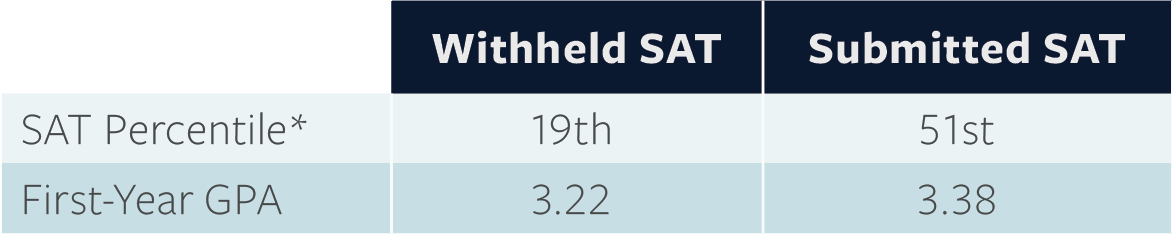
Will a reader assume nothing about the absence of a score when their college’s own research confirms that withheld scores are typically 100–150 points below their average?
Admissions Research Consortium Study: SAT scores and academic performance at 47 public and private universities (* Percentiles were calculated within an institution’s student population.)
Slowly, the prevailing best practice is shifting toward sending scores when in doubt. In fact, this strategy might be most fitting at schools with exceedingly low acceptance rates. At such outliers, readers already know the bulk of applicants will be denied, so they search for reasons to admit. Paradoxically, even a near-perfect SAT score will not stand out as a reason alone to admit someone. Yet a score slightly below a college’s middle range will typically still be seen as affirming and “high enough” if the rest of the application strongly supports admission. On the other hand, colleges that are a bit less selective but conspicuously aspirational may be more intent on protecting their averages.
It is therefore impossible to offer a rule that applies to all students in all situations, and policies will continue to evolve. Applicants over the next few admission cycles should expect additional policy announcements from individual colleges and should periodically revisit the latest guidance rather than rely on policies from prior years. We encourage students and families to seek guidance from their college counselor and appraise the wording of specific policies for additional insight into a school’s attitude toward testing. Statements released by a number of popular schools include color about where they stand and what they are experiencing. For instance:
- Those who have test scores from other standardized exams may submit those.
- Test scores are considered in context. Even if your score is not above average for [the college], but it is for your high school or neighborhood, your score may help you in the admission process.
- Under a test-optional policy, those who provide test scores fared better in the application review process.
It can then be helpful to place any given college into one of three frameworks:
- WHERE TESTING IS IMPORTANT
These colleges have admit rates around or below 10%. Almost every applicant is qualified; virtually every applicant is denied. Test optional policies have lowered admission rates further. Applicants must provide a strong case for admission. Students can choose to demonstrate a strength in testing or choose to blend in with other non-submitters. As the data above show, finding a way to stand out can still provide an advantage.
- WHERE TESTING CAN ADD VALUE
Supply and demand imbalances necessitate a difficult and careful selection process, but applications are read supportively. Test scores have traditionally mattered but not more than a sustained track record of academic achievement. Strong test scores can help but are not always a decisive factor.
- WHERE TESTING IS A LOWER PRIORITY
This is true at colleges that accept the majority of their applicants and evaluate applications based largely on a yes/no assessment of whether a student has shown the capability to succeed at their institution. Admission decisions don’t usually hinge on test scores, and testing will likely remain less central at such schools.
At Compass, we look forward to discussing your specific testing considerations. When you’re ready to reach out, we’re here to guide you on the road ahead.