

**Updated with information from released October 2026 PSAT scores as of November 16.**
If you’d like, jump right to the Compass Projections and State Explorer and then come back for the commentary.
The junior-year PSAT is also the National Merit Scholarship Qualifying Test (NMSQT). Each year, National Merit recognizes the top 55,000 test takers. To be included in that group, students must be among the top 4% of the 1.3 million eligible students who take the PSAT. Of that elite group, approximately 16,500 are recognized as Semifinalists for having the highest scores within their states. Semifinalists have the opportunity to continue in the program to become Finalists and, potentially, scholarship recipients. Some colleges provide significant scholarships and even full rides for Finalists. The remaining 39,000 students are recognized as Commended Students. More information can be found in our National Merit Explained post. If you are looking for Compass’s archived report on the class of 2027 results, find it here.
Calculating the Selection Index
National Merit uses the Selection Index (SI), found on the PSAT score report, to rank students. The Selection Index is calculated by doubling the Reading & Writing score (RW), adding the Math score (M), and dividing that sum by 10. For example, a student with a 720 RW score and a 700 M score has a Selection Index of 214: (720 x 2 + 700) ÷ 10. A student with a 700 RW and 720 M has a Selection Index of 212. The highest SI a student can receive is 228 (760 RW and 760 M). The weighting of the index means that not all students with the same Total Score have the same SI. “Will a 1450 qualify?” is not the right question. Instead, ask whether a student with a 750 RW and 700 M will qualify.
How Semifinalist cutoffs are set in each state
NMSC allocates a target number of Semifinalists to states based on their population of high school graduates, not all of whom take the PSAT. If Texas is allocated 1,500 Semifinalists based on its population of high school graduates, then NMSC works down from a perfect 228 Selection Index until it gets as close as possible to that target. In the class of 2027, 1,462 students scored at or above the cutoff of 219. A cutoff of 220 would have produced too few Semifinalists. A cutoff of 218 would have gone over the allocation. As scores go lower, more and more students occupy each level, and where the crowd forms does not stay consistent from year to year. It is easy for cutoffs to move up or down a point even when there is minimal change in testing behavior or performance. All students at or above a cutoff qualify.
Predicting scores for the class of 2028
The journey to National Merit is a long one. Semifinalists aren’t notified until September 2027, and Finalists might not hear until February 2028. Compass’s research aims to fill in some of the gaps during the long wait.
College Board only summarizes PSAT scores in broad ranges. The top range of 1400 to 1520 has proved to be an excellent indicator of the Commended cutoff and the overall trend in Semifinalist cutoffs.
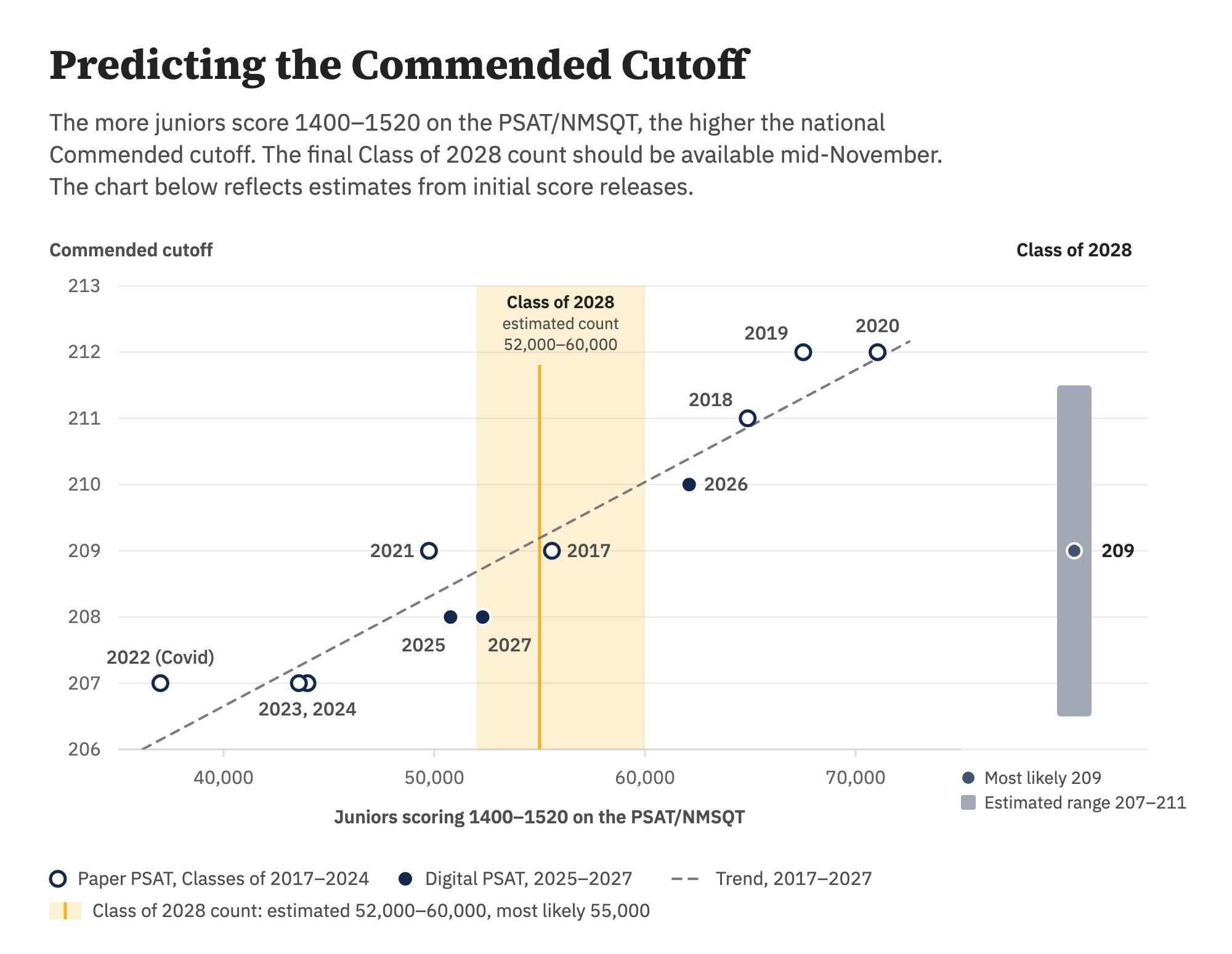
In the class of 2028, 54,000 students reached 1400 and above. That’s only modestly above the 52,300 in the class of 2027, which is why Compass projects this year’s most likely Commended figure to be 209 (with a chance that it remains at 208).
Comparing RW and Math scores also suggests moderation this year
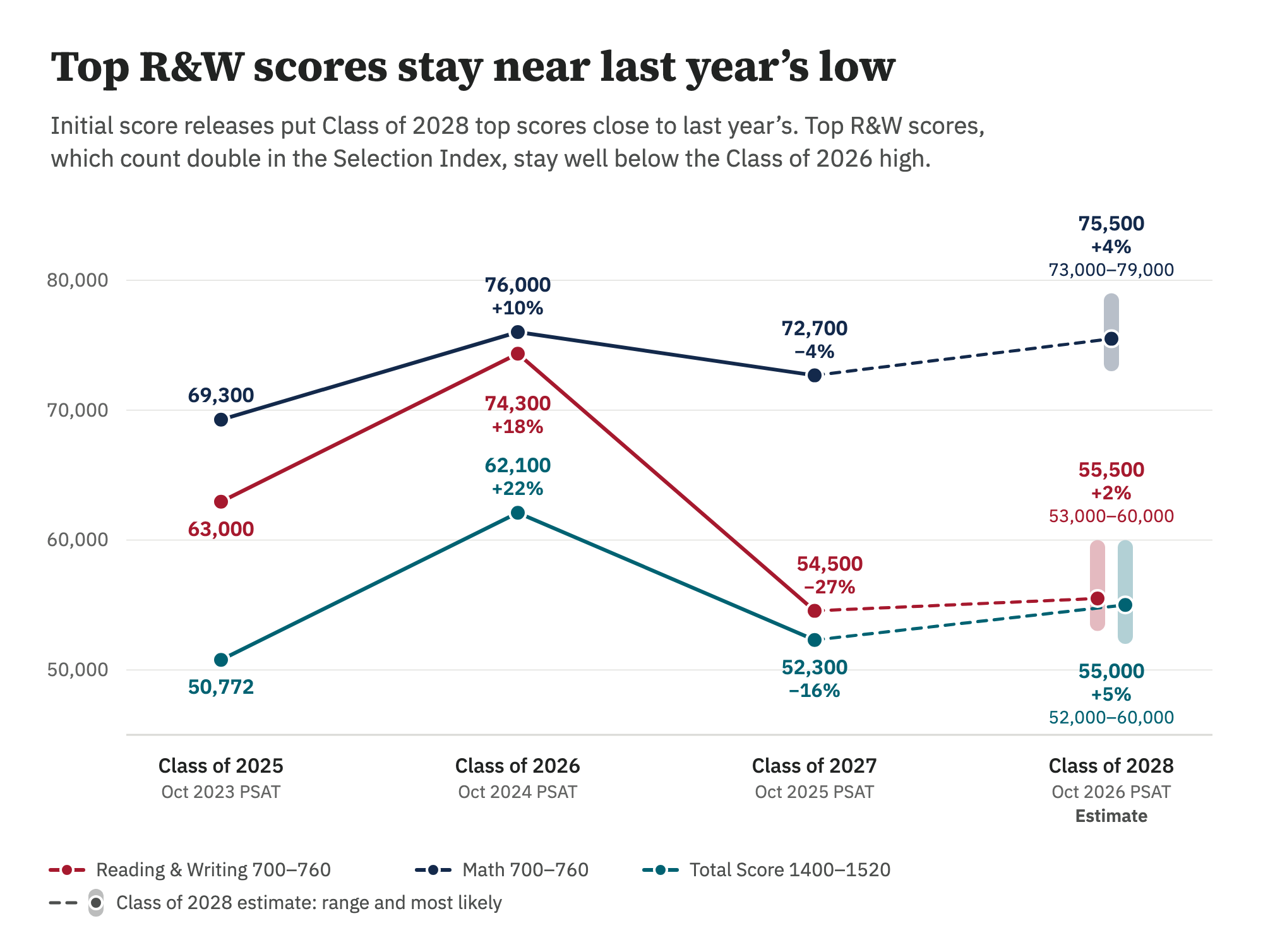
Students considering their odds of qualifying as National Merit Semifinalists often look in horror at the class of 2026 cutoffs, which were among the highest recorded since the revised PSAT was introduced for the class of 2017. Compass has shown that those high cutoffs can likely be attributed to poor scaling of the RW section on the 2024 PSAT. Because RW receives double weight in the Selection Index, the scaling problem had an outsized impact on cutoffs, with New Jersey’s reaching 225. The good news is that this year’s results look more like those from the classes of 2025 and 2027 than they do those from the class of 2026. There are more high Math scores than RW scores (about a 1.33 to 1 ratio), which should keep the highest cutoffs in check. On average, Semifinalist cutoffs may see some upward movement, but there is no evidence of a spike.
Below is a chart of RW, Math, and Total scores over the most recent 4 class years. The number of 700-760 RW scores increased only 3%, and the number of top Math scores increased 6%.
Did I make it?
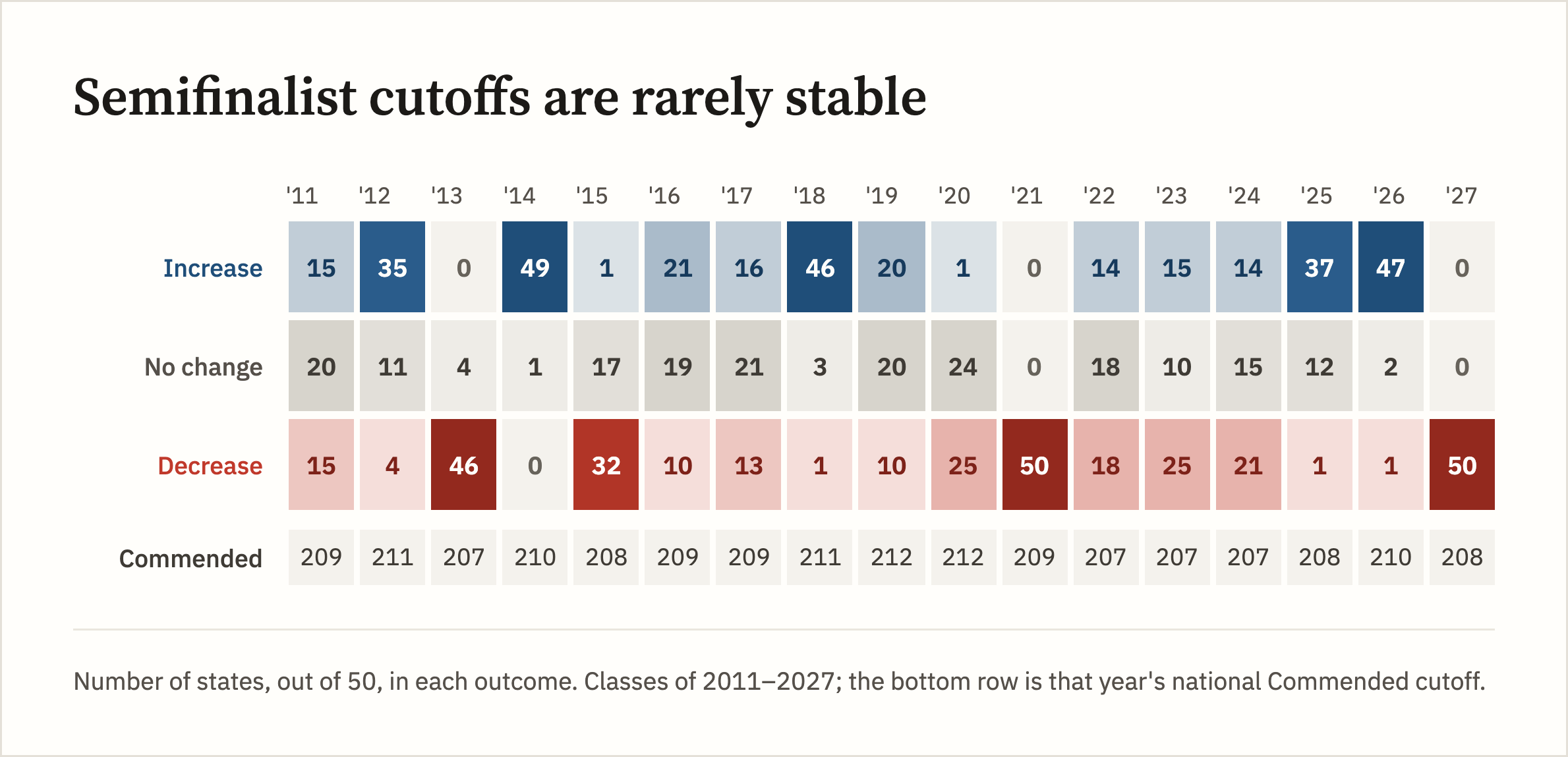
A student’s natural instinct is to look at the prior year’s cutoff and ask, “Did I make it?” The historical record shows the shortcomings of that strategy. From the class of 2011 to the class of 2027, there has never been a year in which even half of the state cutoffs remained unchanged. Even with the added insight of national results, students should consider the likely range of cutoffs rather than focusing on a single score.
Semifinalist trends over time
In October 2015, the PSAT moved to a 320–1520 scale, which was set to provide vertical alignment with the SAT’s 400–1600 scale. The class of 2017 was the first group of students taking the redesigned PSAT/NMSQT, so the fairest comparisons are among the last eleven graduating classes.
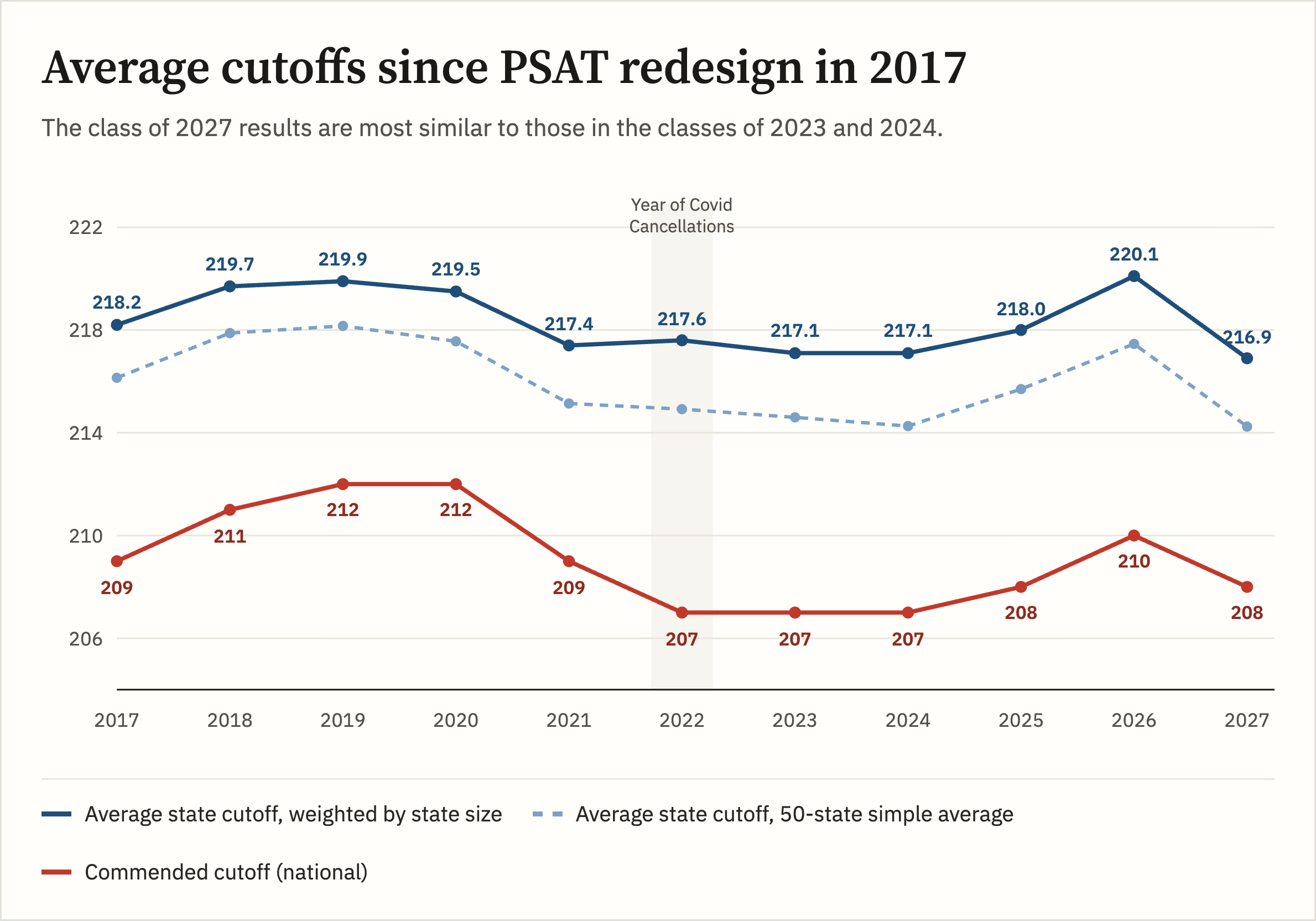
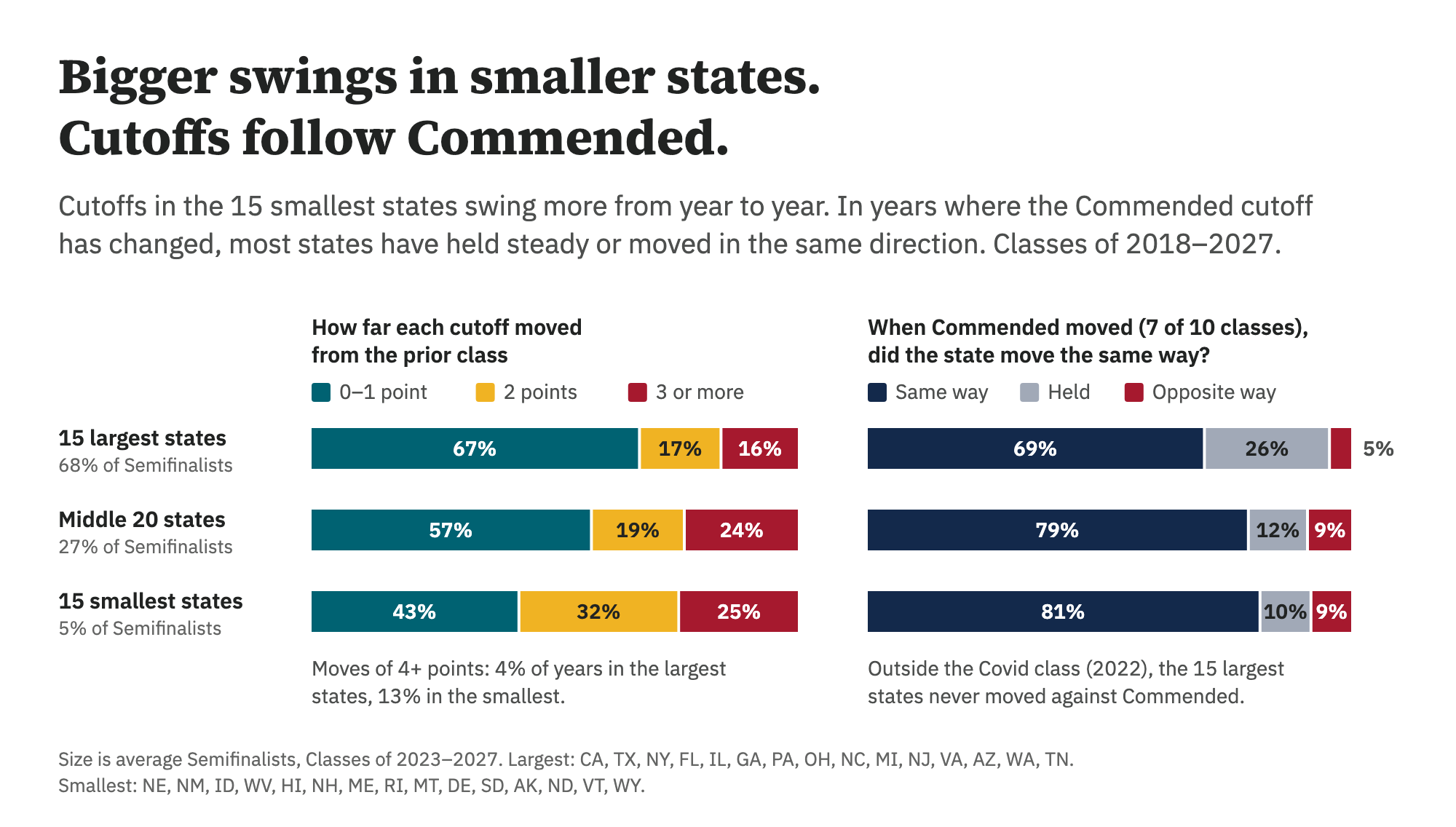
Note how the Commended cutoff and state averages tend to track one another in the chart above. The chart below shows that there is more volatility in individual states, and more volatility in smaller states, but few states move against a rise or fall in the Commended level. We cannot assume, however, that the magnitude of the change will always be the same. We have an estimate of the Commended cutoff — a suspected 1-point increase — but won’t have confirmation until April.
Projections for the class of 2028: Consider the ranges.
In addition to our 50-state cutoff projections, Compass provides a deep dive into each state. Enter your own Selection Index or section scores to see how you stack up historically. The estimates consider state size, prior cutoffs and volatility, and Commended values.
As of 11/16/26, forecasted ranges combine historical data with final PSAT score counts. The Commended cutoff will be confirmed in April.
Class of 2028 estimates by state
| State | Class of 2028 estimate | Past cutoffs | |||
|---|---|---|---|---|---|
| Most likely | Estimated range | 2027 | 2026 | 2025 | |
| Alabama | 211 | 209–214 | 210 | 214 | 212 |
| Alaska | 211 | 208–213 | 208 | 215 | 214 |
| Arizona | 216 | 214–218 | 215 | 218 | 217 |
| Arkansas | 211 | 209–214 | 210 | 215 | 213 |
| California | 221 | 220–223 | 220 | 224 | 221 |
| Colorado | 217 | 215–219 | 217 | 219 | 218 |
| Connecticut | 221 | 219–223 | 220 | 223 | 221 |
| Delaware | 219 | 216–221 | 219 | 220 | 219 |
| District of Columbia | 223 | 221–224 | 223 | 225 | 223 |
| Florida | 217 | 215–218 | 216 | 219 | 217 |
| Georgia | 218 | 216–220 | 217 | 220 | 218 |
| Hawaii | 217 | 215–219 | 218 | 219 | 217 |
| Idaho | 212 | 210–215 | 211 | 215 | 213 |
| Illinois | 219 | 218–221 | 218 | 222 | 220 |
| Indiana | 216 | 214–218 | 215 | 218 | 217 |
| Iowa | 211 | 209–214 | 210 | 214 | 212 |
| Kansas | 214 | 212–216 | 212 | 216 | 215 |
| Kentucky | 212 | 210–214 | 211 | 214 | 213 |
| Louisiana | 213 | 211–215 | 211 | 216 | 214 |
| Maine | 214 | 212–217 | 214 | 217 | 214 |
| Maryland | 222 | 220–223 | 221 | 224 | 222 |
| Massachusetts | 222 | 221–224 | 221 | 225 | 223 |
| Michigan | 217 | 215–219 | 216 | 220 | 218 |
| Minnesota | 216 | 214–218 | 214 | 219 | 217 |
| Mississippi | 211 | 208–213 | 211 | 213 | 212 |
| Missouri | 214 | 212–216 | 214 | 217 | 215 |
| Montana | 209 | 208–212 | 208 | 213 | 209 |
| Nebraska | 212 | 209–214 | 212 | 214 | 211 |
| Nevada | 212 | 210–214 | 211 | 214 | 214 |
| New Hampshire | 216 | 213–218 | 215 | 219 | 217 |
| New Jersey | 223 | 221–224 | 223 | 225 | 223 |
| New Mexico | 209 | 208–212 | 209 | 210 | 211 |
| New York | 220 | 219–222 | 220 | 223 | 220 |
| North Carolina | 218 | 216–219 | 217 | 220 | 218 |
| North Dakota | 209 | 208–211 | 208 | 210 | 210 |
| Ohio | 216 | 215–218 | 216 | 219 | 217 |
| Oklahoma | 210 | 208–212 | 210 | 212 | 211 |
| Oregon | 217 | 215–219 | 216 | 219 | 216 |
| Pennsylvania | 219 | 217–221 | 219 | 221 | 219 |
| Rhode Island | 215 | 213–218 | 213 | 219 | 217 |
| South Carolina | 212 | 210–214 | 212 | 215 | 214 |
| South Dakota | 210 | 208–212 | 210 | 211 | 208 |
| Tennessee | 216 | 214–218 | 214 | 219 | 217 |
| Texas | 219 | 218–221 | 219 | 222 | 219 |
| Utah | 211 | 208–213 | 209 | 213 | 211 |
| Vermont | 213 | 210–216 | 212 | 216 | 215 |
| Virginia | 221 | 220–223 | 221 | 224 | 222 |
| Washington | 221 | 220–223 | 221 | 224 | 222 |
| West Virginia | 209 | 208–210 | 208 | 210 | 209 |
| Wisconsin | 213 | 211–215 | 212 | 215 | 214 |
| Wyoming | 209 | 208–210 | 208 | 210 | 209 |
| U.S. Students Abroad | 223 | 221–224 | 223 | 225 | 223 |
| U.S. Territories | 209 | 208–210 | 208 | 210 | 208 |
| Commended (national) | 209 | 208–210 | 208 | 210 | 208 |
Below are three of the most popular (and controversial) questions I get asked about the National Merit Scholarship Program. A couple of less controversial questions follow. Additional information can be found in our National Merit FAQ.
Why does each state have its own Semifinalist cutoff if the program is NATIONAL Merit?
This is always a hot-button question. NMSC allocates the approximately 16,500 Semifinalists among states based on the number of high school graduates. That way, students across the nation are represented. It also means that there are very different qualifying standards from state to state. A Massachusetts student with a 220 might miss out on being a Semifinalist. If she lived just 10 miles away in New Hampshire, she would qualify.
No Semifinalist cutoff can be lower than the national Commended level. Cutoffs for the District of Columbia and for U.S. students studying abroad are set at the highest state cutoff (typically New Jersey). The cutoff for students in U.S. territories and possessions falls at the Commended level each year. Boarding schools are grouped by region. The cutoff for a given region is the highest state cutoff within the region.
NMSC feels that the allocation method is the best way of ensuring truly national representation. That’s important, because without national representation, the program would likely not exist. National Merit requires participation from corporations and universities across the country. It constantly works to foster investment. The pitch to sponsors would be more difficult if Semifinalists were clustered in a smaller footprint. That doesn’t make the frustration any less real for the students who miss out.
When are National Merit Semifinalists announced? Why does it take so long?
The lists of Semifinalists will not be distributed to high schools until the end of August 2027. With the exception of homeschoolers, students do not receive direct notification. NMSC asks that schools not share the results publicly until the end of the press embargo in mid-September, but schools are allowed to notify students privately before that date. NMSC does not send Commended Student letters to high schools until mid-September. Compass will keep students updated on developments as the dates approach.
NMSC is an organization that values consistency — maybe sometimes to excess. The Semifinalist, Finalist, and Scholar cycle is little changed from what it was 60 years ago. Originally the NMSQT was in the spring of junior year, and email and the internet didn’t exist. Once the PSAT and NMSQT merged into a single exam, testing moved to the fall of junior year. The notification calendar never changed. During the winter and spring, NMSC is busy working with Finalist and Scholar selections. And counselors are busy getting seniors into college! In April and May, schools need to sign off on student eligibility. NMSC has always worked through schools for Semifinalist notifications, so September provides the next logical window. It’s slow and secretive, but it eventually works.
The schedule is hardest on students hoping to get one of the large scholarships offered by a limited number of universities. Key planning gets put on hold. I’d also like to see NMSC modernize its notification process. In the age of Bluebook, there is no excuse not to notify students directly and avoid the uncomfortable rollout of information. Colleges have long learned how to operate this way and build enthusiasm. The days of National Merit students being written up by the local newspaper are long gone, so why not let Instagram and TikTok take over?
Why is RW given twice the weight of Math?
There are many wrong answers to this question floating around the internet. It’s not because the PSAT had separate Reading and Writing sections during the SAT’s 2400 period. The weighting existed decades before that version of the exam. It’s not to favor one demographic over another. It dates back to the very creation of the test. In fact, the current method is more balanced than the original!
The National Merit Scholarship Qualifying Test (just the SQT in 1956 and 1957) was originally a separate test offered in the spring of junior year. The test was developed from the Iowa Testing Programs that also gave birth to the ACT. In fact, the NMSQT looked a lot like the original ACT. It had sections for English, Mathematics, Social Studies (Reading), Natural Sciences (Reading), and Vocabulary. Each section was scored 1-36, and the Selection Index was the sum of the five section scores. So 80% of the original Selection Index came from sections testing verbal skills. In 1971, NMSC merged the NMSQT with the College Entrance Examination Board’s PSAT, written by ETS. The PSAT and SAT only had Verbal and Mathematics scores (20-80 on the PSAT and 200-800 on the SAT). In order to keep a similar balance to the original NMSQT, the Verbal score was doubled to form the Selection Index.
The decision remains controversial, but its roots are 70 years old. As mentioned previously, NMSC likes continuity.
Do state and national percentiles indicate whether a student will be a National Merit Semifinalist?
No! Approximately 1% of test takers qualify as Semifinalists each year, so it is tempting to view a 99th percentile score as indicating a high enough score — especially now that College Board provides students with percentiles by state. There are several flaws in using percentiles as a quick way of determining National Merit status.
- Percentiles are based on section scores or total score, not Selection Index
- Percentiles are rounded. There is a large difference, from a National Merit perspective, between the top 0.51% and the top 1.49%
- Percentiles reveal the percentage of students at or below a certain score, but the “at” part is important when NMSC is determining cutoffs.
- The number of Semifinalists is based on the number of high school graduates in a state, not the number of PSAT takers. Percentiles are based on PSAT takers. States have widely varying participation rates.
- Most definitive of all: Percentiles do not reflect the current year’s scores! They are based on the prior 3 years’ performance. They are set even before the test is given. And if you are going to use prior history, why not use the record of prior National Merit cutoffs rather than the highly suspect percentiles?
When my score report says “Eligible for National Merit,” does that mean I qualify?
Eligibility means entering the program; qualifying comes later. Your PSAT/NMSQT score report tells you whether you meet the eligibility requirements for the NMSP. In general, juniors taking the October PSAT are eligible. If you have an asterisk next to your Selection Index, it means that your answers to the entrance questions have made you ineligible. Your answers are conveniently noted on your score report. If you think there is an error, you will also find instructions on how to contact NMSC. Meeting the eligibility requirements simply means that your score will be considered. Approximately 1.3 million students from the 1.4 million PSAT takers enter the competition each year. Only about 55,000 students will be named as Commended Students, Semifinalists, Finalists, or Scholars. See National Merit Explained for more information.

Do the bold numbers mean you feel certainty?
Jess,
I used that to flag cutoffs where we had narrowed things down to a single score. I think it is more confusing than helpful, so I’ve eliminated it.
Any more news on SC? I’m at a 215 and a bit nervous. Haven’t heard anything from my school yet. Thanks so much for all the updates!
No, the latest report is the qualifier at 217.
I work in a SC school, and as of today, (9/9) we have not received any news/mail. It’s odd.
I wish it were more odd! Thanks for the update, RVH.
What states do you think will be the 210 cutoff, is it going to be multiple?
CJ,
There is not guarantee that there will be a 210 state. NMSC first determines the cutoff for Commended by looking for a Selection Index that would qualify approximately 50,000 students from among the pool of eligible test takers. That was 210 this year. It then looks to get as close as possible to a state’s target number of NMSFs by finding the appropriate cutoff. The catch is that no state’s NMSF cutoff can be below the national Commended cutoff. Let’s say that West Virginia’s allotment of Semifinalists is 65 and that, in order to get to 65, NMSC would need to go to a Selection Index of 208. Instead, WV’s cutoff would be 210 and it might end up with only 55 Semifinalists.
That said, I don’t recall a year where there have ben 0 states at the Commended level. It has happened most frequently in West Virginia and Wyoming and less frequently in the Dakotas. We don’t have any state data that would tell us what states might be at 210 this year.
Hi Art!
Is the CA score – 224 confirmed?
Yes, solid.
I got it in Mississippi with a 214 waiting to see if my friend with a 213 gets it too.
Congratulations!
Does College Board post all the state cutoffs on 9/10? My daughter is Arkansas class of 2027, so I am just seeing how the scores track from 2023-2026.
Would you believe the answer is “sometimes.” One of the reasons I started doing this many years ago is because it was not publishing the cutoffs in a timely manner. I’m hopeful.
MS cutoff at most a 213. My kid has a 214 and another friend of his got in with 213 as well.
Thank you, B. Congratulations to your student!
213 is confirmed for MS. 212 at same school did not make it
Thank you, b! I’ve updated the post.
Someone is commenting on Reddit that with NY 222 their school told they they did NOT make it . Do we have confirmation of that 222 before for NY?
I’m 99% sure that we have a previous report of a 222 qualifying. Checking. In the meantime, I’ve made note of the discrepancy. Thank you.
Does this mean that they made the test too easy? How to interpret this big of a jump?
Malena,
I’ll be doing a complete write-up once we have a full picture. It really depends what we mean by “easy” and “hard.” The questions on the test being easy would normally be offset by a tougher scale. And if the questions are hard, the scale is more generous. On the old paper PSAT, we could say that a given number wrong would align to a certain score based on that form. For example, 1 wrong on Math might be a 750 and 2 wrong a 730. That’s not possible with the digital PSAT. Instead, College Board uses what is known as a 3-parameter IRT model to produce a scaled score based on the specific items seen by a student (not every student sees exactly the same questions). Students with 2 wrong answers could receive different scores depending on the statistics of those items. And each test includes unscored items that are used to try out new questions.
My leading theory is that the item statistics used were flawed. College Board may not have had enough data on them. Also, it’s not easy to accurately scale a test with only 40 problems, even with the adaptive nature of the PSAT. What we can clearly see is that the digital PSAT was more generous (“easier” in that sense) with high scores than it had ever been in the past. Based on the cutoffs, more students earned 740-760 scores than ever before.
Hi,
Any words on the PA cutoff?
No, it has been stubbornly invisible. Please let us know when you hear! Thank you.
I got semifinalist with 224 in PA and also someone with 223 in my school got qualified for NMSQT semifinalist in PA.
Congratulations! PA finally comes through with some intel.
Why do many schools still not have letters for students? I know my daughter’s score of 219 in MS should be good enough (recently saw Reddit post that someone got it in MS with a 213), but I also know the school has not received anything since I am a teacher at the school. My daughter is nervous somehow there has been a mistake.
Janet,
There is no way that a 219 doesn’t qualify in MS (I am assuming that your daughter is not at a boarding school). Reasons that I have seen in the past:
1) USPS. NMSC doesn’t even send the information by Express.
2) Confusion in the mail room. The information goes to the principal, but it is often a college counselor who handles the details. Given your presence in the school, this sounds less likely.
3) Secrecy. NMSC asks that the information not be made public until 9/10. Some schools interpret that to mean that they shouldn’t share the information until 9/10. I’ve seen at least some schools tell untruths to provide cover. “No, we haven’t received anything.”
4) A mistake at NMSC. This doesn’t happen often…except for this year. I am getting multiple reports of counselors receiving incorrect lists (students from other schools mixed in and some students from their school missing).
Don’t worry, mistakes get cleaned up. After 9/10, you or your school’s counselor should be able to contact NMSC.
Same in South Carolina! The principal has checked his box daily, and hasn’t received anything. We are the biggest HS in the state and always have several finalists. At this point it must be a mail issue!
Yes, this is not uncommon.
After the press embargo ends tomorrow, NMSC will generally confirm a qualifier via a phone call. You’ll still need to get the letter from the school, because it has important login information. Your principal will be able to bug NMSC about the letters, as NMSC won’t send one directly to you.
My son was notified that he qualified with a 215 in Iowa!
Congratulations! Thank you for letting us know.
Hey Art – I’m an interested Ohio student and just saw on Reddit that a mother confirmed Ohio cutoff to be at 219. She said the info came from her student’s principal. Thanks for pulling all this info together!
Thanks, Abby! I just included that info on the page.
I got a 216 as a student in Utah, does that mean I qualify for semifinals and if so when and how will I be notified?
Yes, as long as the report of the 216 qualifying is accurate (and I think it is), you will be a Semifinalist. Students are notified via their schools. If you don’t hear after tomorrow, you should be able to call NMSC and ask about your status. You’ll still need to get the letter from your high school, because it will have login instructions for the Finalist application.
Someone in Reddit mentioned OH cutoff is 219
Updated. Thank you for the alert, Steve.
Hi Art,
Is there any further confirmation of 219 in Ohio, or just the one reddit post so far?
Thanks!
Just Reddit, I believe.
Do schools always tell students ahead of the list being published tomorrow? Principal requested a meeting with child for Friday with no stated purpose. Could it be that the school will not tell before the list is published tomorrow? Not a very transparent notification process. 215 in Arkansas…
Jane,
No, they definitely do not. NMSC leaves it up to schools as to how and when to inform students. I wish NMSC would bring the process into the modern age. As I’ve mentioned in a few posts, parents generally have luck getting information from NMSC (by phone) AFTER the press embargo ends.
Bentonville High School notified students today. My coworker has a 2026 winner, but I don’t know the score.
What is the most recent news out of Arkansas? I’m right on the bubble with a 213, and haven’t really seen anything besides the 220 on Reddit. Thanks!
Barrett,
That’s all I have. Good luck!
Arkansas – 216 qualified
Thank you, Petros!
Any news from Nevada?
Marie,
No I have not heard from NV.
Hey Art, any updates on the New York cutoff? Has anyone reliable actually confirmed to have qualified with 222?
Ollie,
I’ve been shaking the trees but don’t have an answer yet. I believe the only report on 222 qualifying was an early Reddit post.
Hi Art! Do you have any idea why the scores jumped so “crazy” with higher-scoring states, but the states in the lower-to-mid range seem to have stayed somewhere around your projected ranges? Just from someone still waiting in a smaller state for tomorrow!
D,
I just happened to answer a similar question earlier this afternoon. It’s a lot of text, so I’ll just link to it.
While the number of 210-215 scores seemed to increase modestly, we saw unprecedented numbers of students scoring 220-228. I’ll cover more theories in a future report.
Is Texas confirmed at 222?
Kristine,
We’ve had multiple students report qualifying at 222. We have had fewer (just 1?), reporting not qualifying at 221. I feel pretty confident in 222.
Is 221 feasible for New York?
JB,
It depends on what one thinks about the student reports. Both come from Reddit, so I don’t have any additional context. Yesterday a student at 222 noted that they were told by their school that they did not make the cut. That would place the cutoff at 223, because there is a report of a 223 qualifying.
BUT, last week a student reported 222 as qualifying. If we favor that report and say that yesterday’s report is mistaken, then a 221 is still in play.
My daughter qualified in Oregon with a 219. Art, thanks for all the work you have put into helping us understand this process!
Congratulations to your daughter, Eric! That’s going to popular news for a lot of students. Thank you.
Thanks for posting! We are in Oregon and have not heard from the school sitting on a selection index of 221. So fingers crossed!
Alaska: my son got it with a 220. Not sure how low the cutoff is though.
Thank you, Matt. Congratulations to your son!
any news on NY?
No, haven’t been able to confirm.
IDK if this means anything, but my friend with a 228 just randomly got a bunch of direct admission offers on his common app. is that correlated to national merit or just random?
Very unlikely that it is NMSF related. Common App maintains its own direct admit program, and I don’t think that it has a relationship with NMSC. It’s likely based on the profile your friend built out on Common App. Not random, but not NM.