

Compass projects lower qualifying scores for the Class of 2027
The junior year PSAT is also the NMSQT — the National Merit Scholarship Qualifying Test. Each year, National Merit recognizes the top 57,000 test takers. In order to be included in that group, students need to be among the top 4% of the 1.4 million students who take the PSAT. Of that elite group, approximately 17,000 are recognized as Semifinalists for having the highest scores within their states. Semifinalists have the opportunity to continue in the program to become Finalists and, potentially, scholarship recipients. The remaining 40,000 students are recognized as Commended Students. More information can be found in our National Merit Explained post.
For the Class of 2027, the exact scores needed to qualify (“cutoffs”) will not be released until September 2026 (the Commended cutoff is likely to leak in April). In order to give students context for their test results, Compass has analyzed the scores from the October 2025 to produce estimates for the national Commended cutoff and the individual state cutoffs. We predict that the majority of state cutoffs will decline this year.
National Merit uses the Selection Index (SI), found on the PSAT score report, to rank students. The Selection Index can be calculated by doubling the Reading & Writing score (RW), adding the Math score (M), and dividing that sum by 10. For example, a student with a 720 RW and 700 M score has a Selection Index of 214 — (720 x 2 + 700)/10. The weighting of the index means that not all students with a 1420 Total Score have the same SI. A student with a 700 RW and 720 M has a Selection Index of 212. The highest SI a student can receive is 228 (760 RW and 760 M). Last year, the Commended cutoff was 210, and Semifinalist cutoffs ranged from 210 to 225 depending on the competitiveness of the state.
Why do we foresee lower cutoff scores?
College Board does not release any information about the distribution of Selection Indexes, but it does produce summaries of broad score ranges. The number of students in the 1400 – 1520 Total Score range has proved to be an excellent indicator of the Commended cutoff. The Class of 2027 saw 16% fewer top scores than did last year’s class. The 52,400 students at 1400 and above is closer to what we saw two years ago with the Class of 2025 and, going back further, similar to the results for the Classes of 2017 and 2021.
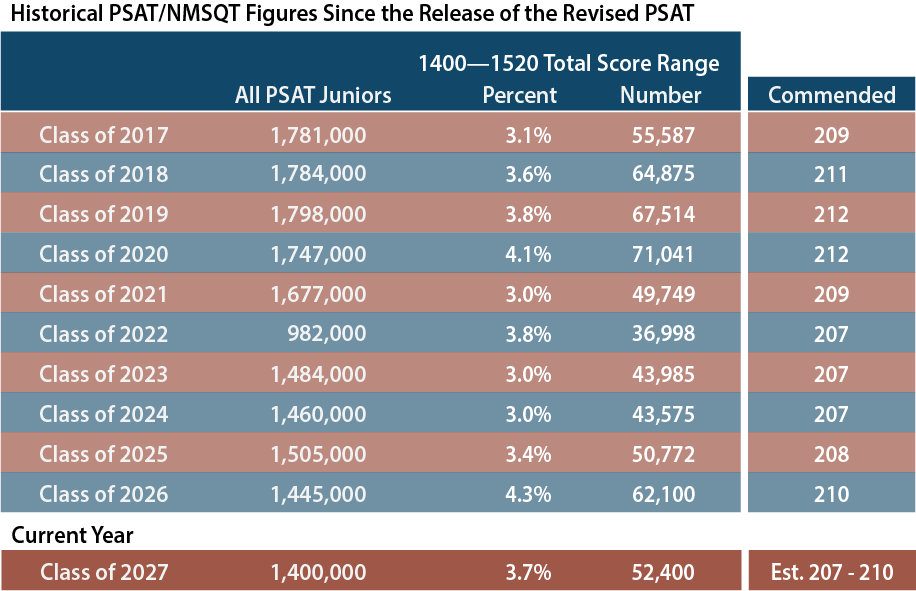
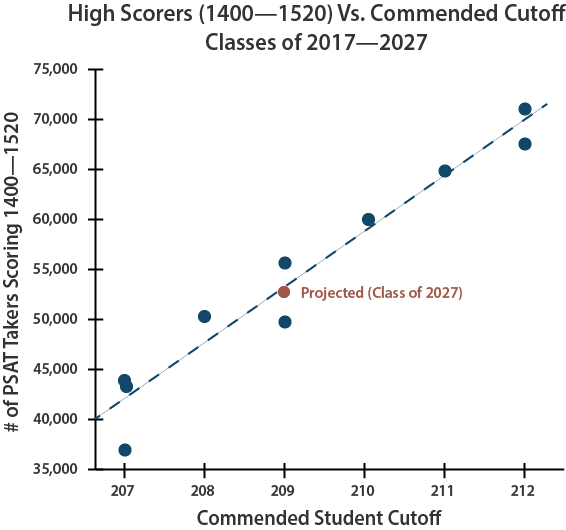
Most of the students who will qualify for National Merit recognition fall in the 1400 – 1520 band (or just outside it). With approximately 10,000 fewer students in the top band of scores this year, we expect the Commended level to drop to 208 or 209. The chart below shows the historical relationship between high scores and the Commended cutoff.
Explaining why last year’s cutoffs reached record levels
After examining this year’s numbers, we also have a better understanding of why Semifinalist cutoffs jumped to such extreme levels last year, and why it should not happen again. The 2024 PSAT saw an unprecedented 18% jump in the number of high Reading & Writing scores (700-760). The weighting of RW in the Selection Index magnified the impact of that change. The table below shows scores for the last three years and how results have fluctuated.
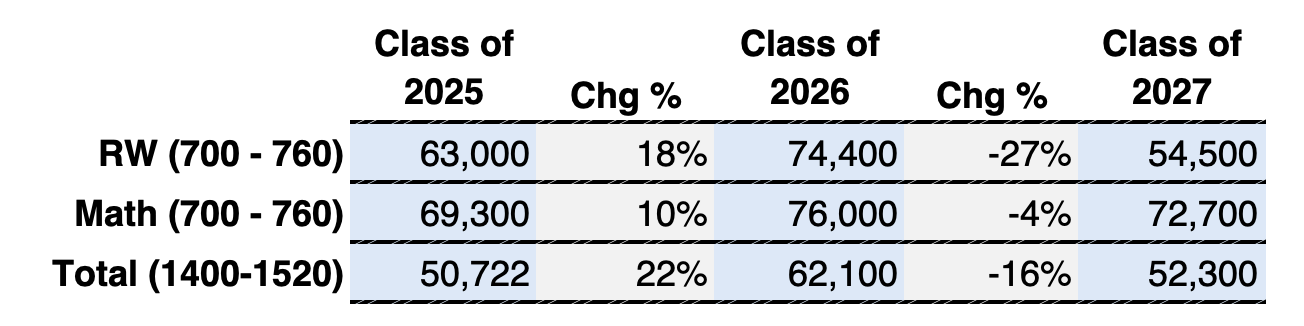
On the 2025 PSAT, the number of high RW scores dropped by 27%. In fact, the RW count for this year is even lower than it was two years ago. The decline in RW scores could even produce Selection Indexes lower than those in the Class of 2025 — at least in some states. The Commended cutoff may provide additional insight in the spring.
The ratio of 700+ M scores to 700+ RW scores reveals just how bizarre last year’s spike was. Traditionally, Math scores have higher distributions at the extremes. There are more very high Math scores on the PSAT and SAT, and there are more very low Math scores.

On the October 2024 PSAT, though, almost as many students scored 700-760 on RW as did on Math. The ratio of high Math scores to high RW scores was 1.02. This helps explain why some cutoffs went as high as 224 and 225 for the first time ever. Students achieved 750 and 760 RW scores in record numbers. In most years, there would be more students scoring 730 RW and 760 M (222 SI), for example, than scoring 760 RW and 730 M (225 SI). That was not true in the the Class of 2025, where there was a more equal distribution. It appears that scores for the Class of 2027 have returned to the traditional Math-heavy distribution. The ratio of high Math scores to high RW scores was 1.33 on the 2025 PSAT/NMSQT. For this reason, we don’t believe we will see a repeat of the 224 and 225 cutoffs seen last year.
Was last year a fluke, shift, or a trend?
The results from the Class of 2027 have answered one of the nagging questions from last year: Were the high cutoffs a fluke, shift, or trend? The answer appears to be fluke. More accurately, results could be labeled an error in test construction and scaling. There is no evidence that the Class of 2026 possessed special test-taking skills. As sophomores, that class performed in line with expectations on the 2023 PSAT. There is no evidence that the Class of 2027 has diminished skills. As sophomores, the class saw the same inflated scores as did the juniors on the 2024 PSAT. The best explanation is that College Board lost control of the scale. College Board dramatically shortened the PSAT when it switched from paper to digital. On the paper test, the Reading and Writing sections had 91 questions, and students were given 95 minutes. The RW on the digital PSAT is truncated to 54 questions over 64 minutes. And only 50 of the questions count toward a student’s score! A shorter exam means a less reliable exam. We saw the occasional wild ride on the paper PSAT, but the rides may get wilder and more frequent on the digital PSAT.
We anticipate the majority of state Semifinalist cutoffs to decline for the Class of 2027. Knowing this overall trend, however, doesn’t tell us which states will be in that majority or how much lower scores will go. The table below provides a Most Likely cutoff score, but the more useful information is the Estimated Range. Almost all cutoffs should fall within that range.
State | Class of 2027 (Most Likely) | Class of 2027 (Est. Range) | Class of 2026 (Actual) | Class of 2025 (Actual) | Class of 2024 (Actual) | Avg NMSFs |
|---|---|---|---|---|---|---|
| Alabama | 213 | 210 - 216 | 214 | 212 | 210 | 250 |
| Alaska | 214 | 210 - 216 | 215 | 214 | 209 | 35 |
| Arizona | 218 | 215 - 220 | 218 | 217 | 216 | 398 |
| Arkansas | 213 | 210 - 216 | 215 | 213 | 210 | 143 |
| California | 223 | 220 - 224 | 224 | 221 | 221 | 2,115 |
| Colorado | 218 | 216 - 221 | 219 | 218 | 216 | 286 |
| Connecticut | 222 | 220 - 223 | 223 | 221 | 221 | 175 |
| Delaware | 219 | 218 - 221 | 220 | 219 | 219 | 44 |
| Florida | 217 | 216 - 220 | 219 | 217 | 216 | 999 |
| Georgia | 219 | 217 - 221 | 220 | 218 | 217 | 602 |
| Hawaii | 218 | 215 - 220 | 219 | 217 | 217 | 62 |
| Idaho | 214 | 211 - 217 | 215 | 213 | 211 | 96 |
| Illinois | 220 | 218 - 222 | 222 | 220 | 219 | 704 |
| Indiana | 217 | 214 - 219 | 218 | 217 | 216 | 313 |
| Iowa | 213 | 211 - 216 | 214 | 212 | 210 | 145 |
| Kansas | 216 | 213 - 219 | 216 | 215 | 214 | 144 |
| Kentucky | 214 | 211 - 217 | 214 | 213 | 211 | 201 |
| Louisiana | 215 | 212 - 218 | 216 | 214 | 214 | 222 |
| Maine | 215 | 212 - 217 | 217 | 214 | 213 | 55 |
| Maryland | 223 | 221 - 225 | 224 | 222 | 221 | 308 |
| Massachusetts | 223 | 221 - 225 | 225 | 223 | 222 | 318 |
| Michigan | 219 | 216 - 220 | 220 | 218 | 217 | 485 |
| Minnesota | 218 | 216 - 220 | 219 | 217 | 216 | 279 |
| Mississippi | 213 | 210 - 215 | 213 | 212 | 209 | 155 |
| Missouri | 216 | 213 - 218 | 217 | 215 | 214 | 289 |
| Montana | 211 | 208 - 214 | 213 | 209 | 209 | 47 |
| Nebraska | 213 | 210 - 216 | 214 | 211 | 210 | 105 |
| Nevada | 214 | 211 - 217 | 214 | 214 | 211 | 168 |
| New Hampshire | 217 | 214 - 219 | 219 | 217 | 215 | 60 |
| New Jersey | 223 | 222 - 225 | 225 | 223 | 223 | 451 |
| New Mexico | 211 | 208 - 214 | 210 | 211 | 207 | 104 |
| New York | 221 | 219 - 223 | 223 | 220 | 220 | 1,012 |
| North Carolina | 219 | 216 - 221 | 220 | 218 | 217 | 510 |
| North Dakota | 210 | 207 - 212 | 210 | 210 | 207 | 30 |
| Ohio | 218 | 215 - 220 | 219 | 217 | 216 | 538 |
| Oklahoma | 212 | 208 - 214 | 212 | 211 | 208 | 204 |
| Oregon | 218 | 215 - 220 | 219 | 216 | 216 | 188 |
| Pennsylvania | 220 | 217 - 222 | 221 | 219 | 219 | 596 |
| Rhode Island | 217 | 214 - 220 | 219 | 217 | 215 | 47 |
| South Carolina | 214 | 210 - 217 | 215 | 214 | 209 | 236 |
| South Dakota | 210 | 207 - 213 | 211 | 208 | 209 | 42 |
| Tennessee | 218 | 215 - 219 | 219 | 217 | 217 | 319 |
| Texas | 221 | 218 - 222 | 222 | 219 | 219 | 1,623 |
| Utah | 212 | 210 - 216 | 213 | 211 | 209 | 196 |
| Vermont | 215 | 211 - 217 | 216 | 215 | 212 | 28 |
| Virginia | 222 | 220 - 224 | 224 | 222 | 219 | 437 |
| Washington | 222 | 220 - 224 | 224 | 222 | 220 | 348 |
| West Virginia | 209 | 207 - 212 | 210 | 209 | 207 | 64 |
| Wisconsin | 214 | 213 - 217 | 215 | 214 | 213 | 292 |
| Wyoming | 209 | 207 - 212 | 210 | 209 | 207 | 24 |
| District of Columbia | 223 | 222 - 225 | 225 | 223 | 223 | 36 |
| Territories | 209 | 207 - 211 | 210 | 208 | 207 | 39 |
| Outside US | 223 | 222 - 225 | 225 | 223 | 223 | 86 |
| Commended | 209 | 207 - 210 | 210 | 208 | 207 |
How cutoffs are determined
Qualifying scores (“cutoffs”) are not based on the total score for the PSAT (360-1520) but on the Selection Index, which is calculated by doubling the RW score, adding the Math score, and then dividing the sum by 10. The maximum Selection Index is 228. Students can find a historical set of cutoff data here or see how Semifinalist and Commended counts have changed state by state.
We estimate that the Semifinalist cutoffs will range from 209 to 223. Semifinalists are allocated by state, and cutoffs are calculated by state. If Florida is allocated 1,000 Semifinalists based on its population of high school graduates, then NMSC works down from a perfect 228 Selection Index until it gets as close as possible to that target. Last year, 1,008 students scored at or above the cutoff of 219. A cutoff of 220 would have produced too few Semifinalists. A cutoff of 218 would have gone over the allocation. Because score levels can get crowded, it is easy for cutoffs to move up or down a point even when there is minimal change in testing behavior or performance.
Why does each state have its own Semifinalist cutoff if the program is NATIONAL Merit?
This is always a hot button question. NMSC allocates the approximately 17,000 Semifinalists among states based on the number of high school graduates. That way, students across the nation are represented. It also means that there are very different qualifying standards from state to state. A Massachusetts student with a 220 might miss out on being a Semifinalist. If she lived 10 miles away in New Hampshire, she would qualify.
No Semifinalist cutoff can be lower than the national Commended level. Cutoffs for the District of Columbia and for U.S. students studying abroad are set at the highest state cutoff (typically New Jersey). The cutoff for students in U.S. territories and possessions falls at the Commended level each year. Boarding schools are grouped by region. The cutoff for a given region is the highest state cutoff within the region.
Change is always the theme
Over the last two decades, at least half of the state cutoffs have changed each year. In some years, as many as 49 states saw ups or downs, usually because of questionable test forms. In addition to last year’s exam, the PSATs from 2011 (Class of 2013), 2016 (Class of 2018), and 2019 stand out as problematic. The anomalous 2019 results could be traced back to a particularly mis-scaled form, which I wrote about at the time. The Class of 2014 also saw significant changes, but those were more of a bounce-back from the previous year. The question for the Class of 2027 is how much of a bounce-back will be seen this year.
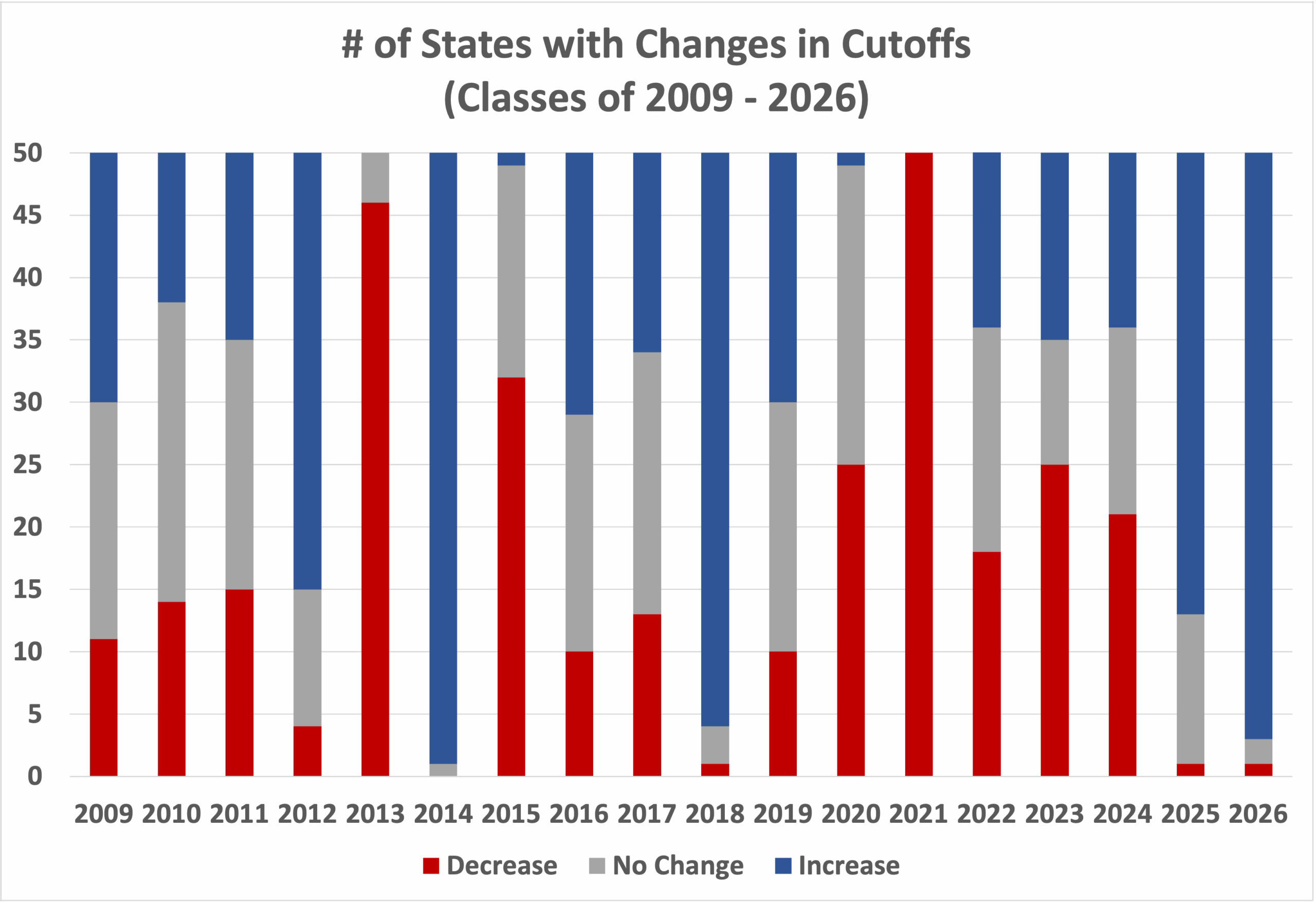
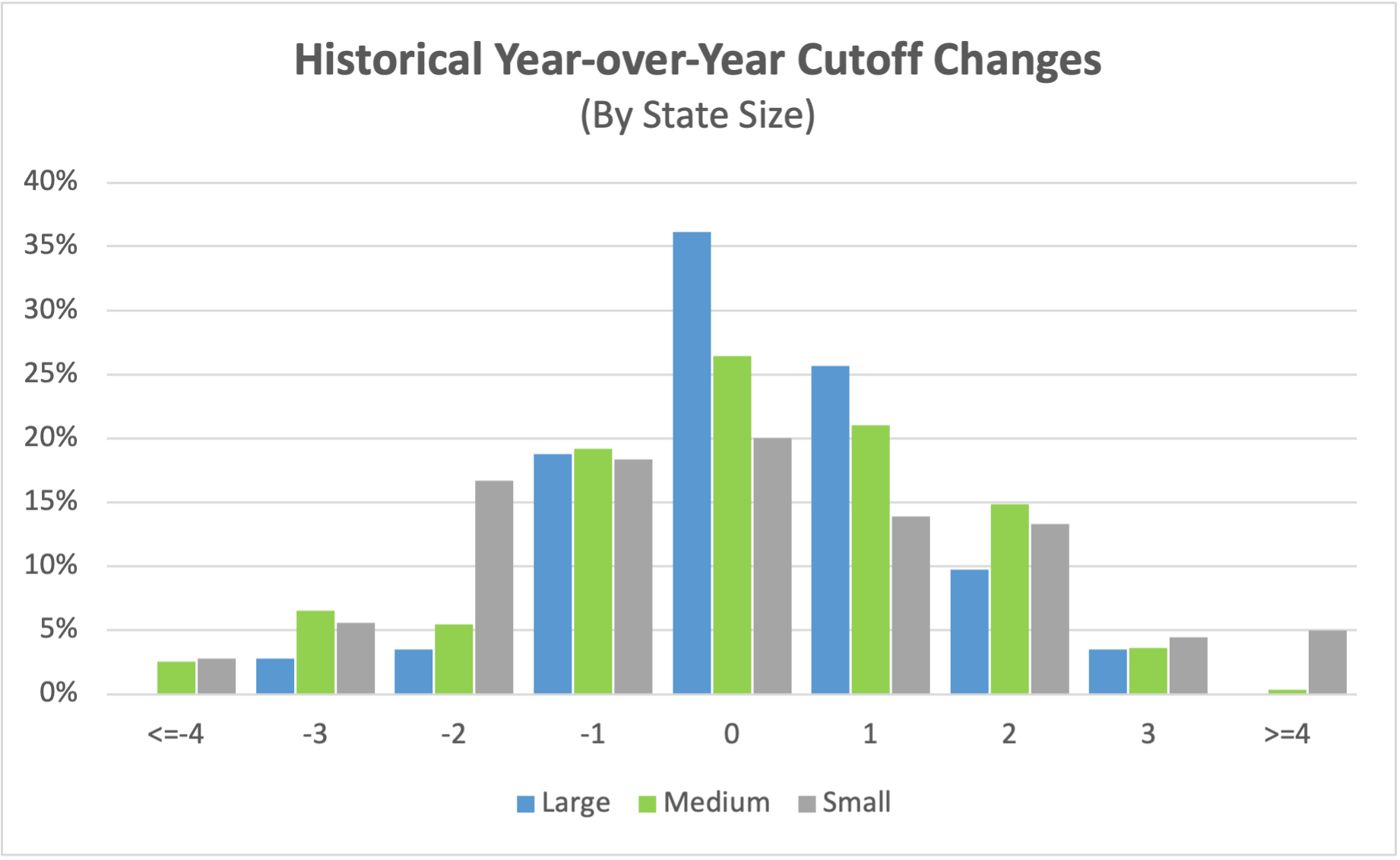
Cutoffs are particularly bumpy in states with smaller pools of test takers and National Merit Semifinalists. Over the last dozen years, cutoffs in the 12 largest states have remain unchanged 36% of the time, while the cutoffs in the smallest states have remain unchanged only 1 time out of every 5. No large state’s cutoff has jumped by more than 3 points in a year, whereas 6-point changes have occurred in the pool of smaller states.
When are National Merit Semifinalists announced?
The lists of Semifinalists will not be distributed to high schools until the end of August 2026. With the exception of homeschoolers, students do not receive direct notification. NMSC asks that schools not share the results publicly until the end of the press embargo in mid-September, but schools are allowed to notify students privately before that date. NMSC does not send Commended Student letters to high schools until mid-September. Compass will keep students updated on developments as the dates approach.
Do state and national percentiles indicate whether a student will be a National Merit Semifinalist?
No! Approximately 1% of test takers qualify as Semifinalists each year, so it is tempting to view a 99th percentile score as indicating a high enough score — especially now that College Board provides students with percentiles by state. There are any number of flaws that rule out using percentiles as a quick way of determining National Merit status.
- Percentiles are based on section scores or total score, not Selection Index
- Percentiles are rounded. There is a large difference, from a National Merit perspective, between the top 0.51% and the top 1.49%
- Percentiles reveal the percentage of students at or below a certain score, but the “at” part is important when NMSC is determining cutoffs.
- The number of Semifinalists is based on the number of high school graduates in a state, not the number of PSAT takers. Percentiles are based on PSAT takers. States have widely varying participation rates.
- Most definitive of all: Percentiles do not reflect the current year’s scores! They are based on the prior 3 years’ performance. They are set even before the test is given. And if you are going to use prior history, why not use the record of prior National Merit cutoffs rather than the highly suspect percentiles?
Entry requirements for National Merit versus qualifying for National Merit.
Your PSAT/NMSQT score report tells you whether you meet the eligibility requirements for the NMSP. In general, juniors taking the October PSAT are eligible. If you have an asterisk next to your Selection Index, it means that your answers to the entrance questions have made you ineligible. Your answers are conveniently noted on your score report. If you think there is an error, you will also find instructions on how to contact NMSC. Meeting the eligibility requirements simply means that your score will be considered. Approximately 1.4 million students enter the competition each year. Only about 55,000 students will be named as Commended Students, Semifinalists, Finalists, or Scholars. See National Merit Explained for more information.


Hi, I was wondering when schools generally receive the cutoff for qualifying scores in Indiana. My school is small, and I am sure my guidance counselor will share the results with me as soon as they arrive. I am anxious to hear whether I made the cutoff because my score is on the bubble. 11 months is too long to wait.
Thank you
Martie,
NMSC mailed notifications to schools on Tuesday, March 26th. Your counselor should be hearing the news soon.
My daughter’s school kind of let slip to her that she will be a semifinalist with a score of 218 in New Mexico.
Congratulations to your daughter, K! Thank you for passing along the first news of the season.
I am curious as to how a school in NM would already have the results on the 28th if they went out bulk mailing the day before. Is there a chance that this counselor is making an educated guess because 218 is so much higher than last year’s cut off for that state? Also I am wondering if when the letters go out do they just tell you which students have made the cut or do they disclose was the index is? Finally, do home schools have the bulk mailing go out the same time as regular schools? Thanks so much!
Jennifer,
I considered that. Given the 218 in NM, I didn’t feel that there was any danger in posting it. It’s not completely out of the question that the notifications reached some schools yesterday. My own experience with bulk mail is that some postmasters don’t treat it any differently than First Class.
Schools are given a list of the qualifying students and the cutoff. Mail is sent to homeschoolers at the same time it is sent to school, but homeschoolers are not told the cutoff.
If the cutoff is 222, does that mean 222 and higher qualifies or only scores above 222?
Joe,
Yes. In your example, a student scoring 222 would be a Semifinalist.
Art, My daughter will likely qualify with a SI 223 in NY. My question is how do we find a reliable list of schools that provide full, half (or significant) scholarships to NMSF qualifiers? We fall in that income level where we don’t qualify for much need based aid but would need to borrow a lot to pay sticker price for college. Trying to find good info on merit aid and have been a bit frustrated. Thank for your great website/blog — love the clarity and thoroughness of the presented information.
D,
The list of schools with significant scholarships is always changing. I recommend the National Merit forum on collegeconfidential.com. Parents discuss options at different schools and provide lots of useful information.
Please update if anyone knows Florida cutoff for 2020. Thanks.
Will do, Hema.
Qualifier with 220 in Indiana
Congratulations, J! Thank you for sharing the news.
I am a homeschool parent in Texas. We got the letter today with a 223, so not unexpected.
Even the not unexpected can be a great relief. Congratulations to your student!
A 221 qualified in NC! 🙂
Becca,
I’ve updated the page to reflect that. Congratulations!
My daughter has a 219 in MA. I know she won’t make the cut off in this state. I am more curious about colleges: can you put your index score of 219 on a college app? Will they understand that this is a good score compared to the rest of the country, even if she is not a semi-finalist?
Cathy,
A student can list the Commended Student honor on an application just as she can other honors. There is not a logical place to list one’s Selection Index. Keep in mind that colleges already have what they consider a more reliable and up-to-date indicator of a student’s testing abilities — SAT or ACT scores.
great..then the 1540 will probably do! (I’ll also have her list “Commended”) Thanks!
I just learned that 222 is a qualifying score in Texas this year. I don’t know whether that’s the lowest qualifying score or not.
Thank you for the update.
I received a 223 in Texas, but haven’t heard anything back yet. How much of a chance is there that I didn’t qualify?
Jacob,
Few students have heard yet, so I wouldn’t put any weight on that at all. I’ve received reports of qualifiers at 222 and 223 in Texas, so your score is definitely high enough. Most schools will be receiving their notifications this week.
Hi Art,
Thanks for providing so much information about the NMSC process. I was wondering if you’ve heard anything about whether or not a 223 in Virginia would qualify as a semifinalist? Do you think there is a big chance of VA moving up to the 224 cutoff?
Thanks in advance!
P,
Nothing from Virginia yet. I expect a rush of reports over the next couple of days. A big chance? No. A chance? Yes. We have yet to see anything in the PSAT data indicating a large shift in scores. While that doesn’t guarantee that we won’t see a 224 cutoff, a move from 223 to 224 is less likely than one from, say, 219 to 220.
Have you heard anything about Ohio yet? My daughter has a 220 and is worried that the cutoff will fluctuate by 2 points to a 221.
Nothing yet. NMSC really picked an odd mailing date this year given the Labor Day weekend.
This was posted on College Confidential this afternoon: “Qualifying SI in OH is <= 220 per my DS20’s principal. She made it!!!!"
Thanks, Heidi. I’ve updated our information.
Hi Art,
I am right on the bubble for Iowa NMSQ but my score does qualify for commended. Will my school get notified that I was commended by one of the packets that were sent out in the mail or is that only for semifinalists?
Samantha,
The first wave of packets is only for Semifinalists. NMSC will send out Commended notifications after the September 11 public release of NMSF names. Most students first learn of their Commended status by omission. Let’s hope your name is on the Semifinalist roster.
Hi Art-
What do you think the odds are that a 221 in Connecticut will qualify this year?
Eric,
In a “flat” year such as this one, we typically see 25-30% of state cutoffs decrease. There is still hope that a 221 will qualify.
Hi Art,
I am currently sitting on a 221 in Michigan. What is the likelihood that the cutoff score will increase by 3 from 219 for semifinalist? I’m not too sure how often an increase like that happens.
AS,
In a year such as this one where overall high score numbers are flat, it would be rare to see a 3-point jump. In a large state such as Michigan, rarer still. I like your odds.
Hi! Do you know the cutoff for Wisconsin yet? I got a SI of 217 so I’m hoping that the cutoff doesn’t increase much. Thanks!!!
Nothing from Wisconsin. Reports are delayed because of NMSC’s late mailing this year. Good luck!
223 is good in IL
Congratulations, Matt! I’ll update the page now.
Hi Art,
Any information for Illinois? My son took it October 24th and got a SI of 220. Since that Exam was graded harshly due to being an easy test will that make the Illinois cutoff go down for 2020?
Mom,
We have a student qualifying with a 223, so we know that something completely crazy didn’t happen. There is too little hard evidence around score distributions for the alternate date to factor it into our considerations. I estimate that we’ll see at least 10-12 states with lower cutoffs this year.
so NC went up a point to 221! My son just got by. whew.
Kathi,
We don’t yet know where the NC cutoff will end up, we just know it isn’t higher than 221. Congratulations to your son!
Hi. We have a 218 in Kentucky. Do you have any word on Kentucky? Do you think 218 will qualify? Kentucky has gone up one point each year for the last three years. Is was 218 last year. Is it likely it will increase for the 4th year in a row?
Claire,
I’ve got three similar inquiries from KY, so I’m going to quote myself for simplicity:
No news from KY yet. I can only fall back on my general prediction that we should see about two-thirds of states end up with the same or lower cutoffs this year.
Any thoughts on if a 218 SI will qualify in Kentucky this year?
No news from KY yet. I can only fall back on my general prediction that we should see about two-thirds of states end up with the same or lower cutoffs this year.
Any updated info on Texas? Is the ground 222?
So far the word is that it is no higher than 222. It may be lower.
Hi Art:
Do you have any idea what ACT score is required to qualify as a “confirming” score? I believe that my daughter may qualify as a semifinalist (fingers crossed) and I’m trying to determine whether I need to register her for the October SAT.
Janie,
This is something that I’ve been meaning to write-up. I’m going to explain things here and then post it in our National Merit FAQ for easy reference.
NMSC wouldn’t do anything as straightforward as directly using an SAT or ACT score as the benchmark. Instead, the confirming score is a minimum SAT Selection Index. Everything on the ACT has to get translated into SAT terms first.
I have heard that this year’s confirming score is an SAT Selection Index of 212. An SAT SI is calculated just like the PSAT SI: Drop the 0’s, double the ERW, and add the M. A student with an SAT score of 740 ERW and 720 M has an SAT SI of 74×2 + 72 = 220. In order to do the same thing with an ACT score, we have to break things apart and use the concordance tables published by ACT/College Board. There is no SAT Science, so NMSC does not look at ACT Science. Throw it out.
Step 1: Find the official concordance tables
Step 2: Add your ACT English and ACT Reading scores
Step 3: Use the ACT E+R to SAT ERW table to find the concordant SAT ERW score based on the sum in step 2. Be sure that you are going in the correct direction when using the concordance tables. ACT E+R to SAT ERW is not always the same as SAT ERW to ACT E+R.
Step 4: Use the ACT M to SAT M table to find the concordant SAT M score based on your ACT Math score.
Step 5: Use the SAT ERW and SAT M from steps 3 and 4 to calculate a Selection Index. You want this number to be at least 212.
Example:
A student has ACT scores of 32E, 34M, 33R, and 31S. Science is not used. The sum of E and R is 65. In the concordance tables, this is equivalent to a 700 ERW. The 34 Math is concordant to a 760. This student’s SAT Selection Index is 70×2 + 76 = 216.
Chances of 225 qualifying in CA?
100%. Congratulations on an amazing score!
thank you!