

Compass projects lower qualifying scores for the Class of 2027
The junior year PSAT is also the NMSQT — the National Merit Scholarship Qualifying Test. Each year, National Merit recognizes the top 57,000 test takers. In order to be included in that group, students need to be among the top 4% of the 1.4 million students who take the PSAT. Of that elite group, approximately 17,000 are recognized as Semifinalists for having the highest scores within their states. Semifinalists have the opportunity to continue in the program to become Finalists and, potentially, scholarship recipients. The remaining 40,000 students are recognized as Commended Students. More information can be found in our National Merit Explained post.
For the Class of 2027, the exact scores needed to qualify (“cutoffs”) will not be released until September 2026 (the Commended cutoff is likely to leak in April). In order to give students context for their test results, Compass has analyzed the scores from the October 2025 to produce estimates for the national Commended cutoff and the individual state cutoffs. We predict that the majority of state cutoffs will decline this year.
National Merit uses the Selection Index (SI), found on the PSAT score report, to rank students. The Selection Index can be calculated by doubling the Reading & Writing score (RW), adding the Math score (M), and dividing that sum by 10. For example, a student with a 720 RW and 700 M score has a Selection Index of 214 — (720 x 2 + 700)/10. The weighting of the index means that not all students with a 1420 Total Score have the same SI. A student with a 700 RW and 720 M has a Selection Index of 212. The highest SI a student can receive is 228 (760 RW and 760 M). Last year, the Commended cutoff was 210, and Semifinalist cutoffs ranged from 210 to 225 depending on the competitiveness of the state.
Why do we foresee lower cutoff scores?
College Board does not release any information about the distribution of Selection Indexes, but it does produce summaries of broad score ranges. The number of students in the 1400 – 1520 Total Score range has proved to be an excellent indicator of the Commended cutoff. The Class of 2027 saw 16% fewer top scores than did last year’s class. The 52,400 students at 1400 and above is closer to what we saw two years ago with the Class of 2025 and, going back further, similar to the results for the Classes of 2017 and 2021.
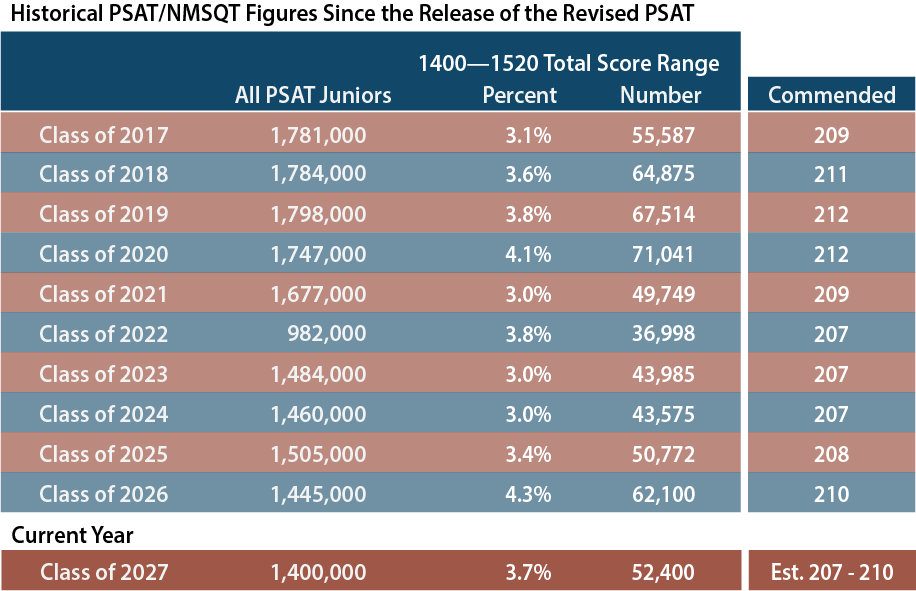
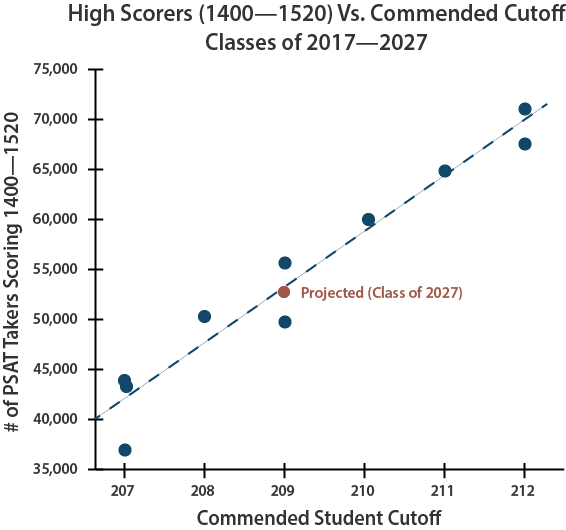
Most of the students who will qualify for National Merit recognition fall in the 1400 – 1520 band (or just outside it). With approximately 10,000 fewer students in the top band of scores this year, we expect the Commended level to drop to 208 or 209. The chart below shows the historical relationship between high scores and the Commended cutoff.
Explaining why last year’s cutoffs reached record levels
After examining this year’s numbers, we also have a better understanding of why Semifinalist cutoffs jumped to such extreme levels last year, and why it should not happen again. The 2024 PSAT saw an unprecedented 18% jump in the number of high Reading & Writing scores (700-760). The weighting of RW in the Selection Index magnified the impact of that change. The table below shows scores for the last three years and how results have fluctuated.
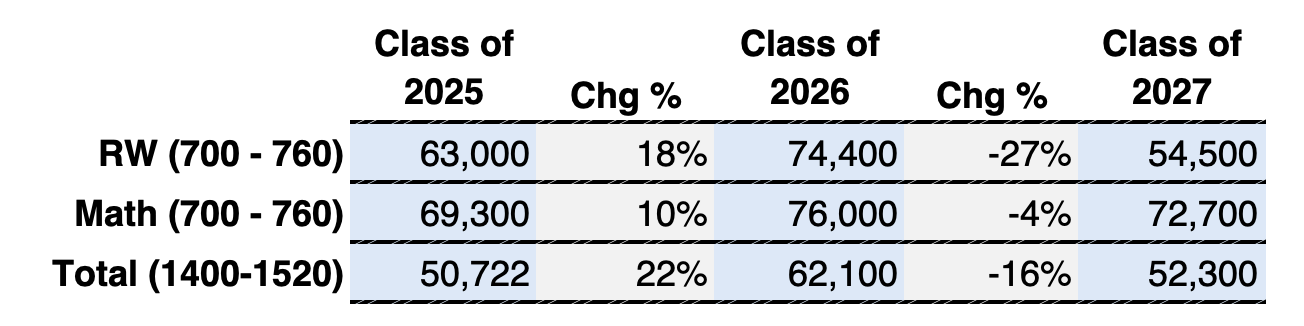
On the 2025 PSAT, the number of high RW scores dropped by 27%. In fact, the RW count for this year is even lower than it was two years ago. The decline in RW scores could even produce Selection Indexes lower than those in the Class of 2025 — at least in some states. The Commended cutoff may provide additional insight in the spring.
The ratio of 700+ M scores to 700+ RW scores reveals just how bizarre last year’s spike was. Traditionally, Math scores have higher distributions at the extremes. There are more very high Math scores on the PSAT and SAT, and there are more very low Math scores.

On the October 2024 PSAT, though, almost as many students scored 700-760 on RW as did on Math. The ratio of high Math scores to high RW scores was 1.02. This helps explain why some cutoffs went as high as 224 and 225 for the first time ever. Students achieved 750 and 760 RW scores in record numbers. In most years, there would be more students scoring 730 RW and 760 M (222 SI), for example, than scoring 760 RW and 730 M (225 SI). That was not true in the the Class of 2025, where there was a more equal distribution. It appears that scores for the Class of 2027 have returned to the traditional Math-heavy distribution. The ratio of high Math scores to high RW scores was 1.33 on the 2025 PSAT/NMSQT. For this reason, we don’t believe we will see a repeat of the 224 and 225 cutoffs seen last year.
Was last year a fluke, shift, or a trend?
The results from the Class of 2027 have answered one of the nagging questions from last year: Were the high cutoffs a fluke, shift, or trend? The answer appears to be fluke. More accurately, results could be labeled an error in test construction and scaling. There is no evidence that the Class of 2026 possessed special test-taking skills. As sophomores, that class performed in line with expectations on the 2023 PSAT. There is no evidence that the Class of 2027 has diminished skills. As sophomores, the class saw the same inflated scores as did the juniors on the 2024 PSAT. The best explanation is that College Board lost control of the scale. College Board dramatically shortened the PSAT when it switched from paper to digital. On the paper test, the Reading and Writing sections had 91 questions, and students were given 95 minutes. The RW on the digital PSAT is truncated to 54 questions over 64 minutes. And only 50 of the questions count toward a student’s score! A shorter exam means a less reliable exam. We saw the occasional wild ride on the paper PSAT, but the rides may get wilder and more frequent on the digital PSAT.
We anticipate the majority of state Semifinalist cutoffs to decline for the Class of 2027. Knowing this overall trend, however, doesn’t tell us which states will be in that majority or how much lower scores will go. The table below provides a Most Likely cutoff score, but the more useful information is the Estimated Range. Almost all cutoffs should fall within that range.
State | Class of 2027 (Most Likely) | Class of 2027 (Est. Range) | Class of 2026 (Actual) | Class of 2025 (Actual) | Class of 2024 (Actual) | Avg NMSFs |
|---|---|---|---|---|---|---|
| Alabama | 213 | 210 - 216 | 214 | 212 | 210 | 250 |
| Alaska | 214 | 210 - 216 | 215 | 214 | 209 | 35 |
| Arizona | 218 | 215 - 220 | 218 | 217 | 216 | 398 |
| Arkansas | 213 | 210 - 216 | 215 | 213 | 210 | 143 |
| California | 223 | 220 - 224 | 224 | 221 | 221 | 2,115 |
| Colorado | 218 | 216 - 221 | 219 | 218 | 216 | 286 |
| Connecticut | 222 | 220 - 223 | 223 | 221 | 221 | 175 |
| Delaware | 219 | 218 - 221 | 220 | 219 | 219 | 44 |
| Florida | 217 | 216 - 220 | 219 | 217 | 216 | 999 |
| Georgia | 219 | 217 - 221 | 220 | 218 | 217 | 602 |
| Hawaii | 218 | 215 - 220 | 219 | 217 | 217 | 62 |
| Idaho | 214 | 211 - 217 | 215 | 213 | 211 | 96 |
| Illinois | 220 | 218 - 222 | 222 | 220 | 219 | 704 |
| Indiana | 217 | 214 - 219 | 218 | 217 | 216 | 313 |
| Iowa | 213 | 211 - 216 | 214 | 212 | 210 | 145 |
| Kansas | 216 | 213 - 219 | 216 | 215 | 214 | 144 |
| Kentucky | 214 | 211 - 217 | 214 | 213 | 211 | 201 |
| Louisiana | 215 | 212 - 218 | 216 | 214 | 214 | 222 |
| Maine | 215 | 212 - 217 | 217 | 214 | 213 | 55 |
| Maryland | 223 | 221 - 225 | 224 | 222 | 221 | 308 |
| Massachusetts | 223 | 221 - 225 | 225 | 223 | 222 | 318 |
| Michigan | 219 | 216 - 220 | 220 | 218 | 217 | 485 |
| Minnesota | 218 | 216 - 220 | 219 | 217 | 216 | 279 |
| Mississippi | 213 | 210 - 215 | 213 | 212 | 209 | 155 |
| Missouri | 216 | 213 - 218 | 217 | 215 | 214 | 289 |
| Montana | 211 | 208 - 214 | 213 | 209 | 209 | 47 |
| Nebraska | 213 | 210 - 216 | 214 | 211 | 210 | 105 |
| Nevada | 214 | 211 - 217 | 214 | 214 | 211 | 168 |
| New Hampshire | 217 | 214 - 219 | 219 | 217 | 215 | 60 |
| New Jersey | 223 | 222 - 225 | 225 | 223 | 223 | 451 |
| New Mexico | 211 | 208 - 214 | 210 | 211 | 207 | 104 |
| New York | 221 | 219 - 223 | 223 | 220 | 220 | 1,012 |
| North Carolina | 219 | 216 - 221 | 220 | 218 | 217 | 510 |
| North Dakota | 210 | 207 - 212 | 210 | 210 | 207 | 30 |
| Ohio | 218 | 215 - 220 | 219 | 217 | 216 | 538 |
| Oklahoma | 212 | 208 - 214 | 212 | 211 | 208 | 204 |
| Oregon | 218 | 215 - 220 | 219 | 216 | 216 | 188 |
| Pennsylvania | 220 | 217 - 222 | 221 | 219 | 219 | 596 |
| Rhode Island | 217 | 214 - 220 | 219 | 217 | 215 | 47 |
| South Carolina | 214 | 210 - 217 | 215 | 214 | 209 | 236 |
| South Dakota | 210 | 207 - 213 | 211 | 208 | 209 | 42 |
| Tennessee | 218 | 215 - 219 | 219 | 217 | 217 | 319 |
| Texas | 221 | 218 - 222 | 222 | 219 | 219 | 1,623 |
| Utah | 212 | 210 - 216 | 213 | 211 | 209 | 196 |
| Vermont | 215 | 211 - 217 | 216 | 215 | 212 | 28 |
| Virginia | 222 | 220 - 224 | 224 | 222 | 219 | 437 |
| Washington | 222 | 220 - 224 | 224 | 222 | 220 | 348 |
| West Virginia | 209 | 207 - 212 | 210 | 209 | 207 | 64 |
| Wisconsin | 214 | 213 - 217 | 215 | 214 | 213 | 292 |
| Wyoming | 209 | 207 - 212 | 210 | 209 | 207 | 24 |
| District of Columbia | 223 | 222 - 225 | 225 | 223 | 223 | 36 |
| Territories | 209 | 207 - 211 | 210 | 208 | 207 | 39 |
| Outside US | 223 | 222 - 225 | 225 | 223 | 223 | 86 |
| Commended | 209 | 207 - 210 | 210 | 208 | 207 |
How cutoffs are determined
Qualifying scores (“cutoffs”) are not based on the total score for the PSAT (360-1520) but on the Selection Index, which is calculated by doubling the RW score, adding the Math score, and then dividing the sum by 10. The maximum Selection Index is 228. Students can find a historical set of cutoff data here or see how Semifinalist and Commended counts have changed state by state.
We estimate that the Semifinalist cutoffs will range from 209 to 223. Semifinalists are allocated by state, and cutoffs are calculated by state. If Florida is allocated 1,000 Semifinalists based on its population of high school graduates, then NMSC works down from a perfect 228 Selection Index until it gets as close as possible to that target. Last year, 1,008 students scored at or above the cutoff of 219. A cutoff of 220 would have produced too few Semifinalists. A cutoff of 218 would have gone over the allocation. Because score levels can get crowded, it is easy for cutoffs to move up or down a point even when there is minimal change in testing behavior or performance.
Why does each state have its own Semifinalist cutoff if the program is NATIONAL Merit?
This is always a hot button question. NMSC allocates the approximately 17,000 Semifinalists among states based on the number of high school graduates. That way, students across the nation are represented. It also means that there are very different qualifying standards from state to state. A Massachusetts student with a 220 might miss out on being a Semifinalist. If she lived 10 miles away in New Hampshire, she would qualify.
No Semifinalist cutoff can be lower than the national Commended level. Cutoffs for the District of Columbia and for U.S. students studying abroad are set at the highest state cutoff (typically New Jersey). The cutoff for students in U.S. territories and possessions falls at the Commended level each year. Boarding schools are grouped by region. The cutoff for a given region is the highest state cutoff within the region.
Change is always the theme
Over the last two decades, at least half of the state cutoffs have changed each year. In some years, as many as 49 states saw ups or downs, usually because of questionable test forms. In addition to last year’s exam, the PSATs from 2011 (Class of 2013), 2016 (Class of 2018), and 2019 stand out as problematic. The anomalous 2019 results could be traced back to a particularly mis-scaled form, which I wrote about at the time. The Class of 2014 also saw significant changes, but those were more of a bounce-back from the previous year. The question for the Class of 2027 is how much of a bounce-back will be seen this year.
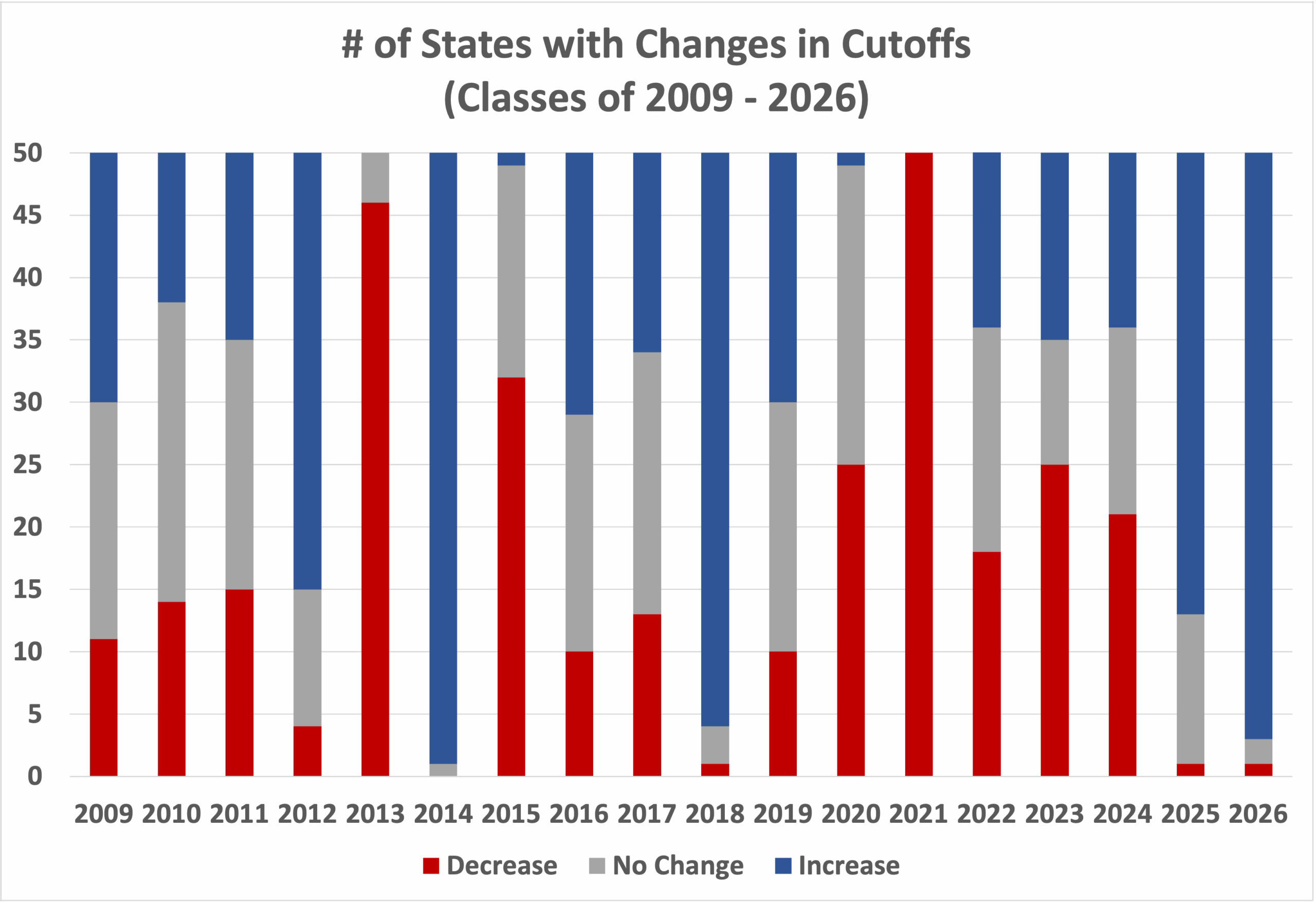
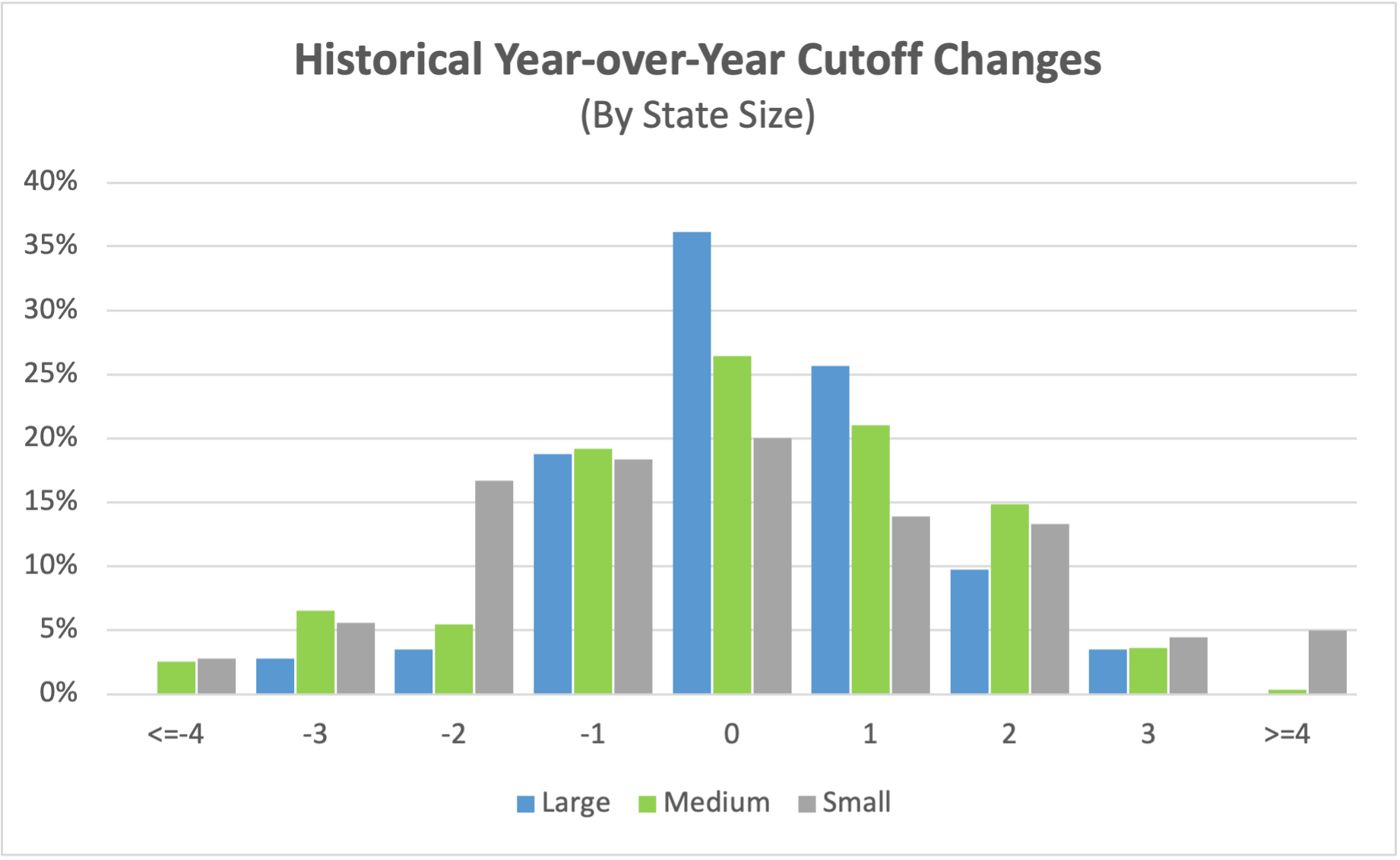
Cutoffs are particularly bumpy in states with smaller pools of test takers and National Merit Semifinalists. Over the last dozen years, cutoffs in the 12 largest states have remain unchanged 36% of the time, while the cutoffs in the smallest states have remain unchanged only 1 time out of every 5. No large state’s cutoff has jumped by more than 3 points in a year, whereas 6-point changes have occurred in the pool of smaller states.
When are National Merit Semifinalists announced?
The lists of Semifinalists will not be distributed to high schools until the end of August 2026. With the exception of homeschoolers, students do not receive direct notification. NMSC asks that schools not share the results publicly until the end of the press embargo in mid-September, but schools are allowed to notify students privately before that date. NMSC does not send Commended Student letters to high schools until mid-September. Compass will keep students updated on developments as the dates approach.
Do state and national percentiles indicate whether a student will be a National Merit Semifinalist?
No! Approximately 1% of test takers qualify as Semifinalists each year, so it is tempting to view a 99th percentile score as indicating a high enough score — especially now that College Board provides students with percentiles by state. There are any number of flaws that rule out using percentiles as a quick way of determining National Merit status.
- Percentiles are based on section scores or total score, not Selection Index
- Percentiles are rounded. There is a large difference, from a National Merit perspective, between the top 0.51% and the top 1.49%
- Percentiles reveal the percentage of students at or below a certain score, but the “at” part is important when NMSC is determining cutoffs.
- The number of Semifinalists is based on the number of high school graduates in a state, not the number of PSAT takers. Percentiles are based on PSAT takers. States have widely varying participation rates.
- Most definitive of all: Percentiles do not reflect the current year’s scores! They are based on the prior 3 years’ performance. They are set even before the test is given. And if you are going to use prior history, why not use the record of prior National Merit cutoffs rather than the highly suspect percentiles?
Entry requirements for National Merit versus qualifying for National Merit.
Your PSAT/NMSQT score report tells you whether you meet the eligibility requirements for the NMSP. In general, juniors taking the October PSAT are eligible. If you have an asterisk next to your Selection Index, it means that your answers to the entrance questions have made you ineligible. Your answers are conveniently noted on your score report. If you think there is an error, you will also find instructions on how to contact NMSC. Meeting the eligibility requirements simply means that your score will be considered. Approximately 1.4 million students enter the competition each year. Only about 55,000 students will be named as Commended Students, Semifinalists, Finalists, or Scholars. See National Merit Explained for more information.


Hi Art,
I spoke to a manager in charge of scholarships at National Merit and I was informed that they waited for a good number of alternate entry scores to be submitted and then created the semifinalist cutoff. She would not comment on the cutoff number for California. I feel like kids were penalized for taking the PSAT’s.
Thanks, Sonia. That confirms what we’ve heard regarding how AE scores were used this year. NMSC had to pick some point (July, let’s say) and close the books. NM stays mum about things until the press release date.
It was certainly an unfortunate situation. With all of the SAT cancellations this spring in CA, getting in a January PSAT was still probably the safest way of entering the competition, even if it’s easier to score well on the SAT.
Hi, Art. When you do have confirmation on whether a score of 221 meets the cutoff in New Jersey, can you let us know? On pins and needles here.
Oh, I will!
The claim on Reddit that 221 in New Jersey meets the cutoff has been challenged, Art.
FYI:
https://www.reddit.com/r/psat/comments/pchyj8/updating_as_released_cutoff_list_by_state/hb67uy5/?context=3
What would motivate someone to lie about this, if that’s what happened? Very odd.
Thanks for sharing that update, James. I’m glad that I’ve kept the asterisk. I may need to asterisk the asterisk at this point.
I’d like to assume that it was misunderstanding or miscommunication.
Hey Art,
Do you have any information on Louisiana? Also, how does the “press release” on September 15th work? Will NM post an official list of cutoffs on their website?
Thank you for any help or advice!
Kailie,
No news on Louisiana. The September 15th date is helpful in some cases and totally useless in others. NM does not release the cutoffs. Instead, they send the list of NMSFs in a state to media outlets in that state. The problem is that many media outlets aren’t interested in publishing a list of hundreds of names outside of their coverage areas. So we’ll see lots of partial lists: Semifinalists in XX County or YY City. Some areas won’t be published at all. It’s better than nothing! Some schools also interpret the 15th as when they can announce results to students. In actuality, they can tell students earlier. Most students will learn their status by or on the 15th, but it is not universal.
Thank you so much. I really appreciate the info!
Kudos to the school administrators who if they had to choose between giving a PSAT and SAT in the Spring of 2021 chose the latter. Not only would their students get a crack at the test that matters for college admissions, those students would still be able to enter the National Merit competition with the ‘easier’ SAT test. Crises reveal decision-making skills. Some school administrators knew what they were doing, others didn’t; as a consequence, some students had better opportunities than others.
Rick,
Given the tradeoffs administrators had to make, I’m willing to cut them some slack. At many schools, NM would just have been one element in the decision to offer the PSAT. And an SAT was far from guaranteed in some areas.
Hello
My daughter is so anxious to know the Washington state score. Do you know what is their score yet? Thank you
Sorry, I do not.
Any news on Maryland?
Not yet, MM.
Hi Art – I am curious about the blending of alternate entry (AE) and those that took the PSAT. I don’t think if they were blended it is appropriate to do so. The initial reports were that they would use the pool of people who took the PSAT and determine the cutoffs as normal, but then allow “no excuse” AE to supplement the number of semifinalists. Since the semifinalists are then cut down basically in half to achieve finalists, there is no harm in this approach as they would end up trimming low scoring semifinalists from the finalists. It sounds like NMSC changed what they said they were going to do partway through the process.
In my daughter’s state there were a large number of PSAT cancellations, which would then depress the cutoff (maybe substantially). Kids, especially these kids, are smart. They know that using the SAT scores results in a higher selection index (SI). Many were forced to go AE, but many opted for that route. The PSAT SI is based on a maximum of 38 for each subject. The SAT is based on 40. It is technically wrong to calculate the SAT SI by simply capping the SI subject score at 38. A 38 on the PSAT represents a much higher percentile than a 38 on the SAT. The college board has all this data, they could do a proper scaling of SAT scores to equivalent PSAT scores but they apparently didn’t. An organization (NMSC) that is representing technical excellence should do better.
This doesn’t even get into the other issues about taking the SAT multiple times, it coming later in development, etc. My daughter’s PSAT SI was 219 (didn’t have a great day) and she probably won’t make the cut but she scored 1580 on the SAT and would have easily made the cut.
Thank you!
David,
You’re correct that NM had, in the past, treated Alternate Entry scores in that way. I think there was hope that the January PSAT would save them from needing to alter that strategy. The pandemic had other ideas. In my state, California, I doubt that we were able to achieve even 1/3 of the usual volume of test takers. Had NM set the cutoffs based on the PSAT alone, they would have had 2x to 3x the targeted number of Semifinalists in the state. A state where most students were able to take the PSAT, on the other hand, would have been about normal and had 1x the target. I can see why NM felt that that was not an ideal outcome.
The PSAT and SAT are vertically scaled, which means that a score on the PSAT should represent the same level of achievement on the SAT. I’ve written before about why this is not really true, but percentiles are also a flawed way of comparing the tests because the pool of students varies. And College Board has no incentive to undermine its claim of vertical alignment.
I was worried that the inclusion of AE scores might distort the cutoffs and push them far higher. Fortunately, we are not seeing that. Yes, cutoffs would have been lower if there had been no blending, but they at least aren’t falling outside of historical norms (if anything, they are below them).
Yes, one strategy would have been to allow all students the option of submitting SAT scores.
Congratulations on your daughter’s 1580, btw!
Hi Art,
How late do you suspect reports arrive at schools here in PR? I imagine it would take longer due to having to be shipped over water.
Ross,
I don’t know about the typical mail delivery to PR, but I do know that the cutoff for U.S. Territories has never been above the Commended level (at least in the last couple of decades). I think it’s a pretty safe bet that the cutoff is 207.
With a 216 that is amazing to hear. I suppose it is worth the wait even if it drags out to the 15th 🙂
Thank you
How is it possible not to have any news from a state as big as Virginia? Going crazy with a 221.
Sorry, VAmom. Trying to get things pinned down. Fingers crossed!
I’ll second that opinion. Also going nuts in Virginia with daughter who has a 222.
I don’t think we’re going to see any state at 223 this year. Stay sane!
In Utah, My son with a 213 was just notified that he is a Semifinalist.
Congratulations to your son! And thank you for the information.
Hey Art, is Texas now fully confirmed at 220?
Faris,
Yes, in the sense that all student reports have been consistent that a 219 did not qualify and that 220 and above did.
When will the press release go out notifying the list of semi finalists?
Sept 15th is the press release. National Merit sends the names to media outlets but does not directly publish the lists or notify students.
My student asked the school today if they got the list and was told they have not received the Semifinalist list yet. Is that even possible considering NMSC mailed the letters August 24? And yes, we expect 6-10 Semifinalists from this Texas school. Thank you.
It’s usually 1 of 3 things: (1) Mail. (2) In somebody’s box, but hasn’t made it to the right person. (3) A polite way of saying, “We’re not releasing the names yet.”
Thank you. It cannot be 1 since Amazon and USPS delivers things from faraway places to here in 2 days. It can be 2 or 3. I suspect 4. Being Texas, football is the greater god than everything else in school. So, NMSF not the highest of priority for the school.
Good call. 😉
Hello Mr. Sawyer!
I’ve done the alternate entry, but I’m getting a different SSI depending on whether I use the raw test scores (capped at 38) or the section scores (capped at 760). I am not sure which one I should lean towards… I got a 1530 on my SAT, 730 in Reading/Writing and 800 in Math, and my raw score are 33, 38, 38. So with one method, my SSI is 222 and with the other, it’s 218. Which one is more likely to be the one NMSC considers?
Amani,
The correct method is to cap your R/WL/M scores at 38, add, and double. With a 730 RWL and 800 M, I assume your section scores are 33, 40, and 40. So 2x(33+38+38) = 218.
Hello! I was wondering if the SAT confirming index is state dependent? Or will it be a single index for everyone no matter which state you are in? If it’s just a single number for everyone, doesn’t it have to be at most the lowest qualifying PSAT index of all states (which this year so far is 210 (OK))? Our qualifying score is just above the commended level which is why I ask. Thanks, Art!!
Cyndi,
The confirming score is a single national number. Oklahoma is the lowest confirmed cutoff, but it’s extremely rare — to the point that I can’t come up with an instance — where at least 1 state’s Semifinalist cutoff falls at the Commended level. This is because no Semifinalist cutoff is allowed to fall below the Commended cutoff. I would recommend calling NMSC and seeing if they can give you any guidance. There are still a number of test dates on which to qualify, but I’m sure your student has better things to do than retesting.
Art,
Thanks so much for this. I took your advice and called the NMSC with the question. The answer was: The NMSC will not release the number that is needed for the confirming score cutoff (ugh). However, she said that the confirming score cutoff will NOT be higher than the lowest qualifying score, which she said was 207 (!!!). So as long as you score at least 207 on the ACT/SAT, your score will be enough to confirm.
That’s really helpful information, Cyndi. Thank you. I’ll work that into this post and our FAQ.
My child asked at school and was told that nothing can be shared until September 15. This is a school that does not regularly have NMSFs. Can I assume the fact that they knew the date of release was September 15 means that this year they do have one? Schools without any NMSF don’t get that letter, do they?
Impatient,
I don’t know the answer to that. It seems unlikely that they are mailing to every school in the country, but they may also notify schools with Commended Students (the Commended letters themselves don’t go out until Sept 15th, but there is not much mystery there given the known cutoff).
The school is incorrect that nothing can be shared, but I’d advise putting up with another week of anxiety rather than pushing that point. Fall of senior year is a bad time to run afoul of a counselor!
Hi Art, just letting you know that I made it in Illinois with 219.
Congratulations, Matthew! That will be welcome news for many students.
Will we ever find out what the distribution of semi-finalists qualified through the AE and the PSAT test itself is in each state? It could be that a much higher proportion qualified through AE in a state like CA where there was mass cancellation of the PSAT. It looks like trying to qualify through the PSAT tests in October or January is really going to hurt CA students who didn’t have an SAT result that they could qualify with. There could be a shockingly low percentage of qualifiers via the PSAT test in CA.
Rick,
I can’t imagine that NM has any interest in publishing this data. One way of looking at the fairness issue is what PSAT students needed to achieve versus prior years. On that score, it doesn’t seem like things are changing much. In some of the highest scoring states the cutoffs are down from an already record low year for the class of 2021. I think the number of PSAT qualifiers will be shockingly low only in rough proportion to the shockingly low percentage of PSAT takers. How is this result possible given qualifying via SAT score should have been a bit easier? Those who were able to take the PSAT benefitted from the fact that there was likely a group of high-caliber student who missed out on the PSAT and didn’t bother to apply AE or weren’t able to get in an SAT by June. There were concerns that an AE blend would greatly distort the cutoffs on a historical basis. That doesn’t seem to have happened. I will be curious to see how many students qualified in each state. Was NMSF able to stick to its targets?
Before you could not use a SAT score for AE if you had a PSAT score, no? Now many more people could use AE via a SAT score because the PSAT was cancelled for them. We don’t know how much AE via SAT scores have pushed up cutoffs because we don’t have data yet from states where there was heavy use of AE due to mass cancellation of the PSAT. It could be that with these PSAT’s in Oct and Jan the cutoff would have dropped to 217 in, say, CA had there not been mass cancellations and few AE’s. Let’s say my kid now gets a 1590 after having finally been able to take the SAT; five were cancelled in the Spring semester. Her school instead chose to give the PSAT, not the SAT. Dumb, in my opinion. She just took a test on 8/28. She can’t use that SAT score for National Merit qualification.
Rick,
I agree that we would likely have seen a healthy decline in CA were it not for AE. My only point is that the standard CA PSAT takers needed to meet (still unclear whether it was 220 or 221) was not that different from what CA students have needed in the past.
The most sensible thing would have been to allow AE for all students. NM’s AE policy effectively assumes/maintains two things: (1) PSAT and SAT are interchangeable as long as the score capping standard is applied. [We can debate that, but AE is built around that assumption.] and (2) Score Choice is OK with SAT scores for AE. If students can choose their best SAT score, why not allow them to choose their best PSAT/SAT score? They are interchangeable, right?
On a practical level, NM may not be setup to handle such a flood of potential scores. Conceptually, however, it seems like it would have been fairer and involved less gaming of the system.
I am raising the counterfactual that there would have been a sharp drop-off in the CA qualifying number even if there was heavy participation in the Oct and January PSAT’s. Why? It was hard to study for the PSAT without in-person group work and tutoring. We are seeing drop-offs in states where PSAT scores were heavily used. But we may not see a sharp drop-off in CA because so many people not having taken the PSAT will qualify with SAT scores that are only in the 96th percentile (or perhaps lower), as Howard has astutely pointed out. In Silicon Valley there was a smart decision to drop the PSAT and give SATs that served the dual purpose of being used for AE and college applications.
I tend to push back when percentiles are used to make comparisons across tests. The test-taking pools for the PSAT and SAT are different. Entire districts, for example, take the PSAT. SAT taking (although there is some state and district testing) tends to be for those applying to 4-year colleges. What we see more than anything when comparing PSAT to SAT is academic growth — similar to what we see between 10th grade PSAT and 11th grade PSAT. College Board uses students final SAT when calculating percentiles across 3 prior academic years, so those scores, on average, probably come 8 months after fall PSAT. Even among top-scoring students, timing matters. Among the many oddities this year, we have entrants taking the PSAT in October, entrants taking the PSAT in January, and entrants taking the SAT anywhere from August of sophomore year to June of junior year.
Art I understand what you are saying but a 221 SI PSAT does not equal a 221 SI SAT because as Howard pointed out they are not scaled properly. Prior to the pandemic about 3.5 million students took the PSAT whereas 2.2 million took the SAT in an average year. Yes the composition of the PSAT test takers is different from the SAT test takers as you indicate. Scores should follow a normal distribution. A (37, 37, 37) 221 on the PSAT is 99.3% or in a state with 10 million people is top 700 whereas that same (37, 37, 37) 221 on the SAT is ~ 97% or top 2000. SI’s may be ‘generally’ the same but they are mixing apples and oranges in those states that had high cancellations. Composition and sample size can’t make up for this large difference. Higher quality PSAT takers will be bumped by lower quality AE’s.
You make a very good point, if they are scaled differently and you can take the SAT multiple times then for this year and the special circumstances they should have let kids choose or simply let in more semifinalists in those affected states. There seems to be little harm in that.
This may not seem like a big deal but considering how competitive this is and what an honor it is to make NMSF it is a very big deal for those kids that are affected.
It is a big deal to many students, and I hope I don’t come off as dismissing the concerns of those who missed out on qualifying. I also don’t want to minimize the achievement of any NMSF. Through no fault of their own, AE students were not able to take the PSAT. They followed rules set up by NMSC, and they qualified.
We’re in agreement that the timing of SATs versus PSATs matters. My point is that this plays a much larger role than scoring differences between the two exams. Maybe it’s mixing Macintosh with Red Delicious. A side note for the testing aficionados: Neither the PSAT or the SAT have normal distributions. They were originally created that way, but College Board abandoned the concept with the revised SAT. The distributions are colloquially referred as normal, but they don’t fit the conditions for normality.
Hello Art,
On the same note, if the cut off and the # of semifinalists is calculated based on PSAT and AE scores submitted through June, what will happen to the AE entrants who submit their scores between June and October and qualify?
My understanding is that they will qualify as NMSFs, although I’m not sure how things will get handled in order to meet the October Finalist application deadline. I think NM is assuming that the number of students in that category is small, since students needed to test by June. It would have represented an interesting case of mass altruism (or self-interest depending on the point of view) if every AE applicant waited until September to submit scores. NM would not have been able to blend AE scores in calculating cutoffs and, in theory, even more Semifinalist would be named.
I called National Merit again this morning. They told me nationwide AE was just over 1% . I asked them to give me the numbers for Ca- the supervisor refused to give me the numbers. In states like Ca where PSAT was widely canceled I have to believe that AE was much higher and that is totally unfair for students that had qualifying SAT scores but took the PSAT anyways and missed out. She explained how she gets calls from parents saying how the SAT is harder and how it’s unfair. I don’t even see how anyone would think that. I asked if we can send an appeal letter in to count SAT scores instead and she obviously said no to that as well.
That’s interesting information, Sonia. Yes, the percentage likely skewed higher in states such as CA. One factor may be that we overestimate the use of AE because we are in an echo chamber. Those of us posting on this site and others are highly attuned to these things. Many students would not have known about AE or may have missed the deadline.
Alternatively, the 1% figure is wrong.
I think the more likely answer is the former – that we are wildly overestimating the use of AE. (with the caveat that states like California might be exceptions to that rule) The fact that cutoff scores haven’t dramatically increased from 2020 would seem to be an indicator that AE isn’t playing a major role.
My guess is that the majority of students that would most likely have used alternate entry would be the same universe of students that would’ve scored well on the PSAT anyway. The number of students that entered the semifinalist pool solely due to being able to take the SAT multiple times should be a relatively small number.
There is of course the question of fairness, but in a pandemic year with multiple test cancellations there wasn’t going to be a perfect system.
Dakota,
From what Sonia was told by NMSC — 1% of NMSFs being AE — it sounds like you’re right.
Hi Rick – I doubt NMSC will publish any of that information because it shouldn’t paint a pretty picture.
Based on last years information, a 760 on the SAT math corresponds to the 96th percentile (which according to the SAT SI calculation for AE would be a 38). A student that scores a 760 on the PSAT math corresponds to the 99+ percentile (also a 38). If AE SI were combined with PSAT test taker SI by NMSC it is heavily biased towards AE as you indicate. Kids that took the PSAT are clearly punished because NMSC or College Board did not perform proper scaling/normalization. Art has a voice and does a great job, it would be appreciated by many if he could find out what NMSC did.
My son got notified by his school that he made it in Virginia at 221.
That’s wonderful! Congratulations to your son. I’ll update the page.
Hi Art – if a student qualifies through AE, that SAT score also serves to confirm, right? Thank you for being our trusted resource!
One,
Good question. I’m 99% sure that it does. I certainly have never seen anything that says otherwise, and it would put a real burden on AE qualifiers.
Any new on Arizona?
AZ mom,
I just got a comment from a qualifier at 218, so we know Arizona is <= 218. Updating the post now.
Hi Mr. Sawyer,
I applied AE, with a breakdown of 760R, 780M. Do you know what index score that would be? Thank you so much.
S,
It depends on how your 760 is split between reading and writing. You should have two 10-40 scores that add up to 76. But each of those gets capped at 38 when computing your Selection Index for AE. So if your 760 is split evenly as 38 and 38, you don’t have to worry about the cap. If it is split 36 / 40, then NM uses 36 and 38 for your reading and writing scores. Since your Math score is 780, I know that your section score is 39. That gets capped at 38.
To calculate your SI, cap each of the three 10-40 scores (R/WL/M) at 38. Sum them. Double that.
Since nobody else from AZ has chimed in, my daughter qualified with a 218. The principal called her in to the office and told her a week ago. He also called me to congratulate us. He didn’t give her the letter that everyone else is getting, but did mention that they couldn’t really say anything until September 15. I appreciate the thorough blog and checked it frequently while waiting for decisions. We were all quite surprised she made it – her SAT was significantly better than her PSAT and we were kicking ourselves that we didn’t do AE.
Congratulations to your daughter! And your news is perfectly timed, since I just got a question about Arizona from another parent.
California : Just informed by my counselor that I made it with Score of 221.
Congratulations, Ryan! Good luck in the rest of the competition.
218 in CA is a commended student, not semi-finalist.
Thank you, Manisha.
Hey Art,
Sorry if this question may have already been answered, but I was just wondering with alternate entry this year since the AE scores are not put towards cutoffs and AE students can have until October to submit their SAT scores, will this dramatically increase the amount of total NM students above 16,000? If so, how much do you think they will go up by, and will this potentially alter some universitys’ outlook on the value of this year’s national merit semifinalist/finalist total and decrease the scholarships they are willing to give for NM students?
Thanks
Interesting take, Ron, but I think it’s a non-issue from both sides.
Even if I didn’t take NM at its word that only about 1% of NMSFs are AE, it’s hard to imagine the profile of a late-entry qualifier. You’d need to have missed both PSATs, been on top of what AE even is, sent in your application by April, taken the SAT by June, scored at Semifinalist level, and then not bothered to send your scores until Sept/Oct. I’d be surprised if that describes a set greater than low double digits. Single digits? The typical NMSF total is 16,500, so it’s a rounding error.
The other side is that universities won’t care. There are some scholarships that are capacity constrained, but usually colleges offer NM scholarships in order to brag about how many NM Scholars they’ve enrolled. If the pool is a little bigger, more opportunity!
There were 16,740 semi-finalists in total this year.
Thanks, again. So a modest increase from last year, but in line with my earlier speculation that it would fall between 16,500 and 17,000.
Hey, student from Wisconsin here. I just found out today that I qualified with a 216! Wanted to pass it along since I haven’t seen any Wisconsin info yet. Thanks for all you’re doing, I spent all of last weekend anxiously reloading the page😂
Congratulations, H.S.! I’m glad that you’ll be able to relax this weekend. Adding the WI information now.
Update from Virginia:
Email from college counseling office today to high-scoring sophomores mentions a Commended cutoff of 207 and NMSF cutoff of 221 for Virginia “last year”, which seems to me to be confirmation it is indeed 221 for the c/o 2022.
That wording would be so much clearer if 221 hadn’t been the cutoff in Sept 2020, too. It does look like that’s where Virginia ends up. Thanks for the information.
Art,
Booklets delivered to HS
Wisconsin went 214
Here is finalized list:
Alabama- 212
Alaska-208
Arizona-218
Arkansas -211
Cali-221
Colorado-217
Conn.-220
Delaware-220
Florida-217
Georgia-219
Hawaii-217
Idaho-214
Illinois-218
Indiana-215
Iowa-211
Kansas-215
Kentucky-212
Louisiana-213
Maine-211
Maryland-224
Mass.-221
Michigan-217
Minnesota-218
Mississippi-213
Missouri-214
Montana-208
Nebraska-210
Nevada-214
New Hampshire-214
New Jersey-222
New Mexico- 210
New York-220
North Carolina-218
North Dakota-207
Ohio-215
Oklahoma-210
Oregon-220
Penn.-218
Rhode Is.-213
South Carolina-213
South Dakota-210
Tenn-215
Texas-220
Utah-212
Vermont-211
Virginia-221
Washington-220
West Virginia-207
Wisconsin-214
Wyoming-208
DC-224
Thank you, Mia! We’ve been working to get this list. I’ll get this in the main post, but I won’t want to wait. That Maryland number stings. Not sure how NMSC explains that without AE. That cutoff also pushes DC and International to 224. Most unfortunate.
The MD number is truly galling. This is clearly a function of AE (most high performing districts in MD did not administer PSAT) and has unfairly advantaged high-performing districts. This seems like a major equity issue. Do you think there is any possibility of movement on the part of NMSC? Is it worth protesting?
If nothing else, some pressure might at least force NMSC to explain the impact of AE in Maryland. I’ve never seen them bend, though. What’s odd is that this only happened in Maryland (Oregon saw a 3 point increase, but that fell in line with its historical norms).
It looks like Oregon was +3 from last year as well.
While I didn’t think AE would play a significant role, is it possible that smaller states (with fewer semifinalists traditionally) were more susceptible to this type of variance?
Historically, smaller states are more susceptible to variance of all kinds. New schools opting into the PSAT. An oddball exam. Small shifts in population. Etc. Alaska bounces all over the place. Oregon and Maryland certainly aren’t CA and TX, but they aren’t particularly small, either. Maryland usually sees about 300 Semifinalists.
Looks like there is going be sharp drop off in cutoff scores especially as compared to 2018-2020 scores (2021 seems to have been anomalous) except in those states that there was mass cancellation of the PSAT and heavy use of AE, meaning that in those states PSAT takers were penalized.
Hi Art,
Have you heard that the University of Oklahoma has sent its National Merit Scholar Family Guide to NMSF before the the lists are released on September 15? Is it true? If so, how does OU get the NMSF lists so early? Thank you.
Ben,
I did hear that. A few possibilities:
1) Oklahoma is buying lists from College Board just like every other college and is setting the parameters to approximate expected cutoffs. I had always assumed this to be the case.
2) As a major sponsor of NM, they get advance notice from NMSC.
2a) They mail the guides whenever they want after receiving the list from NMSC. [A bit odd, since NM makes a big deal about the information not becoming public before the press release.]
2b) Someone messed up this year.
I’m inclined to believe #2a is more possible. My son’s PSAT score is one point lower than last year’s state cutoff. We thought that fat chance he had of being a NMSF this year. When we received the NMS family guide from OU two days ago, I was not sure if it was a good news or not. Today it turned out that my son’s score is just exactly the cutoff. Therefore, I assume OU gets advance notice from NMSC rather than approximating cutoffs.
FYI: there are reports scattered around r/psat of that mailer going to people who did not qualify and how angry they are about it. So my *guess* is 1) AND 2b).
We also got the guide and my son is one point below your cutoff. His school has not notified anyone yet.
Coming close can sting, but your son is clearly a great test taker. Best of luck to him during application season. Thank you for sharing information about the OK guide. It does seem like the university uses score ranges rather than a list of Semifinalists.