

Compass projects lower qualifying scores for the Class of 2027
The junior year PSAT is also the NMSQT — the National Merit Scholarship Qualifying Test. Each year, National Merit recognizes the top 57,000 test takers. In order to be included in that group, students need to be among the top 4% of the 1.4 million students who take the PSAT. Of that elite group, approximately 17,000 are recognized as Semifinalists for having the highest scores within their states. Semifinalists have the opportunity to continue in the program to become Finalists and, potentially, scholarship recipients. The remaining 40,000 students are recognized as Commended Students. More information can be found in our National Merit Explained post.
For the Class of 2027, the exact scores needed to qualify (“cutoffs”) will not be released until September 2026 (the Commended cutoff is likely to leak in April). In order to give students context for their test results, Compass has analyzed the scores from the October 2025 to produce estimates for the national Commended cutoff and the individual state cutoffs. We predict that the majority of state cutoffs will decline this year.
National Merit uses the Selection Index (SI), found on the PSAT score report, to rank students. The Selection Index can be calculated by doubling the Reading & Writing score (RW), adding the Math score (M), and dividing that sum by 10. For example, a student with a 720 RW and 700 M score has a Selection Index of 214 — (720 x 2 + 700)/10. The weighting of the index means that not all students with a 1420 Total Score have the same SI. A student with a 700 RW and 720 M has a Selection Index of 212. The highest SI a student can receive is 228 (760 RW and 760 M). Last year, the Commended cutoff was 210, and Semifinalist cutoffs ranged from 210 to 225 depending on the competitiveness of the state.
Why do we foresee lower cutoff scores?
College Board does not release any information about the distribution of Selection Indexes, but it does produce summaries of broad score ranges. The number of students in the 1400 – 1520 Total Score range has proved to be an excellent indicator of the Commended cutoff. The Class of 2027 saw 16% fewer top scores than did last year’s class. The 52,400 students at 1400 and above is closer to what we saw two years ago with the Class of 2025 and, going back further, similar to the results for the Classes of 2017 and 2021.
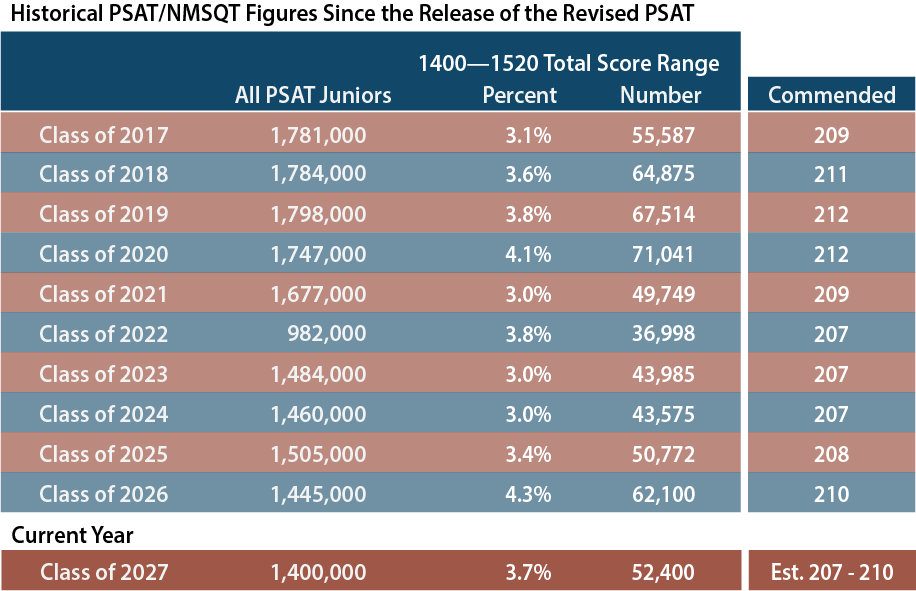
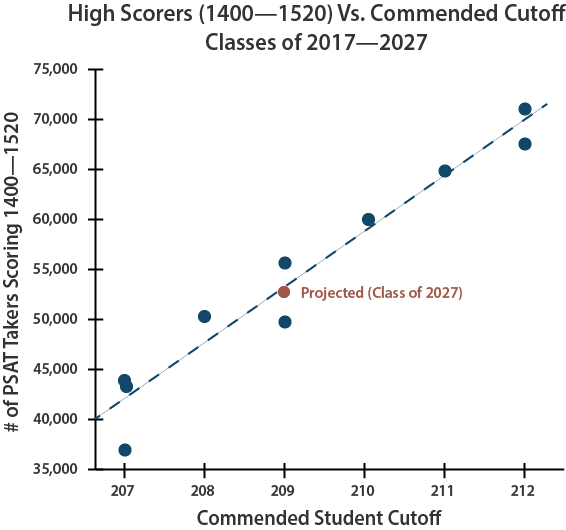
Most of the students who will qualify for National Merit recognition fall in the 1400 – 1520 band (or just outside it). With approximately 10,000 fewer students in the top band of scores this year, we expect the Commended level to drop to 208 or 209. The chart below shows the historical relationship between high scores and the Commended cutoff.
Explaining why last year’s cutoffs reached record levels
After examining this year’s numbers, we also have a better understanding of why Semifinalist cutoffs jumped to such extreme levels last year, and why it should not happen again. The 2024 PSAT saw an unprecedented 18% jump in the number of high Reading & Writing scores (700-760). The weighting of RW in the Selection Index magnified the impact of that change. The table below shows scores for the last three years and how results have fluctuated.
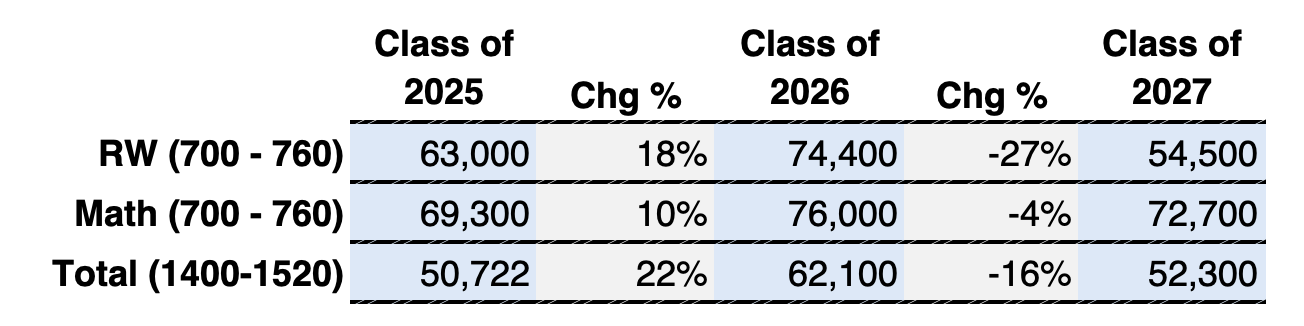
On the 2025 PSAT, the number of high RW scores dropped by 27%. In fact, the RW count for this year is even lower than it was two years ago. The decline in RW scores could even produce Selection Indexes lower than those in the Class of 2025 — at least in some states. The Commended cutoff may provide additional insight in the spring.
The ratio of 700+ M scores to 700+ RW scores reveals just how bizarre last year’s spike was. Traditionally, Math scores have higher distributions at the extremes. There are more very high Math scores on the PSAT and SAT, and there are more very low Math scores.

On the October 2024 PSAT, though, almost as many students scored 700-760 on RW as did on Math. The ratio of high Math scores to high RW scores was 1.02. This helps explain why some cutoffs went as high as 224 and 225 for the first time ever. Students achieved 750 and 760 RW scores in record numbers. In most years, there would be more students scoring 730 RW and 760 M (222 SI), for example, than scoring 760 RW and 730 M (225 SI). That was not true in the the Class of 2025, where there was a more equal distribution. It appears that scores for the Class of 2027 have returned to the traditional Math-heavy distribution. The ratio of high Math scores to high RW scores was 1.33 on the 2025 PSAT/NMSQT. For this reason, we don’t believe we will see a repeat of the 224 and 225 cutoffs seen last year.
Was last year a fluke, shift, or a trend?
The results from the Class of 2027 have answered one of the nagging questions from last year: Were the high cutoffs a fluke, shift, or trend? The answer appears to be fluke. More accurately, results could be labeled an error in test construction and scaling. There is no evidence that the Class of 2026 possessed special test-taking skills. As sophomores, that class performed in line with expectations on the 2023 PSAT. There is no evidence that the Class of 2027 has diminished skills. As sophomores, the class saw the same inflated scores as did the juniors on the 2024 PSAT. The best explanation is that College Board lost control of the scale. College Board dramatically shortened the PSAT when it switched from paper to digital. On the paper test, the Reading and Writing sections had 91 questions, and students were given 95 minutes. The RW on the digital PSAT is truncated to 54 questions over 64 minutes. And only 50 of the questions count toward a student’s score! A shorter exam means a less reliable exam. We saw the occasional wild ride on the paper PSAT, but the rides may get wilder and more frequent on the digital PSAT.
We anticipate the majority of state Semifinalist cutoffs to decline for the Class of 2027. Knowing this overall trend, however, doesn’t tell us which states will be in that majority or how much lower scores will go. The table below provides a Most Likely cutoff score, but the more useful information is the Estimated Range. Almost all cutoffs should fall within that range.
State | Class of 2027 (Most Likely) | Class of 2027 (Est. Range) | Class of 2026 (Actual) | Class of 2025 (Actual) | Class of 2024 (Actual) | Avg NMSFs |
|---|---|---|---|---|---|---|
| Alabama | 213 | 210 - 216 | 214 | 212 | 210 | 250 |
| Alaska | 214 | 210 - 216 | 215 | 214 | 209 | 35 |
| Arizona | 218 | 215 - 220 | 218 | 217 | 216 | 398 |
| Arkansas | 213 | 210 - 216 | 215 | 213 | 210 | 143 |
| California | 223 | 220 - 224 | 224 | 221 | 221 | 2,115 |
| Colorado | 218 | 216 - 221 | 219 | 218 | 216 | 286 |
| Connecticut | 222 | 220 - 223 | 223 | 221 | 221 | 175 |
| Delaware | 219 | 218 - 221 | 220 | 219 | 219 | 44 |
| Florida | 217 | 216 - 220 | 219 | 217 | 216 | 999 |
| Georgia | 219 | 217 - 221 | 220 | 218 | 217 | 602 |
| Hawaii | 218 | 215 - 220 | 219 | 217 | 217 | 62 |
| Idaho | 214 | 211 - 217 | 215 | 213 | 211 | 96 |
| Illinois | 220 | 218 - 222 | 222 | 220 | 219 | 704 |
| Indiana | 217 | 214 - 219 | 218 | 217 | 216 | 313 |
| Iowa | 213 | 211 - 216 | 214 | 212 | 210 | 145 |
| Kansas | 216 | 213 - 219 | 216 | 215 | 214 | 144 |
| Kentucky | 214 | 211 - 217 | 214 | 213 | 211 | 201 |
| Louisiana | 215 | 212 - 218 | 216 | 214 | 214 | 222 |
| Maine | 215 | 212 - 217 | 217 | 214 | 213 | 55 |
| Maryland | 223 | 221 - 225 | 224 | 222 | 221 | 308 |
| Massachusetts | 223 | 221 - 225 | 225 | 223 | 222 | 318 |
| Michigan | 219 | 216 - 220 | 220 | 218 | 217 | 485 |
| Minnesota | 218 | 216 - 220 | 219 | 217 | 216 | 279 |
| Mississippi | 213 | 210 - 215 | 213 | 212 | 209 | 155 |
| Missouri | 216 | 213 - 218 | 217 | 215 | 214 | 289 |
| Montana | 211 | 208 - 214 | 213 | 209 | 209 | 47 |
| Nebraska | 213 | 210 - 216 | 214 | 211 | 210 | 105 |
| Nevada | 214 | 211 - 217 | 214 | 214 | 211 | 168 |
| New Hampshire | 217 | 214 - 219 | 219 | 217 | 215 | 60 |
| New Jersey | 223 | 222 - 225 | 225 | 223 | 223 | 451 |
| New Mexico | 211 | 208 - 214 | 210 | 211 | 207 | 104 |
| New York | 221 | 219 - 223 | 223 | 220 | 220 | 1,012 |
| North Carolina | 219 | 216 - 221 | 220 | 218 | 217 | 510 |
| North Dakota | 210 | 207 - 212 | 210 | 210 | 207 | 30 |
| Ohio | 218 | 215 - 220 | 219 | 217 | 216 | 538 |
| Oklahoma | 212 | 208 - 214 | 212 | 211 | 208 | 204 |
| Oregon | 218 | 215 - 220 | 219 | 216 | 216 | 188 |
| Pennsylvania | 220 | 217 - 222 | 221 | 219 | 219 | 596 |
| Rhode Island | 217 | 214 - 220 | 219 | 217 | 215 | 47 |
| South Carolina | 214 | 210 - 217 | 215 | 214 | 209 | 236 |
| South Dakota | 210 | 207 - 213 | 211 | 208 | 209 | 42 |
| Tennessee | 218 | 215 - 219 | 219 | 217 | 217 | 319 |
| Texas | 221 | 218 - 222 | 222 | 219 | 219 | 1,623 |
| Utah | 212 | 210 - 216 | 213 | 211 | 209 | 196 |
| Vermont | 215 | 211 - 217 | 216 | 215 | 212 | 28 |
| Virginia | 222 | 220 - 224 | 224 | 222 | 219 | 437 |
| Washington | 222 | 220 - 224 | 224 | 222 | 220 | 348 |
| West Virginia | 209 | 207 - 212 | 210 | 209 | 207 | 64 |
| Wisconsin | 214 | 213 - 217 | 215 | 214 | 213 | 292 |
| Wyoming | 209 | 207 - 212 | 210 | 209 | 207 | 24 |
| District of Columbia | 223 | 222 - 225 | 225 | 223 | 223 | 36 |
| Territories | 209 | 207 - 211 | 210 | 208 | 207 | 39 |
| Outside US | 223 | 222 - 225 | 225 | 223 | 223 | 86 |
| Commended | 209 | 207 - 210 | 210 | 208 | 207 |
How cutoffs are determined
Qualifying scores (“cutoffs”) are not based on the total score for the PSAT (360-1520) but on the Selection Index, which is calculated by doubling the RW score, adding the Math score, and then dividing the sum by 10. The maximum Selection Index is 228. Students can find a historical set of cutoff data here or see how Semifinalist and Commended counts have changed state by state.
We estimate that the Semifinalist cutoffs will range from 209 to 223. Semifinalists are allocated by state, and cutoffs are calculated by state. If Florida is allocated 1,000 Semifinalists based on its population of high school graduates, then NMSC works down from a perfect 228 Selection Index until it gets as close as possible to that target. Last year, 1,008 students scored at or above the cutoff of 219. A cutoff of 220 would have produced too few Semifinalists. A cutoff of 218 would have gone over the allocation. Because score levels can get crowded, it is easy for cutoffs to move up or down a point even when there is minimal change in testing behavior or performance.
Why does each state have its own Semifinalist cutoff if the program is NATIONAL Merit?
This is always a hot button question. NMSC allocates the approximately 17,000 Semifinalists among states based on the number of high school graduates. That way, students across the nation are represented. It also means that there are very different qualifying standards from state to state. A Massachusetts student with a 220 might miss out on being a Semifinalist. If she lived 10 miles away in New Hampshire, she would qualify.
No Semifinalist cutoff can be lower than the national Commended level. Cutoffs for the District of Columbia and for U.S. students studying abroad are set at the highest state cutoff (typically New Jersey). The cutoff for students in U.S. territories and possessions falls at the Commended level each year. Boarding schools are grouped by region. The cutoff for a given region is the highest state cutoff within the region.
Change is always the theme
Over the last two decades, at least half of the state cutoffs have changed each year. In some years, as many as 49 states saw ups or downs, usually because of questionable test forms. In addition to last year’s exam, the PSATs from 2011 (Class of 2013), 2016 (Class of 2018), and 2019 stand out as problematic. The anomalous 2019 results could be traced back to a particularly mis-scaled form, which I wrote about at the time. The Class of 2014 also saw significant changes, but those were more of a bounce-back from the previous year. The question for the Class of 2027 is how much of a bounce-back will be seen this year.
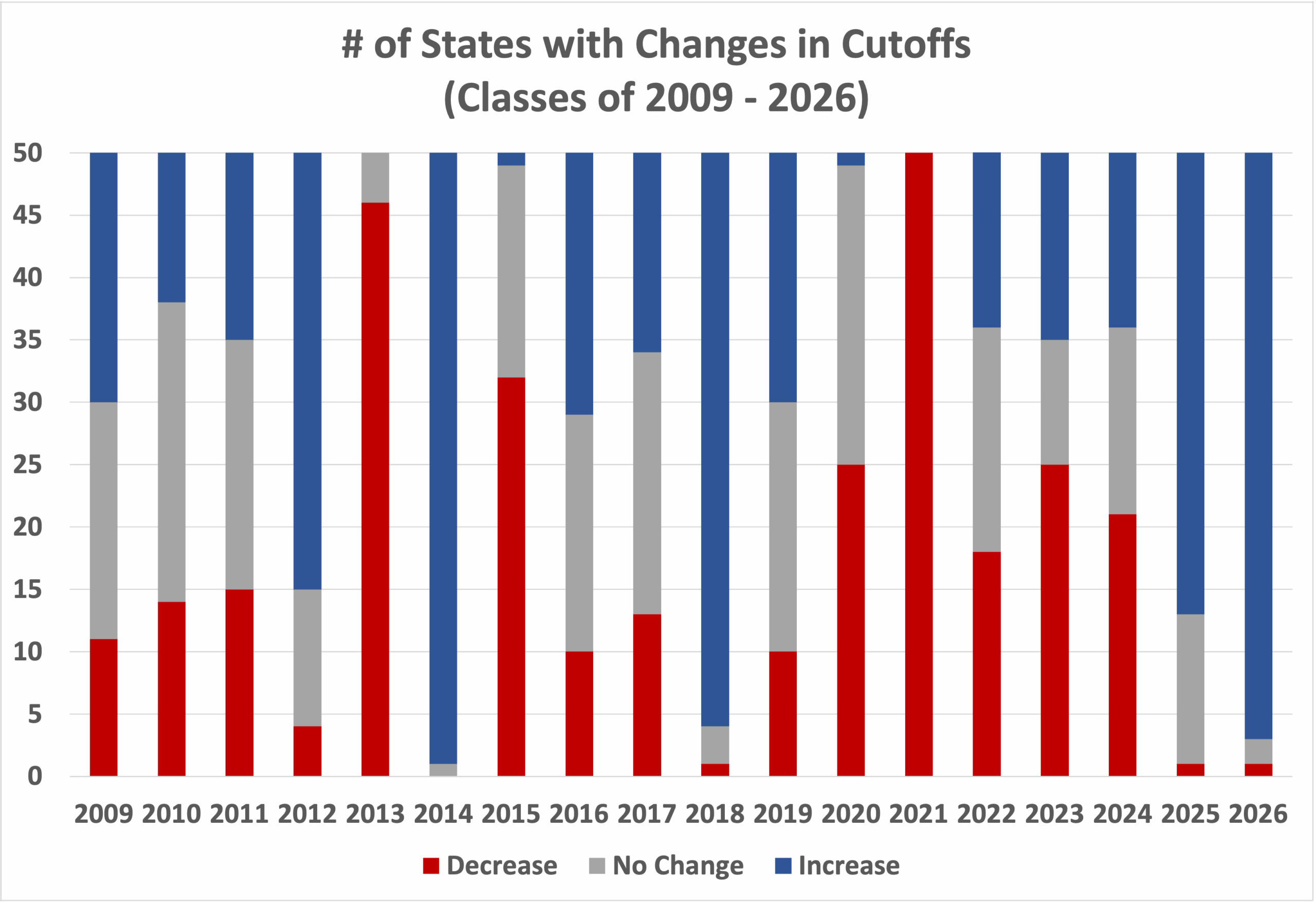
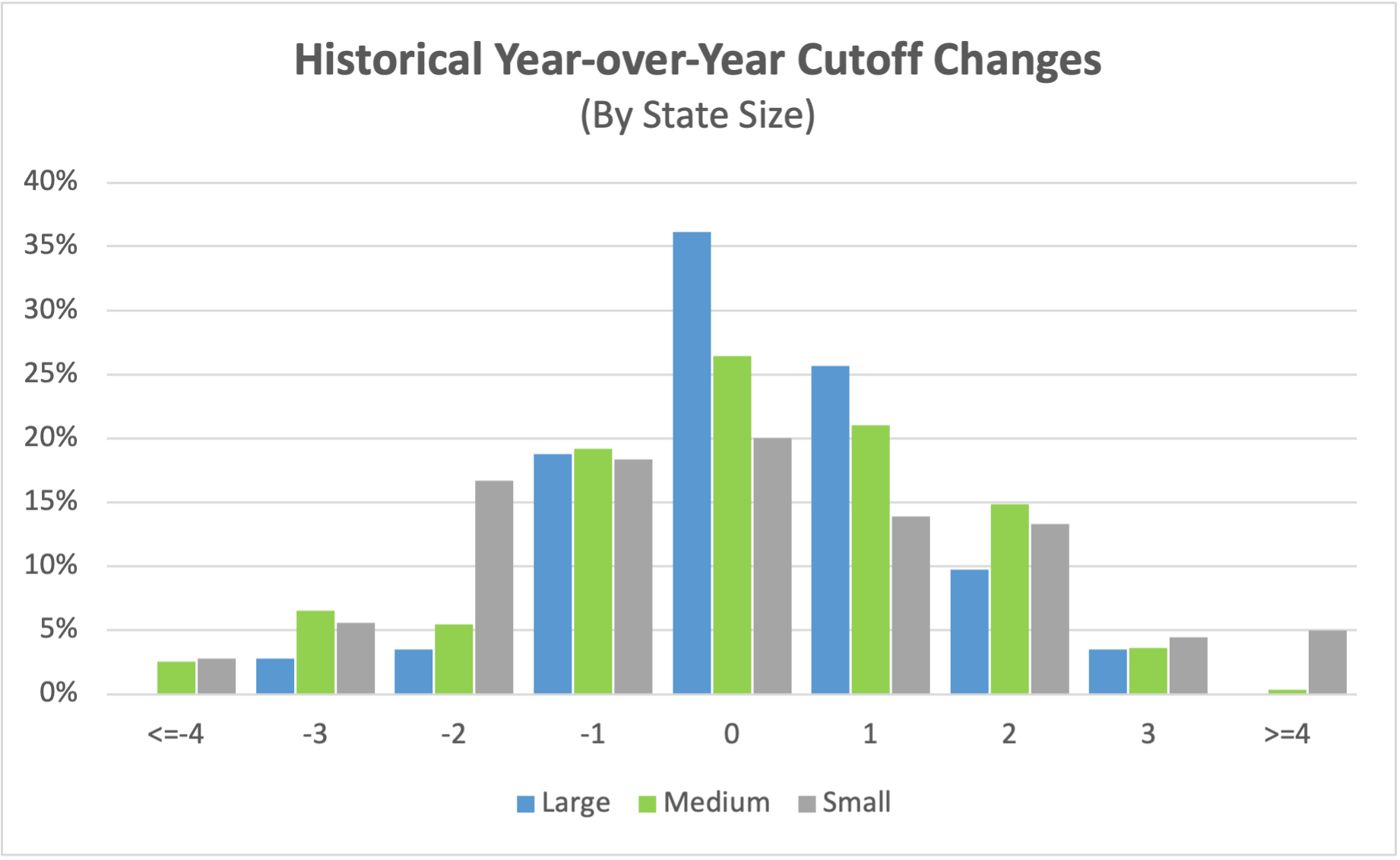
Cutoffs are particularly bumpy in states with smaller pools of test takers and National Merit Semifinalists. Over the last dozen years, cutoffs in the 12 largest states have remain unchanged 36% of the time, while the cutoffs in the smallest states have remain unchanged only 1 time out of every 5. No large state’s cutoff has jumped by more than 3 points in a year, whereas 6-point changes have occurred in the pool of smaller states.
When are National Merit Semifinalists announced?
The lists of Semifinalists will not be distributed to high schools until the end of August 2026. With the exception of homeschoolers, students do not receive direct notification. NMSC asks that schools not share the results publicly until the end of the press embargo in mid-September, but schools are allowed to notify students privately before that date. NMSC does not send Commended Student letters to high schools until mid-September. Compass will keep students updated on developments as the dates approach.
Do state and national percentiles indicate whether a student will be a National Merit Semifinalist?
No! Approximately 1% of test takers qualify as Semifinalists each year, so it is tempting to view a 99th percentile score as indicating a high enough score — especially now that College Board provides students with percentiles by state. There are any number of flaws that rule out using percentiles as a quick way of determining National Merit status.
- Percentiles are based on section scores or total score, not Selection Index
- Percentiles are rounded. There is a large difference, from a National Merit perspective, between the top 0.51% and the top 1.49%
- Percentiles reveal the percentage of students at or below a certain score, but the “at” part is important when NMSC is determining cutoffs.
- The number of Semifinalists is based on the number of high school graduates in a state, not the number of PSAT takers. Percentiles are based on PSAT takers. States have widely varying participation rates.
- Most definitive of all: Percentiles do not reflect the current year’s scores! They are based on the prior 3 years’ performance. They are set even before the test is given. And if you are going to use prior history, why not use the record of prior National Merit cutoffs rather than the highly suspect percentiles?
Entry requirements for National Merit versus qualifying for National Merit.
Your PSAT/NMSQT score report tells you whether you meet the eligibility requirements for the NMSP. In general, juniors taking the October PSAT are eligible. If you have an asterisk next to your Selection Index, it means that your answers to the entrance questions have made you ineligible. Your answers are conveniently noted on your score report. If you think there is an error, you will also find instructions on how to contact NMSC. Meeting the eligibility requirements simply means that your score will be considered. Approximately 1.4 million students enter the competition each year. Only about 55,000 students will be named as Commended Students, Semifinalists, Finalists, or Scholars. See National Merit Explained for more information.

Thanks Art! I appreciate your experience, wisdom, and time in responding.
We’re in Michigan and my student received a selection index score of 218. We’re feeling ‘on the bubble’. Could you tell us whether Michigan is considered a larger state (smaller swings) or a medium state (little more volatile) and what percentage you would apply to the likelihood of being a national merit semifinalist? Thank you!
Brad,
Michigan is relatively steady. We saw big jumps when the Michigan switch from state-funded ACTs to state-funded SATs, but that is well in the rearview at this point. The years where Michigan was at 219 were all ones where we saw high Commended cutoffs. A move to 219 is not impossible, but I consider it very unlikely — <10%. So that puts likelihood of a 218 at 90%+.
Art,
My son is sitting on a 800 Math / 700 EBRW on the SAT. I would like to enroll him in the June 1 SAT Intensive Course (so he could bump that verbal score up for the purpose of NMSC). That said, I would like that to cover only the EVRW portion of the course (at half the cost for the course). Would that be doable? (I have to enroll him by tomorrow, April 26).
Best regards,
Tsvetan
Sorry that I am just seeing this Tsevtan. Unfortunately, we do not currently offer a group class that concentrates exclusively on the ERW.
If he is a junior, then that SAT score will already be sufficient as a confirming score. If he is a sophomore looking to get ready for the fall PSAT/NMSQT, then I can appreciate why he wants to do some verbal work.
Hi, this is all new to us. My daughter got at 212 in South Dakota… I’m thinking from what I’ve read on your site that there is a high chance she will at least be a commended scholar? Thanks!
Rachael,
At minimum, your daughter will receive Commended honors. The Semifinalist cutoff for South Dakota is a wildcard. In the past it has come in as low as the Commended level and as high as 5 points above Commended. Your daughter will qualify as long as it doesn’t go higher than +4 (the Commended is 208 this year). I’d put her chances at Semifinalist at around 60-70%.
Hello, I got 218 in Illinois. Will this be enough to be a semi finalist this year?
John,
I think it’s a bit more likely that the cutoff will come in at 219 this year, but we did see 218 for the class of 2022. I’d estimate the odds of a drop at about 1 in 3. Good luck!
Hi Art,
What would be your take on the NJ cutoff – 222 vs. 223 – for the class of 2025? Yes, my kid is sitting on a 222 🙂
Tsvetan,
From what I am seeing at the national level, I think it’s a tough year for a 222 in NJ. We’ve seen a 222 twice in the last nine years. I’d put the odds a little lower this year. Maybe 15% chance of a 222, 75% chance of 223, and a 10% chance of a 224?
Hi Art,
Thank you for taking the time to answer all our queries, very grateful for that. My daughter has a 222 in CA. I want to tell her that she will make it to NMSF . Before that I need to confirm with you :-)! What do you think?
Paul,
I don’t think that you should flatly tell her that she will make it. I think her chances are very good (90-95%?), but I wouldn’t want to be in your shoes if you got it wrong. I’m just a guy on the internet, so I can take chances!
Hello, I got 206 in Missouri. Will this be enough for commended? Thank you!
Dulina,
Students did very well on this year’s edition of the PSAT, so I think the Commended cutoff will be at least 209.
Hi Art, I appreciate all of the wonderful information you provide on this website, it is very helpful as I try to help my son navigate this process. He got a 216, and we see the most likely cutoff is estimated to be 217 here in Oregon. But with the wide range from 215 to 220, I’m wondering what you would estimate the chances are he’ll make the cutoff. He’s convinced he missed the boat and I’d like to get an idea from you if he has a better chance than he thinks. Thank you for your help and expertise.
Eric,
Sorry for the delayed response. While I do include 215 in the range of possibilities, I think a drop is less likely than an increase. Oregon has not seen a 215 cutoff in at least 15 years. What makes me think it is not impossible is the fact that Oregon has been at 216 the last two years. The 216 was an uncharacteristic drop for a state that had seen an overall upward trend over the last decade. We don’t know the exact impact of the digital PSAT, so I would grade the possibility of a 215 at about 10-15%.
How likely it is for New jersey cutoff to go above 223 ?
Paddy,
It’s unlikely, but I don’t think we can rule it out completely. New Jersey has never topped 223, and the only reason Maryland hit 224 for the class of 2022 was the quirks with COVID-related cancelations and Alternate Entry. Maybe a 10% chance that something unexpected happens with top end scores due to the digital PSAT.
How likely it is for Louisiana cutoff to go above 216?
From your article it appeared 214 was anticipated but range went to 217.
Thanks
Craig
Craig,
Louisiana’s cutoff remained at 214 this year. Congratulations!
When will the article be updated with the semifinalist cutoffs?
Alan,
As soon as I receive them. 😉 NMSFs have been sent to schools. I’m hoping to start hearing from recipients, but many times we don’t start getting information until after Labor Day.
Anything leaking out for Texas (it’s 8/30 today)
No reports, yet. With such an early Labor Day, the news cycle feels like it is going to be very compressed.
Hey art, I am rachel from Florida and I got a 214, but the range you put is 215-219. After speakign to the colleague from Florida, is there a chance that 214 might work?
Thank you
Rachel
Rachel,
I’d peg the odds at 5-10%. We don’t generally see large states move 2 points in a stable year, but it has happened.
Thank you so much for the article. Do you see any possibility for the Cutoff for the state of Kansas to jump above 218?
Jack,
Kansas has seen a 219 cutoff before, but only during a year when the Commended level was quite high. I don’t foresee it going above 218 this year.
My son’s school just called some students for preparing pictures (commended to be published on the end of September local newspaper). One student has 207.
FX,
That’s interesting. I had multiple sources confirm 208 as the Commended cutoff in the spring. So either, something changed, your knowledge of the students’ scores is incomplete, or your school made a mistake.
I don’t have a question. I’m just angry that I can score a 221 selection index but because I live in Massachusetts it may as well be worthless. Why isn’t this stuff nationally standardized???? Are these not literally standardized tests???? Truly, life is not a meritocracy. It’s just so stupid.
John,
As you can imagine, this is a controversial topic. NMSC prefers to see proportional representation across the nation in order to keep the program healthy (and an unhealthy program would mean that National Merit might not be around for anyone). It does create painful situations where what side of a border you live on or whether or not your school has 30% boarders or 60% boarders can be the difference between NMSF and Commended status. Congratulations on a great score! Ultimately, your SAT score will have far more impact on your college admission chances, and you likely did quite well.
Hi Art,
Is there an estimate of when cut-off scores should be known? Also, I’m just curious how likely you think a 216 is to qualify in Kansas. My high school had ~8 people who scored in this 216+ range while we only had ~4 semifinalists last year with a class size of around 450, so I’m not sure if this is just a lucky year for us or if that suggests the cutoff is likely to increase further than estimated.
Thanks in advance,
John
John,
I hope to see initial reports in the coming days. The week after Labor Day is usually quite busy. September 11th is when NMSC removes its press embargo, meaning that papers and websites can publish lists of NMSFs. Many schools wait until that date (or even a little later) to notify students. If a 3-point jump happens, it will likely be in a smaller state such as Kansas, but I really wouldn’t read to much into the results from your school. Sounds like you’ve got a great class. I’d still put a 216 in the 80-90% range.
Hello! Have you heard anything about PA yet?
Nothing yet, PAmom.
Hello Art,
Wouldn’t a commended score of 208 indicate that the digital testing won’t significantly change the selection indices of each state? For example, if it had jumped 6 points that means EVERYONE did better on the digital test and that the selection index would jump too? Also, just curious, did you notice a trend where scores trended lower from COVID? Has it rebounded?
Scott,
You are correct that we are not going to see anything that crazy. But while a 208 is a great Selection Index, it doesn’t really push the edges of the scale (scores are in the 680-700 range). I still have some concern (simply because no data are available) about how well College Board nailed it in the 730-760 range that comes into play with some of the higher cutoffs.
It’s almost impossible to disentangle different contributors — for example, CB’s uneven test construction, student performance, and opt-in rates (who takes the test and where?). The test went through a major scaling change with the class of 2017. In the initial years, we saw a Commended cutoff at 209 – 212. While the class of 2021 still had a Commended cutoff of 209, the test scale and the results were suspect, and we saw a new low for the average NMSF cutoff and a low for the percentage of students reaching a 1400 on the PSAT. The class of 2022 needs to be thrown out, as cancellations were rampant, and many of the cutoffs were determined by SAT scores (Alternate Entry). Since then, testing rates have recovered only partially (we are still down about 200,000 juniors from pre-COVID). Which students are no longer around? California has seen a drop-off because of the UCs and CSUs moving test free. The classes of 2023 and 2024 set consecutive lows in the average NMSF cutoff (which is not an indicator that I love). Is that COVID-related learning loss or something else? We saw a higher percentage of students scoring above 1400 this year, so maybe things are getting back to “normal.” The PSAT/NMSQT is just not designed to be an effective longitudinal measure of student performance.
art chances of 214 in florida my name is samantha. thank you
Samantha,
While 214 falls outside of my projected range, it could happen. This close to score release date, I prefer to stay optimistic, since we’ll soon have an answer!
yeah so what would you put the chances for 214 in flrodia. I heard that you spoke to a colleague and they said that cutoff might drop? is that true? please let me know your thoughts on florida going as low as 214…
Samantha,
Yes, they were of the opinion that the cutoff might drop to 215. Generally, 2-point drops in large states are uncommon. I’d rate a 214 at 5-10% likelihood. I hope to be wrong.
Thank you art.
Why did the colleague believe it will go to 215? Is 214 impossible? If not, then why is it not included in your projected range?
The scores they’ve seen — which is a modest sample — lead them to estimate that Florida may notch down to a 215. I don’t think it is unlikely but not impossible that a 214 will qualify.
Any updates on the cutoffs?
Nanine,
No, things have been quiet. Schools should be receiving materials this week, but students are often not notified until after Labor Day. Some schools wait until the press release date of September 11th.
With the commended cutoff of 208, what are the chances GA goes up only one to 218?
Marie,
I’d say that there is an 85% chance of Georgia coming in at 218 or lower.
Hi. Any idea what Virginia’s cutoff is this year, or when you will know? Thank you.
Jay,
No news on any states yet. Sometimes things don’t pick up until after Labor Day. The official press release date is September 11, but hopefully we’ll get word before then.
How likely is it for Maryland to go to 223 or 224?
Aksh,
Highly unlikely. We have never seen an authentic 224 cutoff in any state. The Maryland 224 for the Class of 2022 was driven by COVID cancellations and Alternate Entry. Is a 224 possible? Yes, but it would require an anomaly in scaling, and we haven’t seen any evidence for that this year.
How likely is it for South Carolina’s cutoff to be 211 v/s your projected 213?
Parth,
What’s so tricky about South Carolina is having no good explanation for last year’s 209. Before last year, SC’s cutoff had never gone as low as 211. My Most Likely is a guess on a bounce back year, but there is a possibility that there was a more fundamental shift such as a set of important schools (or a district) opting out of the PSAT. In most years, there would be 450 – 475 combined Commended and Semifinalist students in SC. Last year, there were only about 315. This is all a long way of saying that I have very little confidence in any SC prediction. Let’s hope it stays low!
Hi Art, you don’t have to respond to this, I just wanted to say how much I appreciate your hosting this forum. My son has a 216 in Oregon so we’re holding our breath. Checking your comments section is going to be my main source of entertainment for the next week and a half! You’re the man!!! 😃
Thank you, Eric. Best of luck to your son!