

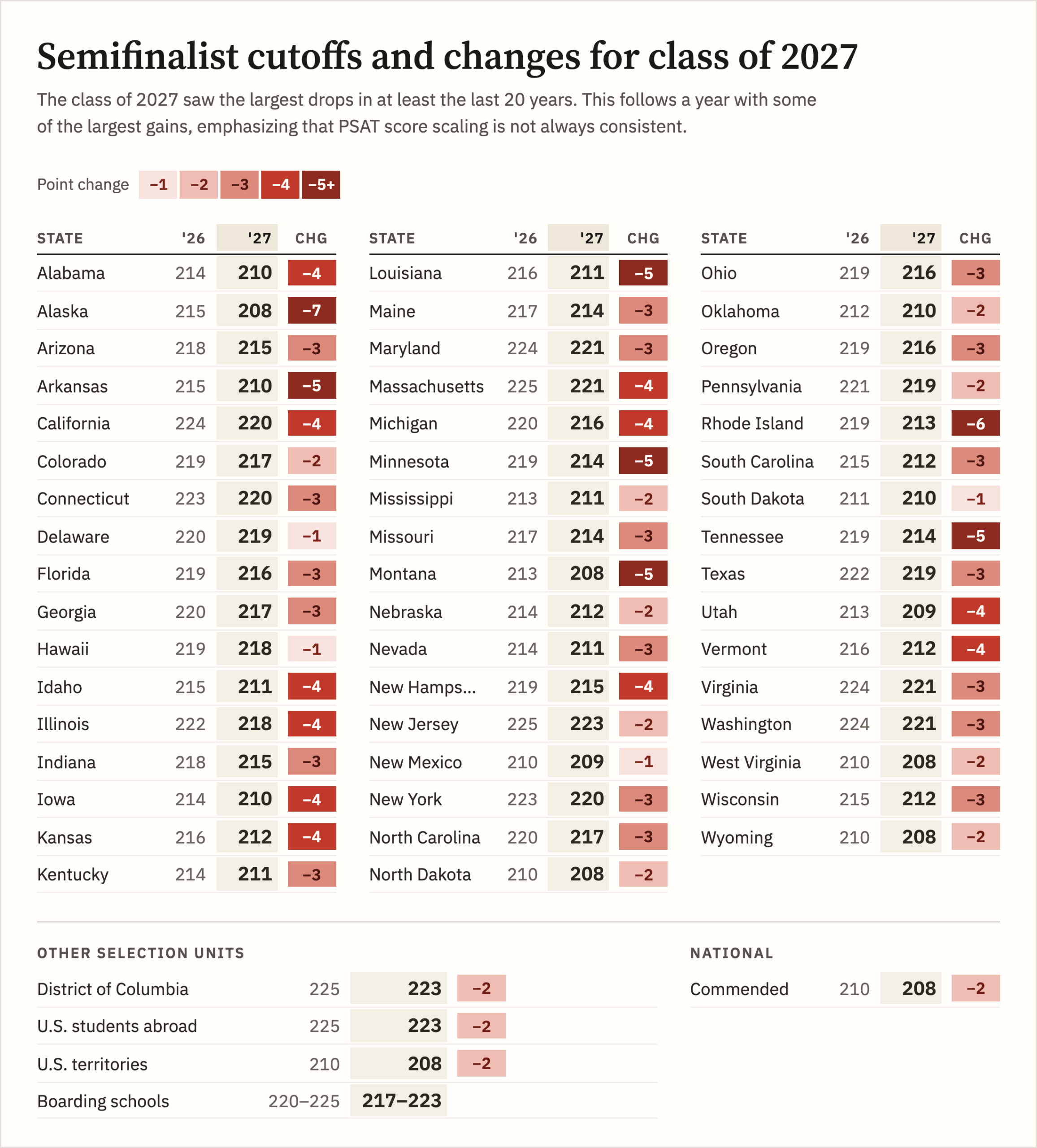
After months of speculation and projections, the official National Merit Semifinalist cutoffs for the class of 2027 were released September 9th. On average, these are the lowest cutoffs in National Merit history, with all 50 state cutoffs sitting lower than they did last year. Most cutoffs went down at least 3 points from the class of 2026’s figures. Alaska set the pace with a 7-point decline. New Jersey again finished with the highest mark, dropping from 225 to 223. Compass will explore:
- How the class of 2027 results stack up historically and how cutoffs are set
- The lower number of Semifinalists nationally
- Why cutoffs declined so precipitously. Hint: It’s not the students.
- The implications of score instability for students, schools, and states
- What the class of 2028 might expect after they take the PSAT/NMSQT in October 2026 and on what timeline
The junior-year PSAT is also the National Merit Scholarship Qualifying Test (NMSQT). Each year, National Merit recognizes the top 55,000 test takers. To be included in that group, students must be among the top 4% of the 1.3 million eligible students who take the PSAT. Of that elite group, approximately 16,500 are recognized as Semifinalists for having the highest scores within their states. Semifinalists have the opportunity to continue in the program to become Finalists and, potentially, scholarship recipients. Some colleges provide significant scholarships and even “full-rides” for Finalists. The remaining 39,000 students are recognized as Commended Students. More information can be found in our National Merit Explained post.
National Merit uses the Selection Index (SI), found on the PSAT score report, to rank students. The Selection Index is calculated by doubling the Reading & Writing score (RW), adding the Math score (M), and dividing that sum by 10. For example, a student with a 720 RW and 700 M score has a Selection Index of 214: (720 x 2 + 700) ÷ 10. A student with a 700 RW and 720 M has a Selection Index of 212. The highest SI a student can receive is 228 (760 RW and 760 M). The weighting of the index means that not all students with the same Total Score have the same SI. “Will a 1450 qualify?” is not the right question. Instead, look at whether a 750 RW and 700 M will qualify.
Summarizing the changes seen for the class of 2027
In October 2015 the PSAT moved to a 320-1520 scale, which was set to provide vertical alignment with the SAT’s 400-1600 scale. The class of 2017 was the first group of students taking the redesigned PSAT/NMSQT, so the fairest comparisons are in the last eleven class years.
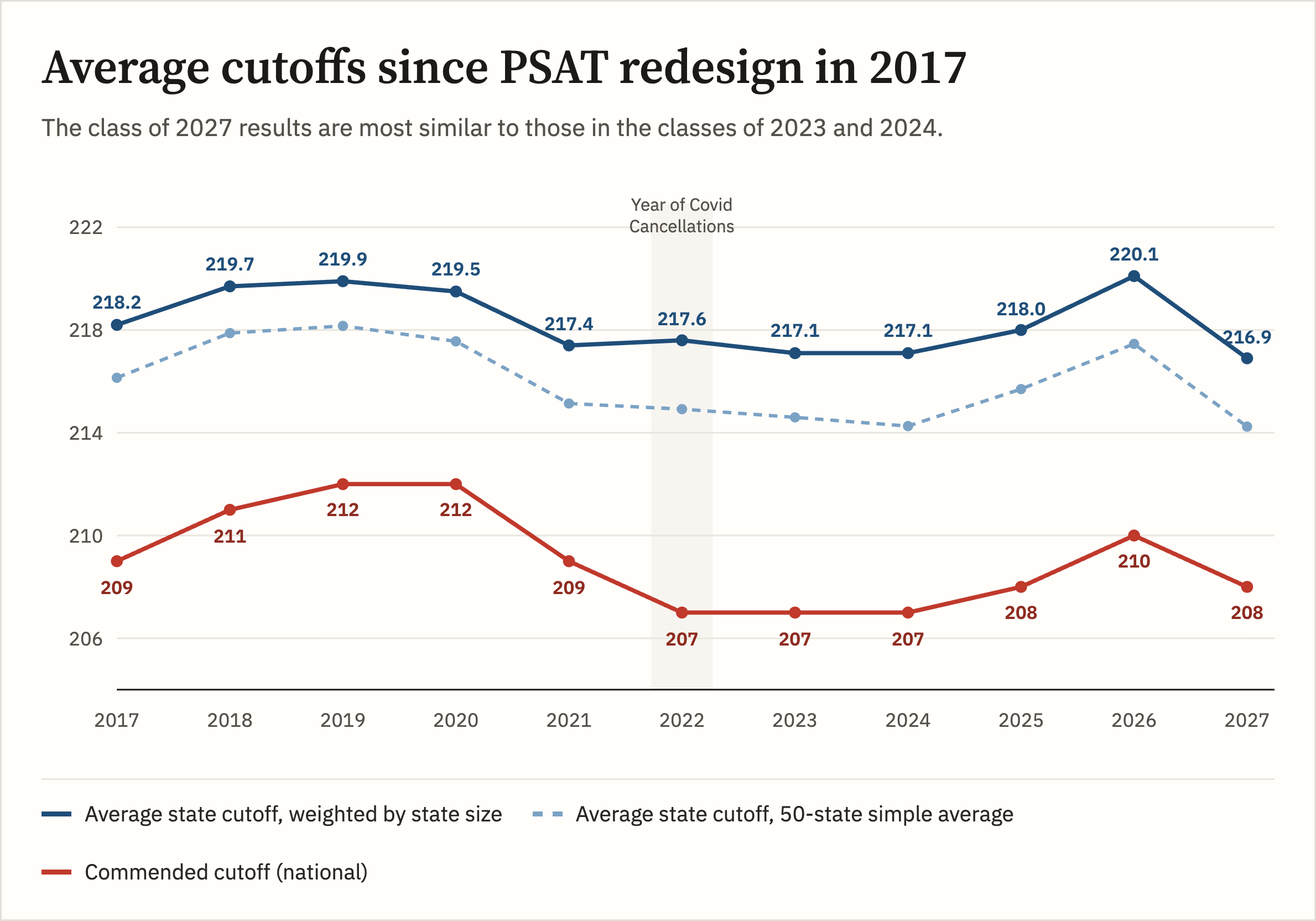
This year saw the average Semifinalist cutoff hit a record low. It provided something of a mirror image to the class of 2026. Last year, 11 states set new record highs in the modern PSAT era, and 10 more tied their records. This year, 5 states established new lows, and 18 tied their record lows. Kansas and Minnesota both dropped 2 points below their previous lows, an unusual event for mid-sized states. Even more unusual was what happened in the largest dozen states. None of those has ever seen a drop of more than 3 points, but this year saw California, Illinois, and Michigan fall 4 points.
Results this year were closer to those in the class of 2024 than they were to the previous two years’ results. Recency is not always a predictor of future results. The Commended level, which is set nationally, declined 2 points this year to 208. The Semifinalist cutoffs, in contrast, fell 3 points.
Entry requirements for National Merit versus qualifying for National Merit.
Your PSAT/NMSQT score report tells you whether you meet the eligibility requirements for the NMSP. In general, juniors taking the October PSAT are eligible. If you have an asterisk next to your Selection Index, it means that your answers to the entrance questions have made you ineligible. Your answers are conveniently noted on your score report. If you think there is an error, you will also find instructions on how to contact NMSC. Meeting the eligibility requirements simply means that your score will be considered. Approximately 1.3 million students enter the competition each year. Only about 55,000 students will be named as Commended Students, Semifinalists, Finalists, or Scholars. See National Merit Explained for more information.
Why did the total number of Semifinalists decline?
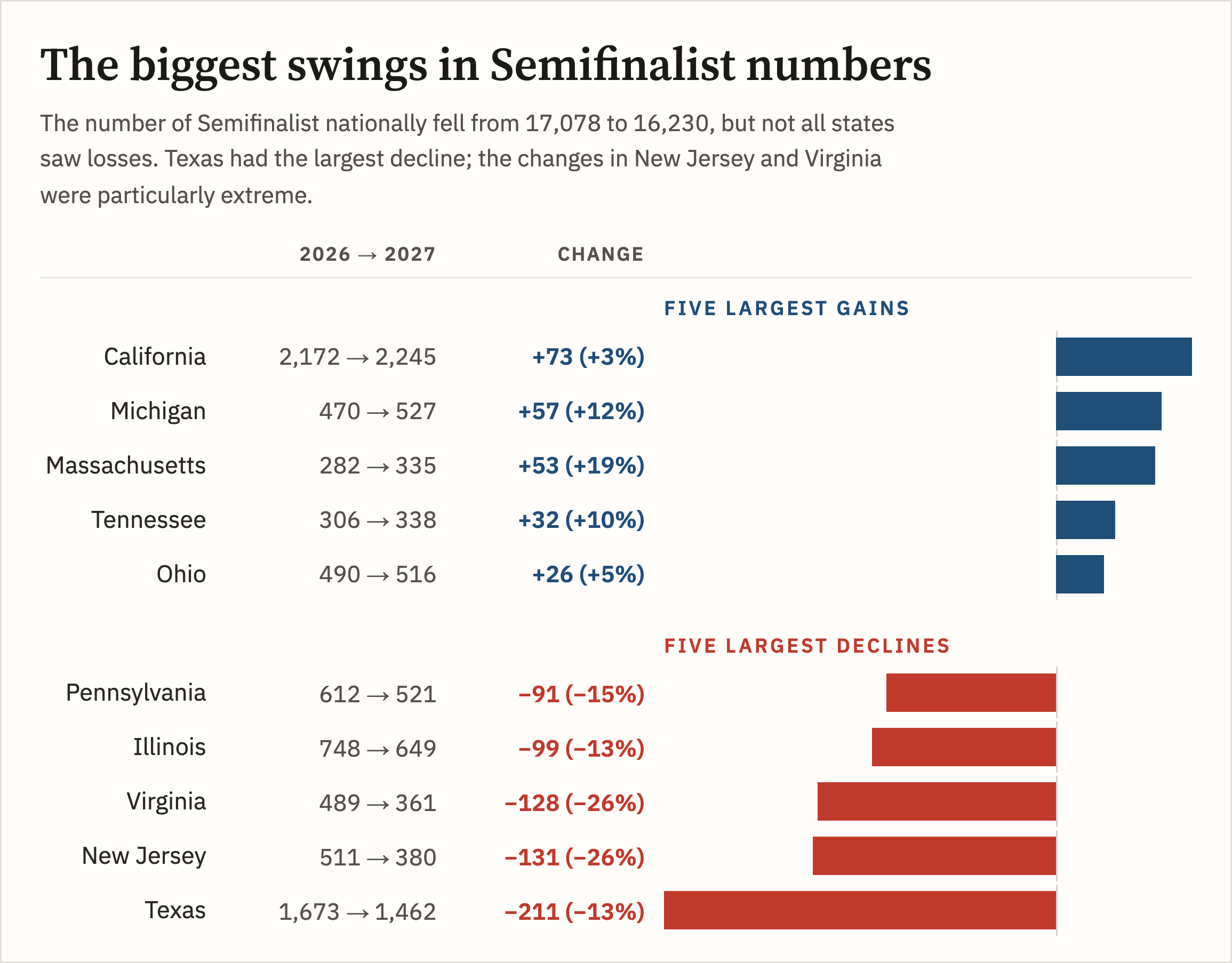
After recognizing more than 17,000 Semifinalists in the prior two years, the class of 2027 saw only 16,230, a decline of 5%. The decline in Semifinalists is a separate issue from lower cutoffs. Setting cutoffs can be a blunt tool. In a large state, there may be more than 200-300 students at a single score. Small states might have multiple scores with zero students. NMSC can’t always hit its targets on the nose. Below are the largest swings in both directions.
How Semifinalists are allocated among states
It’s possible that NMSC recalibrated the total target number of Semifinalists this year. It helps to understand how National Merit sets cutoffs. NMSC allocates a target number of Semifinalists to states based on their population of high school students, not all of whom take the PSAT. If Texas is allocated 1,500 Semifinalists based on its population of high school graduates, then NMSC works down from a perfect 228 Selection Index until it gets as close as possible to that target. In the class of 2027, 1,462 students scored at or above the cutoff of 219. A cutoff of 220 would have produced too few Semifinalists. A cutoff of 218 would have gone over the allocation. As scores go lower, more and more students occupy each level, and where the crowd forms does not stay consistent from year to year. It is easy for cutoffs to move up or down a point even when there is minimal change in testing behavior or performance. All students at or above a cutoff qualify.
The changes in the above chart fit within the historical pattern, so students should expect similar swings to happen in the future. New Jersey had about the same number of Semifinalists in 2023 as it saw this year, and actually fell from a greater height compared to 2022. Similarly, Texas saw fewer than 1,462 Semifinalists in classes of 2020, 2021, and 2022. And there is little chance that NMSC calculated that Texas’ high school population was falling faster than, say, California’s. We won’t know until next September whether the 16,230 Semifinalists was a fluke or a new standard.
The Mystery of the Declining PSAT Scores
When you have eliminated the impossible, whatever remains, however improbable, must be the truth. National Merit cutoffs may not have the makings of a Sherlock Holmes novel. The guilty party is too easy to identify and the deduction not all that improbable. To borrow from another mystery trope: it’s College Board in the testing room with a faulty scale.
When test scores change from year-to-year, College Board issues press releases discussing testing patterns and student achievement. What they never include is “That one’s on us.” When it comes to National Merit scores, however, it often is.
A history of change
Over the last seventeen years, there have been six classes that saw cutoffs change in more than forty states. The heat strip below shows how cutoffs shift from year to year.
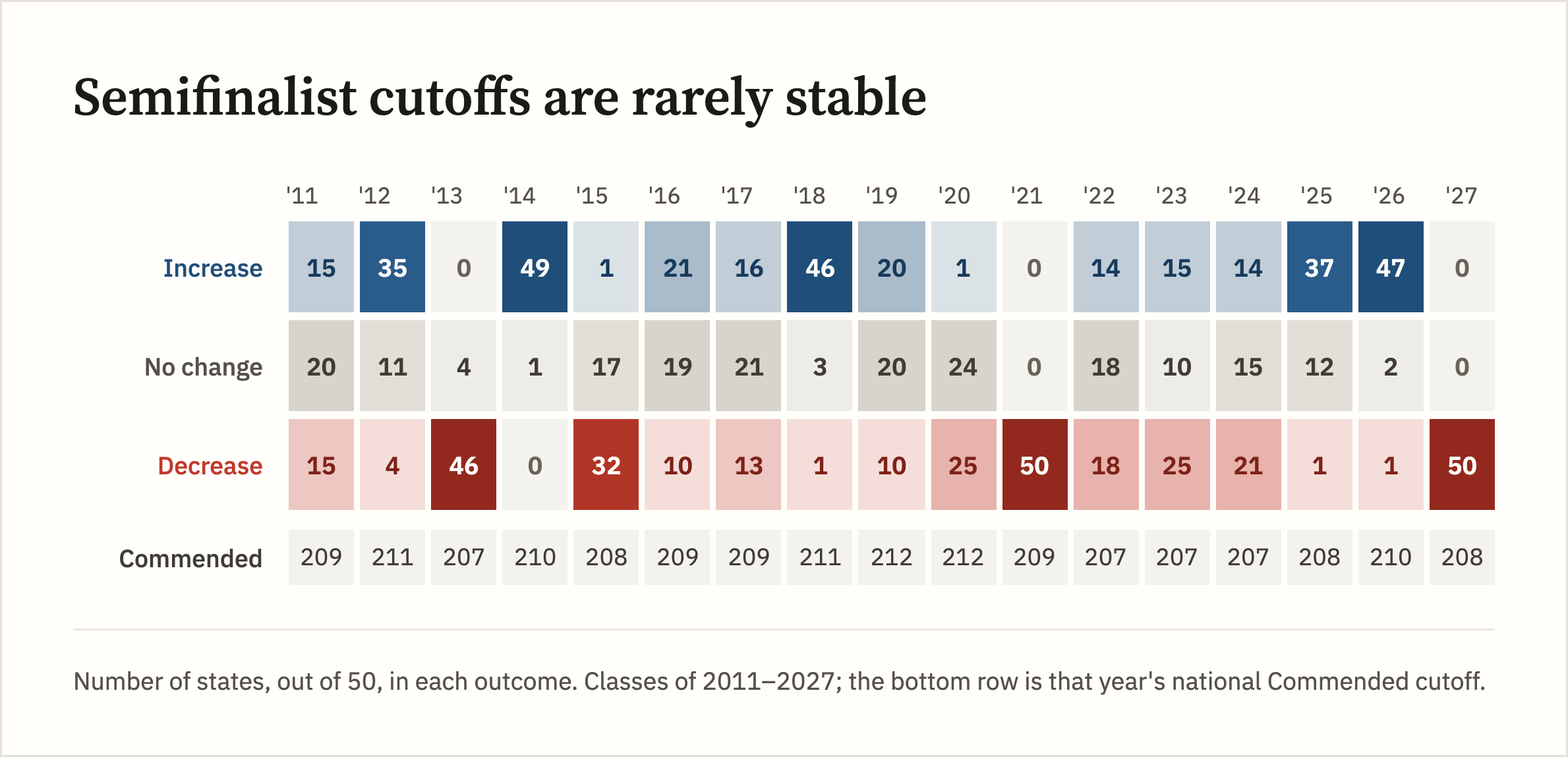
Even if we eliminate “bounce back” years where scores come back into line after an unusual shift, a major disruption occurs approximately every 4 years. Interestingly, none of those scoring disruptions can be attached to the biggest behavioral disruption of all — the Covid cancellations that drove PSAT/NMSQT volumes below one million for the first time in decades. In addition to last year’s exam, the PSATs from 2011 (class of 2013), 2016 (class of 2018), and 2019 (class of 2021) stand out as problematic. The anomalous 2019 results could be traced back to a particularly mis-scaled form, which I wrote about at the time. The class of 2014 also saw significant changes, but those were more of a bounce-back from the previous year, similar to what we are seeing with the class of 2027.
When Semifinalist cutoffs reached vertiginous levels last year, several theories made the rounds:
- (A) Covid-related learning losses were vanquished
- (B) The integrated Desmos calculator on the digital PSAT had “broken” the Math section
- (C) Test preparation — and maybe AI-enabled test preparation — had made the test too easy
- (D) The test taking population shifted
Compass disputed each of these theories, but it wasn’t until this year’s free-fall that we could put each of them fully to rest. A key piece of evidence is which scores rose and fell.
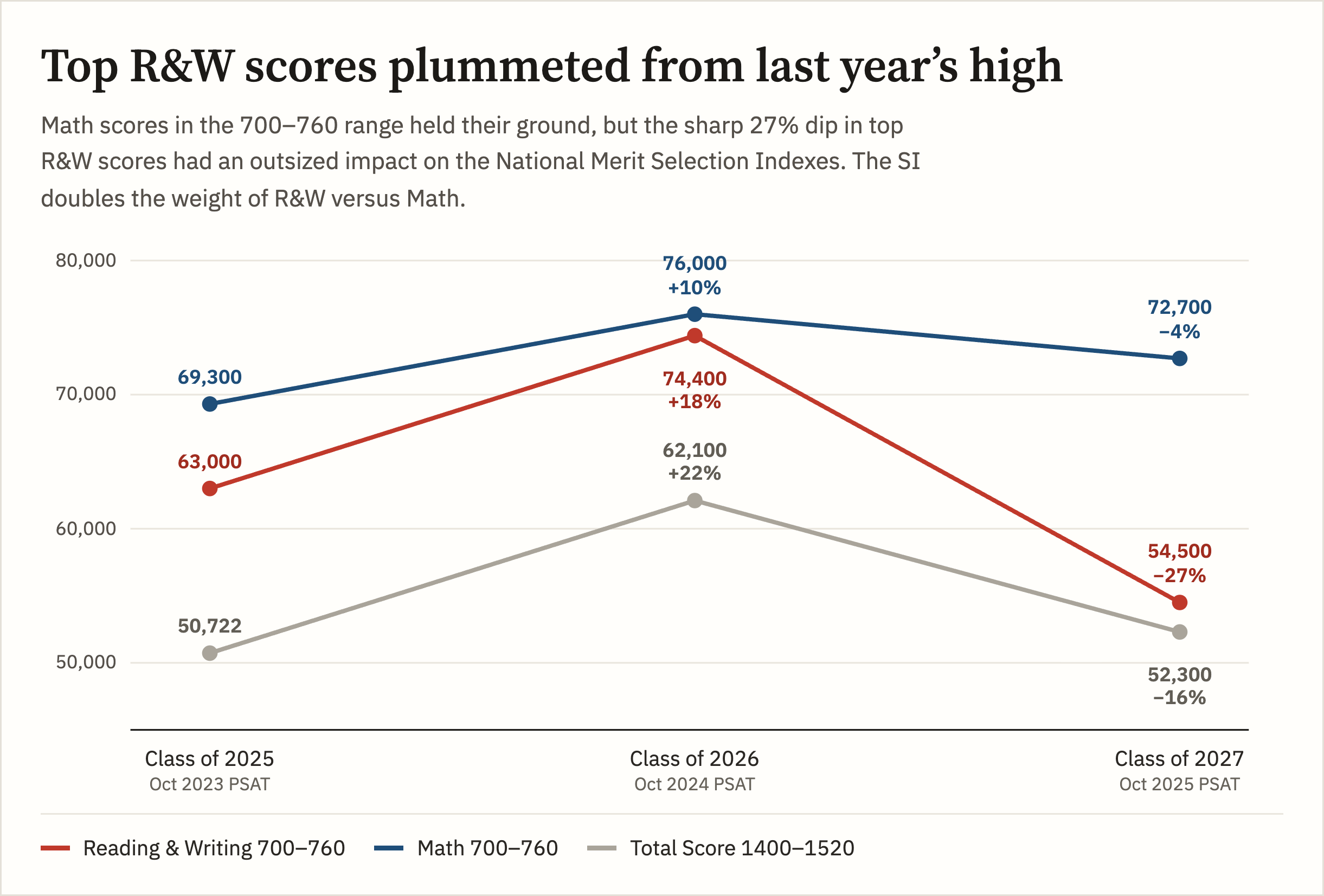
Over the most recent three PSATs, the highest reported Math scores (College Board groups all 700-760 scores together) did go up on the October 2024 PSAT, but they settled back down on the October 2025 PSAT. If improving Math skills were the key driver, why did they not keep progressing upward? The fall PSAT also provides an inherent double-check, because sophomores and juniors both take the exam in similar numbers. Sophomores and juniors consistently tracked each other across the different exams. The class of 2025 and 2026 overlapped, then 2026 and 2027, and then 2027 and 2028. Every PSAT the movement has been similar. Yet sophomores do not do test preparation in sufficient force to shape score results. The sets of classes were in different points of math development during remote learning, and yet they showed the same rises and falls. Learning loss and test preparation do not provide coherent answers.
Reading & Writing scores were the true driver of the class of 2026 records and the 2027 declines
High RW scores are typically less common than high Math scores. But on the October 2024 PSAT, almost as many students scored 700-760 on RW as on Math. Top scores went up by 18%. The double-weight that RW scores provide in the Selection Index pushed cutoffs to new highs. The 210 Commended ranked only fourth when compared to the previous decade. Earlier class years saw cutoffs of 211 and 212 (twice). So why did last year’s cutoffs rise to levels that had seemed impossible? The highest cutoffs had never exceeded 223 (Maryland’s 224 in the class of 2022 was due to every PSAT in the state being cancelled and students qualifying via SAT scores). How did New Jersey and Massachusetts reach 225 and California, Maryland, Virginia, and Washington end up at 224? The best explanation is that the very top RW scores — 740-760 — increased at an even higher rate than 700-730s. A 225 cutoff is not possible without at least a 750 RW. A 224 requires at least a 740 RW. Students were acing the test in record numbers.
The plummet for the class of 2027
On the 2025 PSAT, the number of high RW scores dropped by 27%. In fact, the RW count for the class of 2027 is even lower than it was two years ago. The surfeit of 700+ scores dried up. Obtaining a 740-760 grew harder. As with Math scores, sophomore performance changes matched that of juniors.
Process of elimination
The rapid gains and collapse eliminate (A), (B), and (C). As sophomores, the class of 2027 was phenomenal at reading according to the PSAT. Post-Covid learning changes cannot explain why they suddenly struggled as juniors. Option (B) doesn’t fit, because Math scores were not the source of the changes. Why would test preparation have stopped working (C), and how can it explain that sophomores and juniors were similarly impacted across the years? This leaves (D) as a remote contender. Except that it fails to explain the 50-state reach of the changes and the magnitude of the changes even in the largest states.
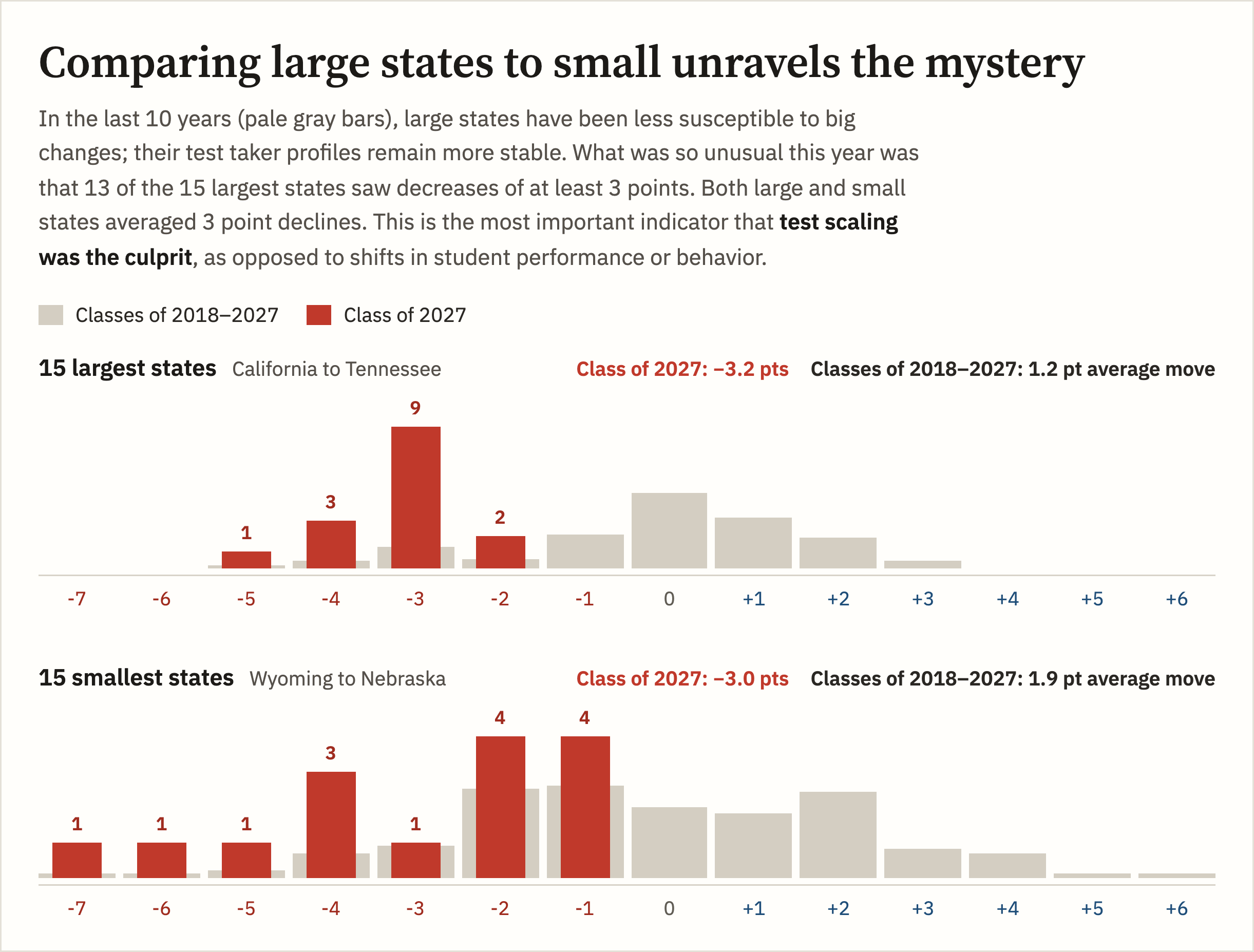
Thirteen of the largest fifteen states dropped by 3 points or more. Pennsylvania and New Jersey saw 2-point declines. If the smaller states were pulling down the class of 2027’s average cutoffs, we might at least attribute some of the disruption to the instability of cutoffs when there are fewer than 100 Semifinalists. That’s not what happened. And if only a few large states saw inflows or outflows of top test takers, the impact would have been muted. Nor did overall test taker numbers change much. When the entire set of large states has this magnitude of a change, the test scale itself has to be at the heart of it.
What does a 3-point change represent and why is it so bad?
For simplicity, the change can be characterized as a 15-point miss in RW on the 160-760 scale (200-800 on the SAT).
- The typical annual growth in RW scores is about 40-50 points, so the scale change represents approximately one-third of an academic year.
- Systematic scaling error is additive to individual student fluctuations in scores — typically around +/-30 points on each side of the PSAT and SAT. Scaling error makes it harder for students to determine where they will score and how their score stacks up.
- Scaling error produces incorrect percentile ranks, because percentiles are based on the 3 prior years of results. Sudden inflation or deflation gives an inaccurate read.
- The PSAT is used for purposes beyond National Merit such as AP placement or state-mandated testing. Results may not align with prior years or academic growth expectations.
- When error happens primarily on one side of the PSAT, some students are unfairly disadvantaged.
- In a competition such as National Merit where relative standing matters, a uniform increase or decrease might be tolerable. A rising tide lifts all students (sort of). Except that there is no way of knowing whether the error applied equally to all students. The digital PSAT is not a single form or even a limited set of forms. Exams across the PSAT testing window can vary, and even on the same test dates, students often see differing questions. It’s one of the security advantages provided by digital testing, but it can also be a curse. College Board provides no reporting on the items or scaling, so students (and Compass) have no way of assessing the impact on individuals. Schools have no way of knowing if their students were hit harder than at other schools.
- This keeps happening. Is College Board having difficulty keeping the digital PSAT scale consistent or will things stay more consistent over time? The historical record says that they will not.
Do these sorts of systematic scaling errors occur on the SAT?
They do. They are harder to spot, but likely even more common. Noted above is that the largest disruptions on the PSAT/NMSQT occur, on average, every 4 years. The SAT is given on (a) 8 national dates every year, (b) during a 2-month SAT School Day window in the spring, and (c) during a 1-month window in the fall. This accelerates the chance for errors. It creates a near certainty that some students will encounter systematic error in their favor and others will see it working against them.
The PSAT and the National Merit Scholarship Program provide a unique laboratory. The PSAT/NMSQT represents one slice in time. The population of PSAT takers is relatively stable from year to year, and the sophomore and junior PSATs provide a sort of longitudinal double-check. The 50 state cutoffs and their varying levels give information about the extent of scaling errors. Comparing ever-shifting SAT dates is difficult, especially because College Board restricts access to the data. It is unfortunate that the primary protection students have is taking the SAT multiple times. In combination with superscoring, it represents the best way for students to lock-in positive error.
How do errors happen? Shouldn’t scores stay consistent?
When new tests are designed, not every problem can be tested on previous populations of students. Instead, a sampling of problems is tested with a sampling of students, perhaps 4-5,000. In theory, that’s a significant enough size that random error will make little difference. The sample group should be comparable to the entire population. Random error is an acceptable part of test creation, because it largely cancels out at scale.
But what if the error is not random? What if the test design is flawed? For example, if the methodology continually overestimates the ability of the sample groups, future questions will be predicted to be harder than they really are. And then over-prediction may happen with the next group. This systematic bias can creep into a test production and equating process. Normally it is spotted. As we see from the October 2024 PSAT and similar examples, sometimes it is not. The National Merit program provides a challenge to test creators, because everything important happens in a narrow part of the scale. On the digital PSAT, only 50 questions count toward a student’s score. Differentiating between a 720 student, for example, and a 730 student, and a 740 student rests on small differences in performance. If College Board has the statistics even slightly off, scores will not align well across tests. We saw the occasional wild ride on the paper PSAT, but the rides may get wilder and more frequent on the digital PSAT.
Predictions and timeline for the class of 2028 and beyond
Compass has always warned students not to be too fixated on a single cutoff target. The crazy events of the last two years have made it obvious that cutoffs can move in large and unexpected ways. It’s better to think in terms of score ranges rather than a pass/fail score. Prior to the PSAT, we can only estimate based on historical figures, without knowing what kind of surprises College Board has in store. After the PSAT, Compass analyzes the national results in the broad buckets that College Board provides. This usually gives a clear idea of which way the overall trend is moving. We should see how RW and Math scores behave, what the 1400-1520 bucket looks like, and develop a tight estimate of the Commended cutoff. For example, here is the estimate from last year.
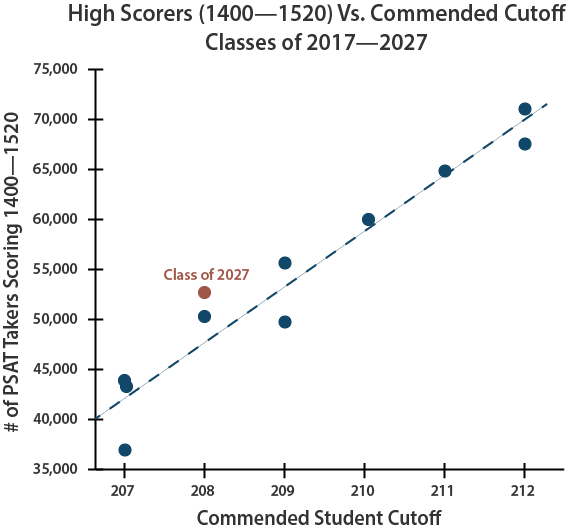
Unfortunately, it does not provide insight into individual states. In April, the Commended level usually leaks, and we get confirmation of the national trend predictions. It’s not until Semifinalist notifications start being handed out in late August that state-by-state information starts coming into focus.
Below is a pre-PSAT summary. Find the range of potential cutoffs in your state, and how it has stacked up in recent class years. Below the table is more information about the National Merit program. You may also want to consult our post on National Merit Explained, which goes more into the steps of the process, what different honors mean, and what sort of scholarships are available.
State | Class of 2028 (Est Range) | Class of 2027 (Actual) | Class of 2026 (Actual) | Class of 2025 (Actual) | Class of 2024 (Actual) | Avg SF Count |
|---|---|---|---|---|---|---|
| Alabama | 209-216 | 210 | 214 | 212 | 210 | 239 |
| Alaska | 207-217 | 208 | 215 | 214 | 209 | 36 |
| Arizona | 214-220 | 215 | 218 | 217 | 216 | 359 |
| Arkansas | 209-215 | 210 | 215 | 213 | 210 | 145 |
| California | 219-224 | 220 | 224 | 221 | 221 | 2,125 |
| Colorado | 216-221 | 217 | 219 | 218 | 216 | 280 |
| Connecticut | 219-223 | 220 | 223 | 221 | 221 | 182 |
| Delaware | 218-222 | 219 | 220 | 219 | 219 | 43 |
| Florida | 215-219 | 216 | 219 | 217 | 216 | 959 |
| Georgia | 216-220 | 217 | 220 | 218 | 217 | 554 |
| Hawaii | 215-220 | 218 | 219 | 217 | 217 | 62 |
| Idaho | 210-216 | 211 | 215 | 213 | 211 | 90 |
| Illinois | 217-222 | 218 | 222 | 220 | 219 | 693 |
| Indiana | 214-219 | 215 | 218 | 217 | 216 | 320 |
| Iowa | 209-216 | 210 | 214 | 212 | 210 | 152 |
| Kansas | 211-219 | 212 | 216 | 215 | 214 | 147 |
| Kentucky | 210-218 | 211 | 214 | 213 | 211 | 208 |
| Louisiana | 210-217 | 211 | 216 | 214 | 214 | 227 |
| Maine | 211-217 | 214 | 217 | 214 | 213 | 61 |
| Maryland | 220-224 | 221 | 224 | 222 | 221 | 313 |
| Massachusetts | 220-225 | 221 | 225 | 223 | 222 | 322 |
| Michigan | 215-220 | 216 | 220 | 218 | 217 | 509 |
| Minnesota | 213-220 | 214 | 219 | 217 | 216 | 284 |
| Mississippi | 209-215 | 211 | 213 | 212 | 209 | 149 |
| Missouri | 213-217 | 214 | 217 | 215 | 214 | 299 |
| Montana | 207-214 | 208 | 213 | 209 | 209 | 46 |
| Nebraska | 210-216 | 212 | 214 | 211 | 210 | 105 |
| Nevada | 210-218 | 211 | 214 | 214 | 211 | 148 |
| New Hampshire | 213-219 | 215 | 219 | 217 | 215 | 64 |
| New Jersey | 222-225 | 223 | 225 | 223 | 223 | 486 |
| New Mexico | 207-215 | 209 | 210 | 211 | 207 | 99 |
| New York | 219-223 | 220 | 223 | 220 | 220 | 998 |
| North Carolina | 216-220 | 217 | 220 | 218 | 217 | 502 |
| North Dakota | 207-212 | 208 | 210 | 210 | 207 | 28 |
| Ohio | 215-219 | 216 | 219 | 217 | 216 | 588 |
| Oklahoma | 208-216 | 210 | 212 | 211 | 208 | 195 |
| Oregon | 215-221 | 216 | 219 | 216 | 216 | 185 |
| Pennsylvania | 217-221 | 219 | 221 | 219 | 219 | 623 |
| Rhode Island | 212-220 | 213 | 219 | 217 | 215 | 50 |
| South Carolina | 209-217 | 212 | 215 | 214 | 209 | 225 |
| South Dakota | 208-215 | 210 | 211 | 208 | 209 | 39 |
| Tennessee | 213-219 | 214 | 219 | 217 | 217 | 324 |
| Texas | 218-222 | 219 | 222 | 219 | 219 | 1,508 |
| Utah | 208-216 | 209 | 213 | 211 | 209 | 181 |
| Vermont | 211-217 | 212 | 216 | 215 | 212 | 30 |
| Virginia | 219-224 | 221 | 224 | 222 | 219 | 412 |
| Washington | 220-224 | 221 | 224 | 222 | 220 | 353 |
| West Virginia | 207-212 | 208 | 210 | 209 | 207 | 64 |
| Wisconsin | 211-217 | 212 | 215 | 214 | 213 | 295 |
| Wyoming | 207-213 | 208 | 210 | 209 | 207 | 21 |
| District of Columbia | 222-225 | 223 | 225 | 223 | 223 | 36 |
| Studying Abroad | 222-225 | 223 | 225 | 223 | 223 | 87 |
| U.S. Territories | 207-212 | 208 | 210 | 208 | 207 | 39 |
| Commended | 207-212 | 208 | 210 | 208 | 207 |
How cutoffs are determined
Qualifying scores (“cutoffs”) are not based on the total score for the PSAT (320-1520) but on the Selection Index, which is calculated by doubling the RW score, adding the Math score, and then dividing the sum by 10. The maximum Selection Index is 228. Students can find a historical set of cutoff data here or see how Semifinalist and Commended counts have changed state by state. Students still ahead of the October PSAT can prepare with small group PSAT classes built around the Selection Index.
Why does each state have its own Semifinalist cutoff if the program is NATIONAL Merit?
This is always a hot button question. NMSC allocates the approximately 16,500 Semifinalists among states based on the number of high school graduates. That way, students across the nation are represented. It also means that there are very different qualifying standards from state to state. A Massachusetts student with a 220 might miss out on being a Semifinalist. If she lived 10 miles away in New Hampshire, she would qualify.
No Semifinalist cutoff can be lower than the national Commended level. Cutoffs for the District of Columbia and for U.S. students studying abroad are set at the highest state cutoff (typically New Jersey). The cutoff for students in U.S. territories and possessions falls at the Commended level each year. Boarding schools are grouped by region. The cutoff for a given region is the highest state cutoff within the region.
When are National Merit Semifinalists announced?
The lists of Semifinalists will not be distributed to high schools until the end of August 2027. With the exception of homeschoolers, students do not receive direct notification. NMSC asks that schools not share the results publicly until the end of the press embargo in mid-September, but schools are allowed to notify students privately before that date. NMSC does not send Commended Student letters to high schools until mid-September. Compass will keep students updated on developments as the dates approach.
Do state and national percentiles indicate whether a student will be a National Merit Semifinalist?
No! Approximately 1% of test takers qualify as Semifinalists each year, so it is tempting to view a 99th percentile score as indicating a high enough score — especially now that College Board provides students with percentiles by state. There are any number of flaws that rule out using percentiles as a quick way of determining National Merit status.
- Percentiles are based on section scores or total score, not Selection Index
- Percentiles are rounded. There is a large difference, from a National Merit perspective, between the top 0.51% and the top 1.49%
- Percentiles reveal the percentage of students at or below a certain score, but the “at” part is important when NMSC is determining cutoffs.
- The number of Semifinalists is based on the number of high school graduates in a state, not the number of PSAT takers. Percentiles are based on PSAT takers. States have widely varying participation rates.
- Most definitive of all: Percentiles do not reflect the current year’s scores! They are based on the prior 3 years’ performance. They are set even before the test is given. And if you are going to use prior history, why not use the record of prior National Merit cutoffs rather than the highly suspect percentiles?
Entry requirements for National Merit versus qualifying for National Merit.
Your PSAT/NMSQT score report tells you whether you meet the eligibility requirements for the NMSP. In general, juniors taking the October PSAT are eligible. If you have an asterisk next to your Selection Index, it means that your answers to the entrance questions have made you ineligible. Your answers are conveniently noted on your score report. If you think there is an error, you will also find instructions on how to contact NMSC. Meeting the eligibility requirements simply means that your score will be considered. Approximately 1.3 million students enter the competition each year. Only about 55,000 students will be named as Commended Students, Semifinalists, Finalists, or Scholars. See National Merit Explained for more information.

215 in ID. How are my chances?
Logan,
It may not be a slam dunk, but your chances are very good.
Hey Art,
I got a 221 in California, think I will qualify to be a semifinalist?
Trent,
I think 221 will qualify this year. The data I’ve seen point to at least a 1 point decline. However, I can’t quite put it in the “sure thing” category.
Hi Mr. Sawyer – I have a 218 in Pennsylvania. What do you think are my chances to qualify for semi-finalist? Thanks!
Theresa,
I expect my “most likely” estimates to be about 60/40 odds, and you’re on the 60 side, of course. That still means a long wait until September.
Hi Art,
I got a 222 in Massachusetts. At first I thought I would be a point off, but reading this has got my hopes higher. Thoughts?
Thanks!
Dave,
I think you’re right to raise your hopes. I think a 223 cutoff is unlikely this year.
My high school junior child only missed one question in the Writing section of the 10/30 test and that question was deemed a “hard” question. The index score was 36. It doesn’t seem right that they would deduct two points for missing one hard question. Any thoughts?
Steve,
It’s not great test construction on the part of College Board (I’m being polite), but that doesn’t mean that the drop is “wrong.” It means the test was too easy overall. That makes even a single error very expensive. The difficulty of the question your daughter missed doesn’t play a role.
Hi,
Do you think a 222 in Arizona will make Semi-Finalist?
Thanks
Justin,
With much room to spare. Congratulations!
Art, My daughter has a 217 in Louisiana. She missed a few really easy Math questions, but she already has lots of upper level college Math. How important does the actual PSAT score matter one you make the semi-finalist cutoff for Finalist status and scholarships?
CeeCee,
I’m confident that your daughter will make Semifinalist this year. Congratulations! In order to qualify as a Finalist, she’ll need to achieve a “qualifying score” on the ACT or SAT (this shouldn’t be that hard for her), have great grades, and stay on the good side of the school administration. She’ll receive more detailed in September about the Finalist application. Most college-sponsored scholarships depend only on achieving Finalist status. The NMSC-sponsored scholarships are more competitive, but also less valuable than many of the college awards.
Hi Art,
My son got a 216 on the 2021 PSAT in Ohio. Do you think he has a good chance?
Bill,
I’d put most of my “most likely” estimates as 60/40. Still very much a toss-up, I’m afraid.
Hi Art,
My daughter in Pennsylvania has 219. Do you think she has a chance of being a semifinalist? she already gave SAT and scored 1530. Does SAT score make any difference on being a finalist?
Ty,
Your daughter just needs the PA cutoff to fall 1 point, and I think that’s likely in most states this year. That’s not a guarantee, but her chances look good. No, her SAT will matter at the Finalist stage (it’s high enough), but is not a factor when choosing Semifinalists.
Hi Art
Would there be any chance with a selection index Of 218 on Illinois ?
Three point swings are unusual in large states, but this is such an abnormal year that it is possible.
Hi Art,
Thanks for this information, it is very helpful.
My son is in NC and has a score on the PSAT of 221 which should qualify him for NMSF. He took the SAT in August 2018 and got a 1550 but are we right to understand that this score was taken too early by a month for it to count as a confirming score? He feels it is high enough and did not plan to take the SAT again. Instead, he was going to give the ACT a shot in a few weeks but we are now concerned that the test may be cancelled given the coronavirus. I guess we might have to scramble to find a testing location?
NC Stan,
As you can tell, I’ve been slow at getting back to questions. We’ve been kept busy helping students with all of the changes this spring. Your son’s April ACT was, of course cancelled. I’m concerned about June dates, as well, so he should be looking to schedule later dates. You are correct that NMSC has traditionally ruled out scores received before fall of sophomore year. He’ll have no problem getting a confirming score once the tests return.
Art,
How does all this work for home schoolers. Daughter is in FL and got a 219 PSAT index (EBR&W=730, Math=730). She has a 35 ACT score (English=38, Reading=35, Math=35). I saw that the College Board sends scores and notifications to the high school. My kids have been home schooled for the longest time. How will we receive the notifications? Is there anyone I need to contact or call… or are there special forms I need to fill out?
I sure hope you are right about FL cut off for NMS being lower this year. Such an honor will guarantee her a full ride scholarship. As she is my youngest, that will be three out of three! :o) We were overseas for the first two so they didn’t take the PSAT; so this is my first time dealing with this. My first two had to compete up front for the full ride scholarships… a much more difficult route. I am hoping my daughter gets a NMS as that will get her a full ride and save a lot of time and effort.
Thanks for any advice or guidance.
Steve,
This is a time when being a homeschooler can be a real advantage, because you are treated as the “principal” as far as NMSC is concerned. You should soon receive notification from NMSC that your daughter will be at least Commended (they may not word it that way, but it’s what the letter means). If you don’t receive something in the next 2 weeks, I would give NMSC a call. This also means that you’ll find out your daughter’s Semifinalist status earlier than most (depending on the mail in late August), because the notification will come right to you.
It is hard for me to imagine Florida’s cutoff going up this year. I know how much it can mean to someone like your daughter, so I will keep thinking good thoughts. I’d also be grateful if you would write back when you receive any notices. It can be a real help for other students. Thank you!
Art,
Thank you so much for all of your work on this. I’m wondering if the decline in high scores is partly related to social media. My older son graduated in 2018, and although there was some technology in his elementary/middle school, it was minimal. My younger son will graduate in 2021, and his peers have been glued to technology since they were toddlers. I see a vast difference in the attention span and educational motivation between the two classes. Just a thought.
Jeanne
Jeanne,
That’s an interesting theory, but it’s one that would be more likely to confirmed in long-term trends. This year’s drop was abrupt and very much about College Board’s poor test construction. Then again, maybe College Board’s test makers are spending too much time on social media!
Hi Art,
I scored a 217 in Michigan. Do you think I have a good chance to become a semifinalist?
PLS,
I think your 217 puts you in a good position. I’d rate my most likely’s at about 60/40.
Hi Art,
When will you know more about the official cutoffs? Does NM release more information before they begin notifying semi finalists in the fall?
Thanks!
AD,
NMSC does not officially release any information until notifying schools in the fall. It usually contacts schools in April to get more information on students who it has identified as above the Commended mark (although it does not come out and say this). Given the number of school closures, I don’t know how smoothly this process will go or whether or not we will get word of the Commended cutoff. Again, it is not officially released.
Hello Art,
I hope you and your family are taking care during this time. My daughter scored a 217 in AL. From your projections she looks to have made the cut?
Gloria,
Congratulations, your daughter will make Semifinalist! We are staying safe, at home, and soaped up, thank you. Stay well!
College Board changed the NHRP program to CBRP, adding African Americans, Indigenous, and students from rural or small towns. Is it likely that the rural small town category would have a significant effect on cutoffs compared to last year’s NHRP cutoffs? CBRP is sending out emails today, apparently.
It looks like I guessed correctly. The rural and small town category caused a giant leap in cutoffs (using the terms “rural” and “small town” loosely, as some large suburban high schools are on the list, linked at College Board). Conveniently papers over the drop in PSAT scores.
No need to post, or even post the above comments either, but just FYI because you probably want to know about cutoffs: per email from CBRP, “The College Board Hispanic cutoff score for Colorado is 1340.” For the past two years, it was around 1280.
(Nevermind that my kid’s score dropped on this year’s PSAT compared to sophomore year. Six weeks later, on the Dec SAT, he scored 180 points higher and his sibling scored 320 points higher compared to Oct PSAT. Thank goodness that is what matters! Sorry if I was a little upset yesterday)
Don’t worry, Bonnie, I didn’t interpret it that way at all. I hope you don’t mind that I am going to go ahead and post this, since it can be valuable to others.
Wow! Congratulations to your student on the SAT score!
Bonnie,
Thank you for the update. The changes in definitions and scores for what was once the NHRP have certainly surprised many people. It’s unfortunate that College Board couldn’t have provided more information up front. For example, it could have easily computed cutoffs based on prior years’ data. I’ve been very slow to incorporate new information this year because (a) Compass has been busy helping students deal with a crazy testing environments and (b) I just haven’t received enough data to make accurate comments.
I really appreciate when readers like you can contribute. Thank you!
Thanks again, Bonnie. Our NHRP page needs a complete overhaul due to the changes, but College Board has been slow in leaking out details.
Mr.Sawyer,
My daughter received an email inviting her to apply for one of the College Board National Recognition Programs (CBRP). I am exicted for her, but not really sure what to expect. I understand that this is a new program especially for schools designated as “Rural” based on information from the National Center for Education Statistics. Following is a part of the email she received.
“Congratulations! You scored in the top 2.5% on the PSAT/NMSQT among high school junior test-takers in your region who identify as one or more of the following: African American, Hispanic American or Latinx, Indigenous, or attend school in a rural area or are from a small town. As a result of your test performance, College Board is pleased to invite you to participate in the College Board National Recognition Programs (CBRP).
In order to be considered, please complete a brief application and provide supporting verification online at “removed link”. Your invitation number needed to complete the online application is XXXXXX. You have been invited to apply to the following: Rural/Small town”
Sam
Sam,
Congratulations to your daughter, and thank you for giving the specific language used in the letter! The College Board’s recognition programs have traditionally been about just that — recognition. They are not directly linked to scholarships. If your daughter meets the other criteria as part of the application, she will be officially recognized. It will be up to colleges to decide whether or not to attach any merit scholarships to the designation.
Hi Art,
First off thanks for putting this all together. I have a 217 in Kentucky. Do you think there’s any chance at all the cutoff grows higher or should I feel safe?
Lukas,
I think you are 99.9% safe. Given what we’ve seen, I can only imagine a higher cutoff happening in a state smaller than Kentucky.
Hi, Mr. Sawyer. I got a 212 alternate SAT score in Delaware. What are my chances looking like this year?
Abigail,
You will be a Commended Student. Delaware always has one of the highest Semifinalist cutoffs, but you are well above the 209 Commended level!
Hi Mr. Sawyer,
Do you think a 219 is good enough for GA to qualify for a semifinalist? I was thinking it would be a 220, but after reading this blog, I’m a little more confident.
SC,
I think 40-45 states will see drops this year because of the unusual scores. I like your chances at 219.
Any updates about how the current situation is gonna affect us? Any updates on commended or New Mexico cutoff.
AE,
There are so many ways it is going to effect us, but I imagine that you mean as it relates to National Merit. It looks like NMSC has gotten out its April letters on time (the requests it makes to schools for more information on students at or above the Commended level). The initial report is that the Commended level is 209. That doesn’t change my Most Likely for New Mexico at 212. I don’t know if, at some point, NMSC will make a decision to relax the requirement of a confirming score for Finalist. As more test dates get erased, it becomes an added burden on students.
Hi Mr. Sawyer! Thank you for all your articles and insight! My son got a 216 in Ohio, is it possible to be a semifinalist? Thanks!
Tom A,
I think it’s a little better than possible. I’d peg it at 60/40 that Ohio’s cutoff comes down 2 points.
Dear Art,
Your post and data analysis raises my hopes about my daughter’s PSAT score.
She received a 218 in Pennsylvania. Where do you think she will fall: Commended or Semi-Finalist?
Thanks for your insights!
MK,
I feel confident that Pennsylvania will see a lower cutoff, so the only chance of her missing out would be if it comes in at 219. She has better than even odds of being a Semifinalist.
Hi Art,
My daughter got a selection index score of 216 for OHIO, how confidently you think that she will be a semifinalist?
Also, I like to thank you for your valuable insights and service!
Thanks,
SM
Thank you, SM. I’ve been pegging 216 as about 60/40 for Ohio, but that’s just one man’s take. We did get confirmation of the Commended level falling to 209, so it’s just more evidence that everything will be moving lower this year.
Hi Art,
The selection score is 209 or above as per the letter I (homeschooling parent/principal) received today from NMSQT.
Sophia,
Thank you for sharing this! The “209 or above” generally means the cutoff is at 209. I am going to risk being wrong and update the post to reflect this information. Since the 209 falls where we expected, it doesn’t change things that much.