

Compass projects lower qualifying scores for the Class of 2027
The junior year PSAT is also the NMSQT — the National Merit Scholarship Qualifying Test. Each year, National Merit recognizes the top 57,000 test takers. In order to be included in that group, students need to be among the top 4% of the 1.4 million students who take the PSAT. Of that elite group, approximately 17,000 are recognized as Semifinalists for having the highest scores within their states. Semifinalists have the opportunity to continue in the program to become Finalists and, potentially, scholarship recipients. The remaining 40,000 students are recognized as Commended Students. More information can be found in our National Merit Explained post.
For the Class of 2027, the exact scores needed to qualify (“cutoffs”) will not be released until September 2026 (the Commended cutoff is likely to leak in April). In order to give students context for their test results, Compass has analyzed the scores from the October 2025 to produce estimates for the national Commended cutoff and the individual state cutoffs. We predict that the majority of state cutoffs will decline this year.
National Merit uses the Selection Index (SI), found on the PSAT score report, to rank students. The Selection Index can be calculated by doubling the Reading & Writing score (RW), adding the Math score (M), and dividing that sum by 10. For example, a student with a 720 RW and 700 M score has a Selection Index of 214 — (720 x 2 + 700)/10. The weighting of the index means that not all students with a 1420 Total Score have the same SI. A student with a 700 RW and 720 M has a Selection Index of 212. The highest SI a student can receive is 228 (760 RW and 760 M). Last year, the Commended cutoff was 210, and Semifinalist cutoffs ranged from 210 to 225 depending on the competitiveness of the state.
Why do we foresee lower cutoff scores?
College Board does not release any information about the distribution of Selection Indexes, but it does produce summaries of broad score ranges. The number of students in the 1400 – 1520 Total Score range has proved to be an excellent indicator of the Commended cutoff. The Class of 2027 saw 16% fewer top scores than did last year’s class. The 52,400 students at 1400 and above is closer to what we saw two years ago with the Class of 2025 and, going back further, similar to the results for the Classes of 2017 and 2021.
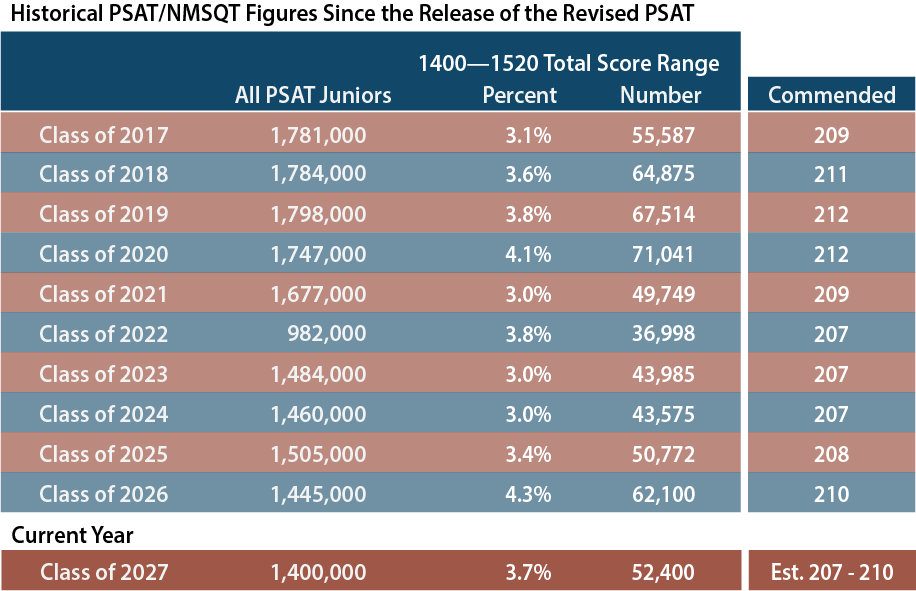
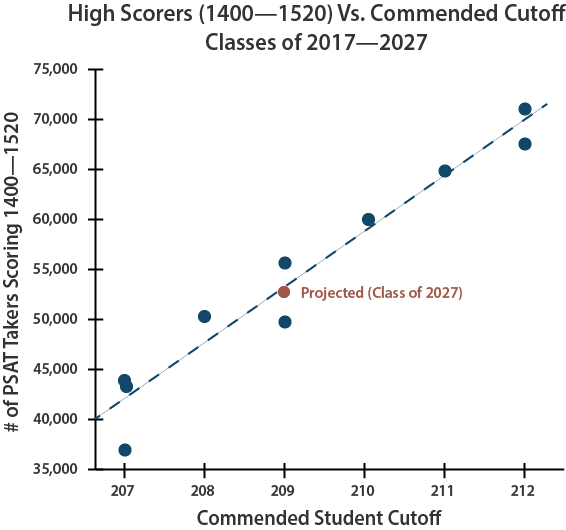
Most of the students who will qualify for National Merit recognition fall in the 1400 – 1520 band (or just outside it). With approximately 10,000 fewer students in the top band of scores this year, we expect the Commended level to drop to 208 or 209. The chart below shows the historical relationship between high scores and the Commended cutoff.
Explaining why last year’s cutoffs reached record levels
After examining this year’s numbers, we also have a better understanding of why Semifinalist cutoffs jumped to such extreme levels last year, and why it should not happen again. The 2024 PSAT saw an unprecedented 18% jump in the number of high Reading & Writing scores (700-760). The weighting of RW in the Selection Index magnified the impact of that change. The table below shows scores for the last three years and how results have fluctuated.
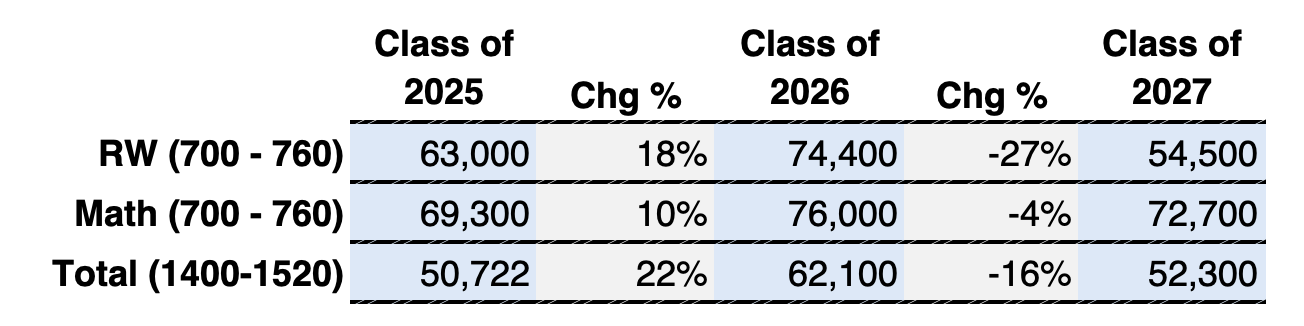
On the 2025 PSAT, the number of high RW scores dropped by 27%. In fact, the RW count for this year is even lower than it was two years ago. The decline in RW scores could even produce Selection Indexes lower than those in the Class of 2025 — at least in some states. The Commended cutoff may provide additional insight in the spring.
The ratio of 700+ M scores to 700+ RW scores reveals just how bizarre last year’s spike was. Traditionally, Math scores have higher distributions at the extremes. There are more very high Math scores on the PSAT and SAT, and there are more very low Math scores.

On the October 2024 PSAT, though, almost as many students scored 700-760 on RW as did on Math. The ratio of high Math scores to high RW scores was 1.02. This helps explain why some cutoffs went as high as 224 and 225 for the first time ever. Students achieved 750 and 760 RW scores in record numbers. In most years, there would be more students scoring 730 RW and 760 M (222 SI), for example, than scoring 760 RW and 730 M (225 SI). That was not true in the the Class of 2025, where there was a more equal distribution. It appears that scores for the Class of 2027 have returned to the traditional Math-heavy distribution. The ratio of high Math scores to high RW scores was 1.33 on the 2025 PSAT/NMSQT. For this reason, we don’t believe we will see a repeat of the 224 and 225 cutoffs seen last year.
Was last year a fluke, shift, or a trend?
The results from the Class of 2027 have answered one of the nagging questions from last year: Were the high cutoffs a fluke, shift, or trend? The answer appears to be fluke. More accurately, results could be labeled an error in test construction and scaling. There is no evidence that the Class of 2026 possessed special test-taking skills. As sophomores, that class performed in line with expectations on the 2023 PSAT. There is no evidence that the Class of 2027 has diminished skills. As sophomores, the class saw the same inflated scores as did the juniors on the 2024 PSAT. The best explanation is that College Board lost control of the scale. College Board dramatically shortened the PSAT when it switched from paper to digital. On the paper test, the Reading and Writing sections had 91 questions, and students were given 95 minutes. The RW on the digital PSAT is truncated to 54 questions over 64 minutes. And only 50 of the questions count toward a student’s score! A shorter exam means a less reliable exam. We saw the occasional wild ride on the paper PSAT, but the rides may get wilder and more frequent on the digital PSAT.
We anticipate the majority of state Semifinalist cutoffs to decline for the Class of 2027. Knowing this overall trend, however, doesn’t tell us which states will be in that majority or how much lower scores will go. The table below provides a Most Likely cutoff score, but the more useful information is the Estimated Range. Almost all cutoffs should fall within that range.
State | Class of 2027 (Most Likely) | Class of 2027 (Est. Range) | Class of 2026 (Actual) | Class of 2025 (Actual) | Class of 2024 (Actual) | Avg NMSFs |
|---|---|---|---|---|---|---|
| Alabama | 213 | 210 - 216 | 214 | 212 | 210 | 250 |
| Alaska | 214 | 210 - 216 | 215 | 214 | 209 | 35 |
| Arizona | 218 | 215 - 220 | 218 | 217 | 216 | 398 |
| Arkansas | 213 | 210 - 216 | 215 | 213 | 210 | 143 |
| California | 223 | 220 - 224 | 224 | 221 | 221 | 2,115 |
| Colorado | 218 | 216 - 221 | 219 | 218 | 216 | 286 |
| Connecticut | 222 | 220 - 223 | 223 | 221 | 221 | 175 |
| Delaware | 219 | 218 - 221 | 220 | 219 | 219 | 44 |
| Florida | 217 | 216 - 220 | 219 | 217 | 216 | 999 |
| Georgia | 219 | 217 - 221 | 220 | 218 | 217 | 602 |
| Hawaii | 218 | 215 - 220 | 219 | 217 | 217 | 62 |
| Idaho | 214 | 211 - 217 | 215 | 213 | 211 | 96 |
| Illinois | 220 | 218 - 222 | 222 | 220 | 219 | 704 |
| Indiana | 217 | 214 - 219 | 218 | 217 | 216 | 313 |
| Iowa | 213 | 211 - 216 | 214 | 212 | 210 | 145 |
| Kansas | 216 | 213 - 219 | 216 | 215 | 214 | 144 |
| Kentucky | 214 | 211 - 217 | 214 | 213 | 211 | 201 |
| Louisiana | 215 | 212 - 218 | 216 | 214 | 214 | 222 |
| Maine | 215 | 212 - 217 | 217 | 214 | 213 | 55 |
| Maryland | 223 | 221 - 225 | 224 | 222 | 221 | 308 |
| Massachusetts | 223 | 221 - 225 | 225 | 223 | 222 | 318 |
| Michigan | 219 | 216 - 220 | 220 | 218 | 217 | 485 |
| Minnesota | 218 | 216 - 220 | 219 | 217 | 216 | 279 |
| Mississippi | 213 | 210 - 215 | 213 | 212 | 209 | 155 |
| Missouri | 216 | 213 - 218 | 217 | 215 | 214 | 289 |
| Montana | 211 | 208 - 214 | 213 | 209 | 209 | 47 |
| Nebraska | 213 | 210 - 216 | 214 | 211 | 210 | 105 |
| Nevada | 214 | 211 - 217 | 214 | 214 | 211 | 168 |
| New Hampshire | 217 | 214 - 219 | 219 | 217 | 215 | 60 |
| New Jersey | 223 | 222 - 225 | 225 | 223 | 223 | 451 |
| New Mexico | 211 | 208 - 214 | 210 | 211 | 207 | 104 |
| New York | 221 | 219 - 223 | 223 | 220 | 220 | 1,012 |
| North Carolina | 219 | 216 - 221 | 220 | 218 | 217 | 510 |
| North Dakota | 210 | 207 - 212 | 210 | 210 | 207 | 30 |
| Ohio | 218 | 215 - 220 | 219 | 217 | 216 | 538 |
| Oklahoma | 212 | 208 - 214 | 212 | 211 | 208 | 204 |
| Oregon | 218 | 215 - 220 | 219 | 216 | 216 | 188 |
| Pennsylvania | 220 | 217 - 222 | 221 | 219 | 219 | 596 |
| Rhode Island | 217 | 214 - 220 | 219 | 217 | 215 | 47 |
| South Carolina | 214 | 210 - 217 | 215 | 214 | 209 | 236 |
| South Dakota | 210 | 207 - 213 | 211 | 208 | 209 | 42 |
| Tennessee | 218 | 215 - 219 | 219 | 217 | 217 | 319 |
| Texas | 221 | 218 - 222 | 222 | 219 | 219 | 1,623 |
| Utah | 212 | 210 - 216 | 213 | 211 | 209 | 196 |
| Vermont | 215 | 211 - 217 | 216 | 215 | 212 | 28 |
| Virginia | 222 | 220 - 224 | 224 | 222 | 219 | 437 |
| Washington | 222 | 220 - 224 | 224 | 222 | 220 | 348 |
| West Virginia | 209 | 207 - 212 | 210 | 209 | 207 | 64 |
| Wisconsin | 214 | 213 - 217 | 215 | 214 | 213 | 292 |
| Wyoming | 209 | 207 - 212 | 210 | 209 | 207 | 24 |
| District of Columbia | 223 | 222 - 225 | 225 | 223 | 223 | 36 |
| Territories | 209 | 207 - 211 | 210 | 208 | 207 | 39 |
| Outside US | 223 | 222 - 225 | 225 | 223 | 223 | 86 |
| Commended | 209 | 207 - 210 | 210 | 208 | 207 |
How cutoffs are determined
Qualifying scores (“cutoffs”) are not based on the total score for the PSAT (360-1520) but on the Selection Index, which is calculated by doubling the RW score, adding the Math score, and then dividing the sum by 10. The maximum Selection Index is 228. Students can find a historical set of cutoff data here or see how Semifinalist and Commended counts have changed state by state.
We estimate that the Semifinalist cutoffs will range from 209 to 223. Semifinalists are allocated by state, and cutoffs are calculated by state. If Florida is allocated 1,000 Semifinalists based on its population of high school graduates, then NMSC works down from a perfect 228 Selection Index until it gets as close as possible to that target. Last year, 1,008 students scored at or above the cutoff of 219. A cutoff of 220 would have produced too few Semifinalists. A cutoff of 218 would have gone over the allocation. Because score levels can get crowded, it is easy for cutoffs to move up or down a point even when there is minimal change in testing behavior or performance.
Why does each state have its own Semifinalist cutoff if the program is NATIONAL Merit?
This is always a hot button question. NMSC allocates the approximately 17,000 Semifinalists among states based on the number of high school graduates. That way, students across the nation are represented. It also means that there are very different qualifying standards from state to state. A Massachusetts student with a 220 might miss out on being a Semifinalist. If she lived 10 miles away in New Hampshire, she would qualify.
No Semifinalist cutoff can be lower than the national Commended level. Cutoffs for the District of Columbia and for U.S. students studying abroad are set at the highest state cutoff (typically New Jersey). The cutoff for students in U.S. territories and possessions falls at the Commended level each year. Boarding schools are grouped by region. The cutoff for a given region is the highest state cutoff within the region.
Change is always the theme
Over the last two decades, at least half of the state cutoffs have changed each year. In some years, as many as 49 states saw ups or downs, usually because of questionable test forms. In addition to last year’s exam, the PSATs from 2011 (Class of 2013), 2016 (Class of 2018), and 2019 stand out as problematic. The anomalous 2019 results could be traced back to a particularly mis-scaled form, which I wrote about at the time. The Class of 2014 also saw significant changes, but those were more of a bounce-back from the previous year. The question for the Class of 2027 is how much of a bounce-back will be seen this year.
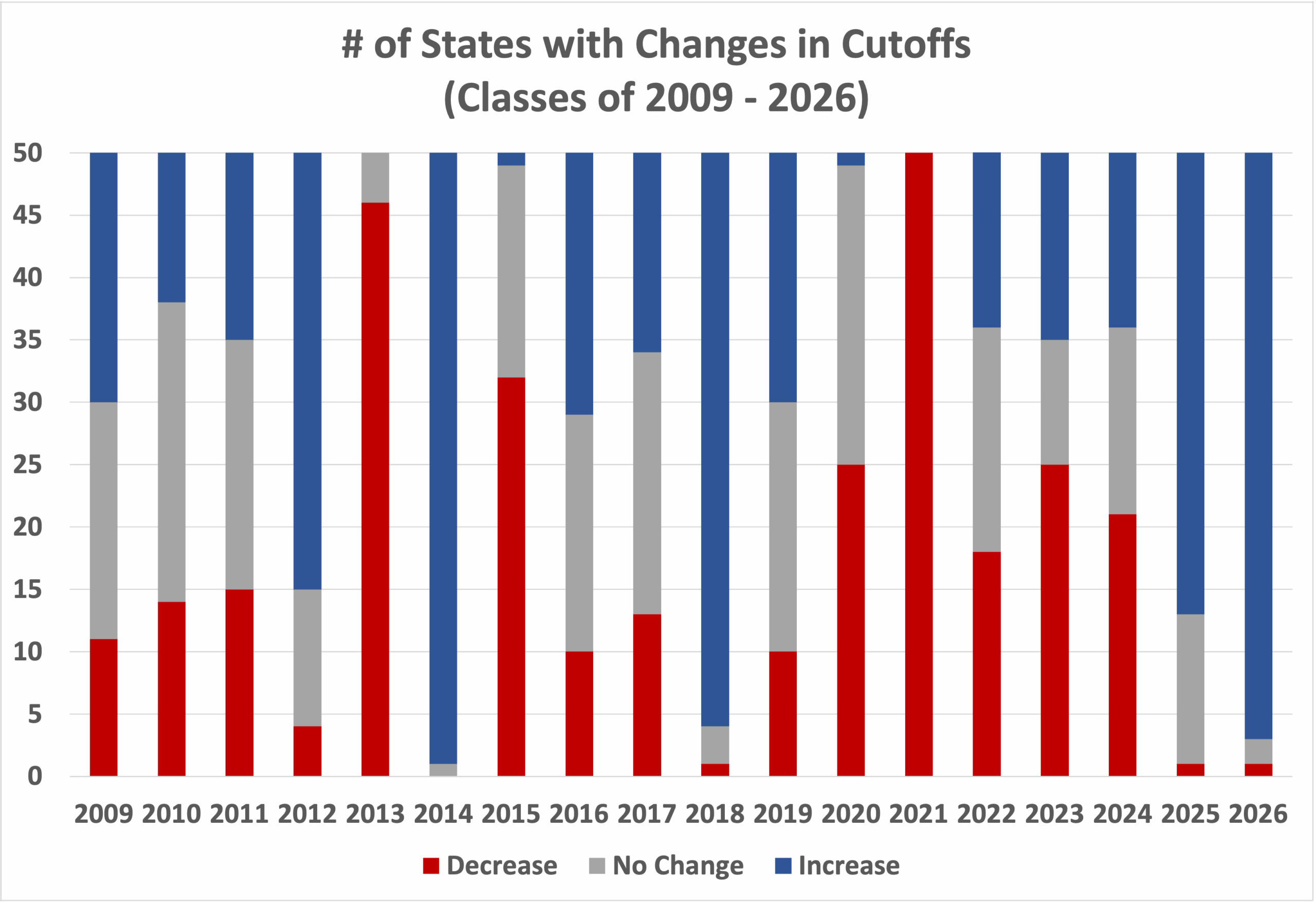
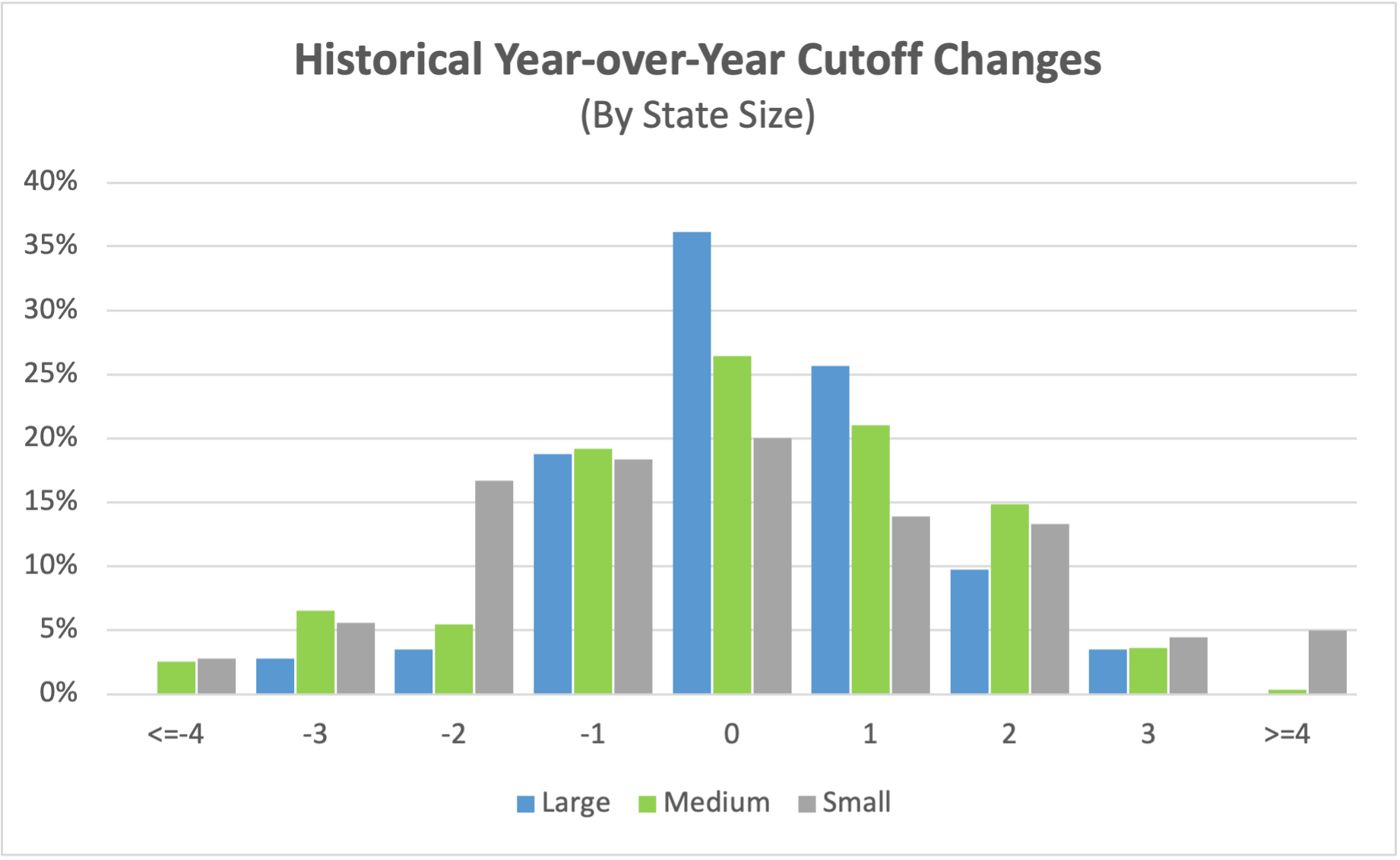
Cutoffs are particularly bumpy in states with smaller pools of test takers and National Merit Semifinalists. Over the last dozen years, cutoffs in the 12 largest states have remain unchanged 36% of the time, while the cutoffs in the smallest states have remain unchanged only 1 time out of every 5. No large state’s cutoff has jumped by more than 3 points in a year, whereas 6-point changes have occurred in the pool of smaller states.
When are National Merit Semifinalists announced?
The lists of Semifinalists will not be distributed to high schools until the end of August 2026. With the exception of homeschoolers, students do not receive direct notification. NMSC asks that schools not share the results publicly until the end of the press embargo in mid-September, but schools are allowed to notify students privately before that date. NMSC does not send Commended Student letters to high schools until mid-September. Compass will keep students updated on developments as the dates approach.
Do state and national percentiles indicate whether a student will be a National Merit Semifinalist?
No! Approximately 1% of test takers qualify as Semifinalists each year, so it is tempting to view a 99th percentile score as indicating a high enough score — especially now that College Board provides students with percentiles by state. There are any number of flaws that rule out using percentiles as a quick way of determining National Merit status.
- Percentiles are based on section scores or total score, not Selection Index
- Percentiles are rounded. There is a large difference, from a National Merit perspective, between the top 0.51% and the top 1.49%
- Percentiles reveal the percentage of students at or below a certain score, but the “at” part is important when NMSC is determining cutoffs.
- The number of Semifinalists is based on the number of high school graduates in a state, not the number of PSAT takers. Percentiles are based on PSAT takers. States have widely varying participation rates.
- Most definitive of all: Percentiles do not reflect the current year’s scores! They are based on the prior 3 years’ performance. They are set even before the test is given. And if you are going to use prior history, why not use the record of prior National Merit cutoffs rather than the highly suspect percentiles?
Entry requirements for National Merit versus qualifying for National Merit.
Your PSAT/NMSQT score report tells you whether you meet the eligibility requirements for the NMSP. In general, juniors taking the October PSAT are eligible. If you have an asterisk next to your Selection Index, it means that your answers to the entrance questions have made you ineligible. Your answers are conveniently noted on your score report. If you think there is an error, you will also find instructions on how to contact NMSC. Meeting the eligibility requirements simply means that your score will be considered. Approximately 1.4 million students enter the competition each year. Only about 55,000 students will be named as Commended Students, Semifinalists, Finalists, or Scholars. See National Merit Explained for more information.

I got a 208 on the latest PSAT (for class of 2026) and a 1400 overall. I was wondering whether that was a good or bad score.
Samir,
It’s certainly a good score! Only about 4% of students do that well. It may fall just short this year, though, of qualifying for National Merit honors.
What are the chances that 217 makes the cutoff for Michigan? Thank you.
LA,
A lot of Michiganders in the comments today! It looks like things are shaping up to be very competitive this year. A 217 has qualified in 4 of the 9 years of the current PSAT incarnation. Unfortunately, the years in which we have seen the strongest scores nationally also saw Michigan’s cutoff at 219. Things can still go your way, but I don’t want to mislead you. Maybe a 20% chance.
What do you think is the chance I will get NMSF with a 219 in Illinois? Thanks.
Tanish,
If I am candid, it is going to take a bit of good fortune. Scores nationally seem to be on an upward trend, so I think it’s more likely than not that Illinois’ cutoff will be at 220 or 221. But we don’t really know how the students of Illinois did, so you are still in the running. 20-25% would be the chances I’d estimate.
my daughter got a 218 . We live in Florida. Do you think the score is enough for her being a semifinalist for 2025? Also should she be doign anything now?
Your thoughts. Thank you
Deepa,
I think it is likely that Florida’s cutoff will move up from last year’s 217. The question then becomes whether it goes to 218 or 219. I still think 218 is a bit more likely.
The good news is that she doesn’t need to do anything beyond what she is likely already doing. Semifinalist is based just on her score, so that’s a waiting game. The Finalist stage also accounts for grades and school recommendation (and your daughter’s essay). So good grades and stay out of trouble! Sounds like what every parent would like to see.
I was going to ask about a 218 in Florida as well. My oldest son is a NMSF this year (class of 2025) with a 219 index score (1460 total). My younger son (class of 2026) has a 218 (1470 total) so it’s going to be a long 10 months of waiting to hear officially, with a little extra brotherly competition thrown in 🤣🤦♀️. Your blog is such a great resource, thank you for all your efforts!
Thank you, Liz. Oof, those sibling rivalries can be tough. Let’s hope the streak continues!
Jumping in here, but first would like to thank you for this excellent and informative page. My son got a 220 for NY. You predict that NY will remain at 220, which would be fantastic, but could you explain why it is you believe it will not change upward for the Class of 2026? (I saw elsewhere that NY has hovered at 220 for the past 5 years, only one of those years dipping to 219…but for the three years prior to that (2018-2020), it was at 221.) I am just trying to interpret these trends (and possibly understand the three-year blip at 221) and see if we can hold onto the idea that it is at least “LIKELY” he will make it when SF statuses are released next fall. Many thanks for your assistance. Looking forward to checking back here next week when the last batch drops.
JMAC,
I gave a lot of thought to that one, since we can say with a high degree of confidence that New York will come in at 219, 220, or 221. The reason I decided to stick with a 220 “most likely” is that we still don’t know what the last set of scores will show. In those years where we saw a 221 for NY, the national figures for 1400-1520 scorers ranged from 65K to 71K. We are currently at 58,000. That’s already well more than last year, so why didn’t I bump the most likely to 221? Because that’s still less than 65,000. In the paper-test era, those high years usually reflected form codes that skewed high in terms of results. As much as College Board tries to keep every test aligned, it doesn’t always succeed. When the cause of high scores is misalignment, that is usually going to flow through to many states. Ultimately, we want know how New York students did until next fall. Are the odds of 220 vs 221 40/60, 50/50, 60/40? I’ll probably tip my estimate one way or another next week, but it will still just be an estimate. Alas, September is a long way away.
Thank you for your reply. Am I correct, though, that you would need to see increases in the numbers of students scoring at the 1480+ level (correlating to 220+) to see upward movement of the index? Because students in the low 1400s would not put any upward pressure on it, I wouldn’t think. (I am asking this without any knowledge of how the data are collected.) Either way, I will definitely come back here next week. Thanks again!
You’re right. If only College Board would provide those scores! So the best we can do is assume that the distribution of all scores within the 1400-1520 range have shifted upward. In other words, more 210s, more 215s, more 220s. Historically, that has proved true, but if it were a perfect correlation, the world would be so much easier.
Hello again, Art: Was very interested to see what changed after the last score drop – if anything. Still focusing on NY and it looks like you still have it “likely” at a 220. In our earlier conversation, you mentioned you’d tip your estimate after this last score data drop in terms of how likely is your “likely.” I did read through some of your recent comments and noted you stated that (1) the data showed fewer top scores in the last score dump; and (2) the largest percent of scores in the 1400-1520 band are at the 1400-1440 level (and that there are fewer at the 1480+ level). My son got a 1480 (720/760) with a SI of 220. Do you feel comfortable giving a confidence level to your NY “likely 220” prediction now that all the data are in? Many thanks!!
JMAC,
I may have to go back and check my wording on the 1400-1440 comment, because you are the second person that interpreted it in a different way than I meant it. Apologies. That was referencing the general distribution of scores. There will always be more modestly high scores than extremely high scores. College Board does not provide those break downs year-to-year, so I didn’t mean to imply a particular change for *this* year. I still don’t think we can rule out a 221, but I like the chances of a 220 in NY. 80%-ish.
What are the normal trends you see in the third wave of score releases? Do they follow a trend? What are you thinking we will get up to for high score # total? If we are already at 57k!
Laura,
The multi-date return only started last year (and it was in halves). The second half had fewer high scores, but it will be interesting to see what the last wave has in store this time. It’s going to be the smallest batch. If we guess that there are another 200,000 scores coming and that they come in at about 3.5% in the top range, then we’d be looking at around 65K total in the 1400-1520 range. I’m quite curious.
My junior son just got his scores and was thrilled with his 227. He expected to to well, but not that well. Based on your site, he is a guaranteed Semi-Finalist. But does the SAT confirmation for Finalist status need to match or exceed his PSAT score, or does it just need to correlate to the state minimum for a semi-finalist? We live in the highest PSAT scoring state (224 historically based on your chart), so the bar is already high. Just wanted to understand how well he needs to do on the SAT to be a lock as a Finalist (all of the other criteria being met) and if that too has a different bar for each state. He will be applying early decision to a score blind university, so we would like him to take his confirmation SAT well before the Semi-finalist notification date.
Congratulations! The great news is that the confirming score is set nationally — usually at the year’s Commended level. So even if we saw the Commended level rise to 212, your son should have no problem at all getting a confirming score.
Thank you for your quick reply!
My child scored 1570 on the August SAT and then 1440 on the Oct 26 PSAT. Seems incongruent. Are you sensing any differences in scores reported between the PSAT dates this year, as occurred three years ago when the final October PSAT date had a steep scoring scale?
Patricia,
No, we are not seeing that sort of discrepancy nationally. The PSAT does have an inherent problem in measuring high scores, since even a perfect run is capped at 1520.
It’s the SAT score that matters for college admission, of course, so there are many students who would gladly take that 1570. Great job!
I got a 224 index (1480, Math: 720, Reading/Writing: 760) in Massachusetts, is it likely I qualify for semifinalist? Thanks!
Sarah,
Yes, I consider it a certainty. Massachusetts’ cutoff will not go over 224. Congratulations!
My son received a 216. We live in Pennsylvania. Do you believe his score is sufficient to advance him to the 2026 semifinals? Your ideas. Thank you!
RP,
That’s a great score and would qualify in many states. Unfortunately, Pennsylvania is quite competitive, and we’ve never seen its cutoff go below 217.
My daughter got a perfect score, which is fantastic news, but I’m seeing plenty of other kids on Reddit getting perfect scores as well. My question is, if more than 50,000 kids get perfect scores, how will nmsqt choose semi-finalists?
Jessica,
That’s amazing! Reddit can be a wonderful source of information, but it’s not a good place to find an unbiased sample. Only about 1,000 students a year achieve a perfect score on the PSAT. Your daughter will be named a Semifinalist.
Thank you! Somehow I always find something to worry about, lol. You’ve set my mind at ease!
Hello,
I am slightly worried about my PSAT Score. I live in California, and got a 760 Math 740 EBRW (224 NMQST Score). Although I haven’t studied SAT in around a year (studied and got a 1580 in sophomore year, so was rusty as a junior), I didn’t expect it to cut it this close to the cutoff. Probably should have taken a couple of reading practice tests closer to the PSAT testing date.
How likely do you believe that California’s cutoff will stay in the 220-223 range, and that I will qualify as a National Merit Semifinalist when September rolls around?
David,
I’m confident that California’s cutoff will stay in the 220-223 range. I am certain that it will not go above 224. Congratulations! And you’ve already got your confirming SAT score.
Hello,
I just got my score and I had an index score of 220 in Texas, which caused me to become nervous when I saw your predicted range with a maximum of 221. I just want to understand why you predicted that Texas will have a cutoff of 220 instead of a 221 to hopefully ease my nerves, as the other high years with similar score range numbers from 2018-2020 had their cutoffs at 221s. Also, do you think I am likely to become a semi-finalist? And if you have some in mind, what would you say the odds are? Thank you.
It looks like it’s a toss-up at this point. Will the final score release make things resemble the class of 2017 (220 cutoff) or 2018 (221)? It’s likely to fall somewhere between those two. Your chances of becoming a Semifinalist are around 50/50.
Thank you for your prompt response. Considering it’s equivalent to a coin flip, I have some final questions, as I am nervous. Based on what you have seen so far, are you leaning towards one or the other? Do you also have a range of how much the percentages of students between 1400-1520 will drop on the final wave? Thank you.
Johnny,
The arrangement of releasing scores in 3 batches is new, so I don’t have good information on what we’ll see in the final wave. If it’s really strong and we get closer to 70,000 high scorers, then 221 becomes a bit likelier. For now, I’m sticking with 220.
Hello, my daughter has a 1490 score for her PSAT test. She got 223 in Washington. Can she become a semi-finalist? Thanks.
Catherine,
Yes, a 223 will qualify as a Semifinalist in Washington. Congratulations to your daughter!
I’m in Michigan and have a 219. I was excited thinking I would have it nearly for sure, based on past cutoffs. But then I read your explanation about higher numbers having higher scores and I wonder if it will be enough. You explained more scores are higher and that cutoffs would go up, but Michigan is estimated the same as last year. What do you think my chances are? Will it go up to 220 and make me miss it? Thank you for the great explanations of everything.
Kiley,
I didn’t move Michigan up to 219, for now, because it has only hit 219 during the strongest of years, and we don’t yet know what the last set of scores will show. As for a 220 cutoff, that would be a new record for Michigan. For a large state such a Michigan, that’s not likely. I wish I could say that it was impossible, but I can’t. I think your chances are in the 90% range.
Hi Art, my son got 223, and we are in NJ. Do you think he is qualified to be a semifinalist if the cutoff stays at 223? Many thanks!!
Trinity,
We’ve still never seen a cutoff at 224 (not counting the COVID-cancellation driven cutoff in Maryland in the class of 2022), and I don’t think that we will this year. But if there is a state that can do it, it will be New Jersey. I think there is a 95+% chance that a 223 qualifies.
Thank you for your response sir!
Hello
My daughter has index score of 224 in NJ. Any probability of NJ cutoff jumping to 225?
Thank you for very informative article.
YH,
No chance. The scores thin out dramatically as you hit those top numbers. There simply aren’t enough 225-228 scorers to drive a cutoff above 224. Congratulations to your daughter!
So I got a 217 score index. I live in Michigan. What are the chances that the cutoff is 217 for the class of 2026? Thanks.
Sid,
It may take a little bit of luck. I expect most cutoffs to be at least as high as the class of 2025 numbers. There will be exceptions, though, so we might see a 217 in Michigan. I’d put the chances at about 20-25%.
Hello Sir,
I have recently received my score as well and am wondering how sure your prediction of 219 is in Pennsylvania as I have received a 218 index. Sorry just a little nervous I guess.
Sam,
One of the reasons I give a projected range is that “most likely’s” are rarely sure. States don’t move in unison. This does seem to be an “up” year, however, given the number of high scores nationally. I think we’ll see PA in the 218-220 range, but there is more likelihood that the cutoff goes up a point than down a point. I’m sorry to add to your nervousness. I’d put the odds at about one in four for a drop. In the class of 2021 we saw a 217, so let’s hope I’m wrong!
Hello again,
Do you think that since a lot increased last year, they will decrease down this year?
Sam,
There is a possibility that some states will move downward, but overall I believe cutoffs will move upward, because we are seeing a surge in high scores.
I got a 217 on this years PSAT in Florida. How likely am I to get semi Finalist? Thank you!
Sailor,
I think there is a good chance that Florida’s cutoff moves up this year. Still, I would not rule out a 217. One out of three?
Hello,
I got a 219 SI in Texas (740 Reading & Writing, 710 Math). Your range was between 218-221 for Texas, but you predicted most likely a 220 would be the SF cutoff. Why is it that you predict that you predict it will go up from 219 the past 3 years to 220?
Thanks for your help.
John,
Keep in mind that I am just basing these predictions based on trends seen at the national level. Those trends trends typically flow through to the states, but not in a uniform way.
Texas has been at 219 in recent years, but the number of students in the 1400-1520 range has also been lower than in some past years. In the classes of 2018-2020, for example, we saw high numbers of high scorers and high cutoffs to go along with them. Texas was at 221 in those years. I don’t think we’ll see numbers go that high this year — not as many students take the PSAT anymore — but there is enough pressure on scores that I think many cutoffs will rise. What we can hope for, of course, is that Texas is not among them!
Hello! My son received his PSAT score last night (1470 with a 220 index). We live in Louisiana. Do you see any scenario where that wouldn’t qualify for Semifinalist? Thank you so much.
Janie,
No. Congratulations to your son! He will be named a Semifinalist.
Hi! I got a 218 index in Arizona. I’m super excited! But waiting until September is a really long time. Will you put out new projection numbers when the final PSAT numbers come in on November 14th? And what do you think the odds are of a 218 making the cutoff for 2026 in Arizona? All your thoughts are greatly appreciated. Thank you!
Lilou,
Yes, I’ll evaluate the estimates when I get more information. A 218 would have qualified in the last 5 class years. It’s the earlier ones that concern me a bit — AZ was at 219/220 in the classes of 2017 – 2020. I think it’s about 50/50.
Do you have any state specific scores at this point? For example, how many kids received a score over 1400 in South Carolina?
Tina,
Alas, no. And I will not have any.
My son got a 1480 (730 EBRW and 750 Math). Index is 221. What are his chances of being a semifinalist? Thanks
GB,
If you are referring to South Carolina, then your son’s chances are 100%. Congratulations to your son!
Hi what are the odds do you think of qualifying for National Merit Semi finalist if I only got a 218 selection index in Pennsylvania
Sunjeep,
A drop in a large state like Pennsylvania is going to take a little luck this year (well, it’s not really luck; it depends on how many students tested in PA). Unfortunately, I’d say there is about an 80% chance that it will be at 219 or higher.