

Compass projects lower qualifying scores for the Class of 2027
Every year, Compass tracks the National Merit process from the PSAT in October of junior year through the announcement of Semifinalists in September of senior year. One of the most important insights comes in April with the reveal of the national Commended cutoff. Compass has confirmed that this year’s Commended level is 208, down from last year’s 210. There has never been a year when all 50 states see lower cutoffs, but this year may come close. The Class of 2026 saw record Semifinalist cutoffs in 21 states; this year, Compass projects none. Our Semifinalist estimates have been updated with the latest information.
The junior-year PSAT is also the National Merit Scholarship Qualifying Test (NMSQT). Each year, National Merit recognizes the top 57,000 test takers. To be included in that group, students must be among the top 4% of the 1.4 million students who take the PSAT. Of that elite group, approximately 17,000 are recognized as Semifinalists for having the highest scores within their states. Semifinalists have the opportunity to continue in the program to become Finalists and, potentially, scholarship recipients. The remaining 40,000 students are recognized as Commended Students. More information can be found in our National Merit Explained post.
National Merit uses the Selection Index (SI), found on the PSAT score report, to rank students. The Selection Index is calculated by doubling the Reading & Writing score (RW), adding the Math score (M), and dividing that sum by 10. For example, a student with a 720 RW and 700 M score has a Selection Index of 214: (720 x 2 + 700) ÷ 10. The weighting of the index means that not all students with a 1420 Total Score have the same SI. A student with a 700 RW and 720 M has a Selection Index of 212. The highest SI a student can receive is 228 (760 RW and 760 M). Because Reading and Writing carries double weight, a student with balanced section scores can trail a student with a lower total. Sophomores and juniors preparing for the October PSAT can work on that imbalance directly in a National Merit-focused PSAT class. Last year, the Commended cutoff was 210, and Semifinalist cutoffs ranged from 210 to 225 depending on the competitiveness of each state. Compass expects this year’s cutoffs to range from 208 to 223.
Why do we foresee lower cutoff scores?
The first indication of a decline was the lower number of top scorers reported by College Board when PSAT results were released in November. College Board does not release any information about the distribution of Selection Indexes, but it does produce summaries of broad score ranges. Only 52,400 students in the Class of 2027 earned scores in the 1400 – 1520 Total Score range, down 16% from the previous year. That figure is closer to what we saw two years ago with the Class of 2025 and is similar to the results for the Classes of 2017 and 2021.
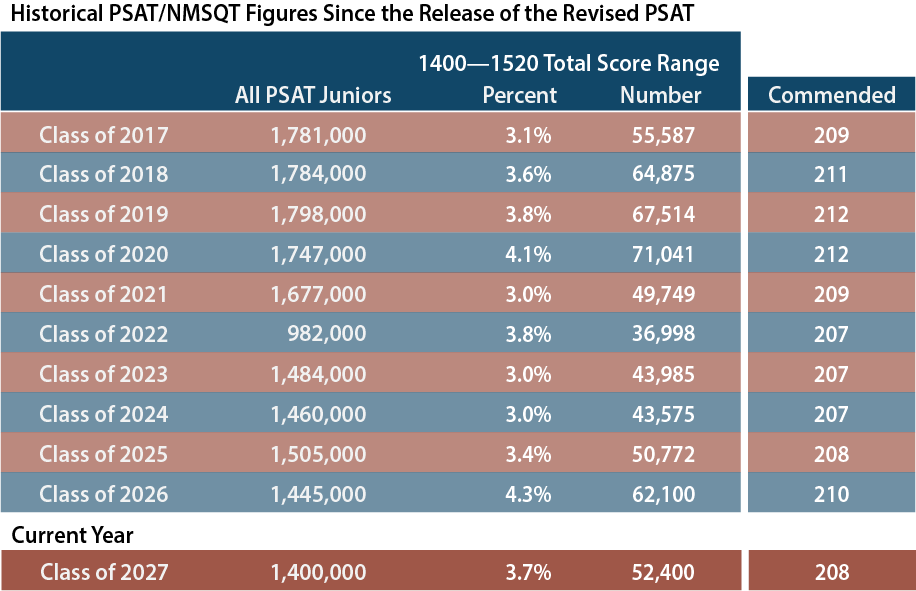
Most of the students who will qualify for National Merit recognition fall in the 1400 – 1520 band (or just outside it). With approximately 10,000 fewer students in the top band of scores this year, the Commended cutoff was bound to decline. The chart below shows the historical relationship between high scores and the Commended cutoff.
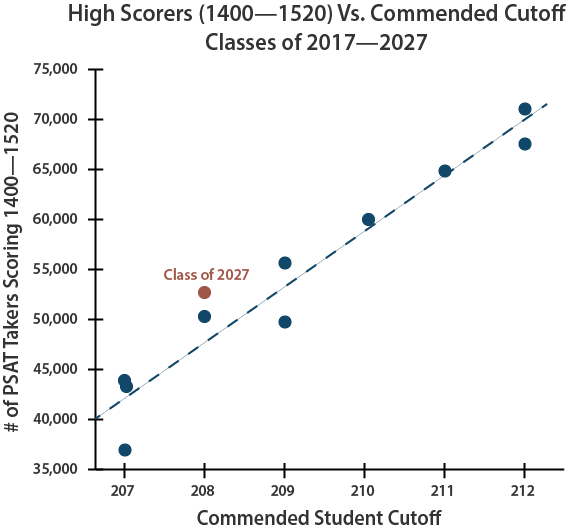
A big drop after last year’s record levels
After examining this year’s numbers, we also have a better understanding of why Semifinalist cutoffs jumped to such extreme levels last year, and why that is unlikely to happen again. The 2024 PSAT saw an unprecedented 18% jump in the number of high Reading & Writing scores (700-760). The weighting of RW in the Selection Index magnified the impact of that change. The table below shows scores for the last three years and how results have fluctuated.
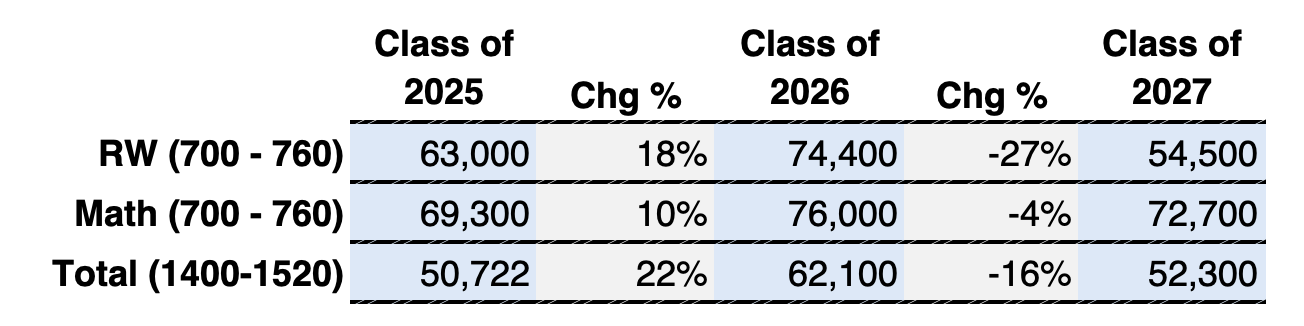
On the 2025 PSAT, the number of high RW scores dropped by 27%. In fact, the RW count for this year is even lower than it was two years ago. The decline in RW scores could even produce Selection Indexes lower than those in the Class of 2025 — at least in some states.
On the October 2024 PSAT, almost as many students scored 700-760 on RW as on Math. Based on the results in the highest scoring states, we know that a record number of students achieved 750 and 760 RW scores. In most years, there would be more students scoring 730 RW and 760 M (222 SI), for example, than scoring 760 RW and 730 M (225 SI). That was not true in the Class of 2025, where there was a more equal distribution. It appears that scores for the Class of 2027 have returned to the traditional Math-heavy distribution. For this reason, we don’t believe there will be a repeat of the 224 and 225 cutoffs seen last year.
We anticipate that the majority of state Semifinalist cutoffs will decline for the Class of 2027. Knowing this overall trend, however, doesn’t tell us which states will be in that majority or how much lower scores will go. The table below provides a Most Likely cutoff score, but the more useful information is the Estimated Range. Almost all cutoffs should fall within that range.
| State | Class of 2027 (Most Likely) | Class of 2027 (Est. Range) | Class of 2026 (Actual) | Class of 2025 (Actual) | Class of 2024 (Actual) | Avg NMSFs |
|---|---|---|---|---|---|---|
| Alabama | 213 | 210 - 215 | 214 | 212 | 210 | 250 |
| Alaska | 213 | 210 - 216 | 215 | 214 | 209 | 35 |
| Arizona | 218 | 215 - 220 | 218 | 217 | 216 | 398 |
| Arkansas | 213 | 210 - 215 | 215 | 213 | 210 | 143 |
| California | 221 | 220 - 223 | 224 | 221 | 221 | 2,115 |
| Colorado | 218 | 216 - 220 | 219 | 218 | 216 | 286 |
| Connecticut | 221 | 220 - 222 | 223 | 221 | 221 | 175 |
| Delaware | 219 | 218 - 221 | 220 | 219 | 219 | 44 |
| District of Columbia | 223 | 222 - 224 | 225 | 223 | 223 | 36 |
| Florida | 217 | 216 - 219 | 219 | 217 | 216 | 999 |
| Georgia | 219 | 217 - 220 | 220 | 218 | 217 | 602 |
| Hawaii | 217 | 215 - 219 | 219 | 217 | 217 | 62 |
| Idaho | 214 | 211 - 216 | 215 | 213 | 211 | 96 |
| Illinois | 220 | 218 - 222 | 222 | 220 | 219 | 704 |
| Indiana | 216 | 214 - 219 | 218 | 217 | 216 | 313 |
| Iowa | 213 | 211 - 216 | 214 | 212 | 210 | 145 |
| Kansas | 215 | 213 - 218 | 216 | 215 | 214 | 144 |
| Kentucky | 214 | 211 - 217 | 214 | 213 | 211 | 201 |
| Louisiana | 214 | 212 - 217 | 216 | 214 | 214 | 222 |
| Maine | 214 | 212 - 217 | 217 | 214 | 213 | 55 |
| Maryland | 222 | 220 - 224 | 224 | 222 | 221 | 308 |
| Massachusetts | 223 | 221 - 224 | 225 | 223 | 222 | 318 |
| Michigan | 218 | 216 - 220 | 220 | 218 | 217 | 485 |
| Minnesota | 218 | 216 - 220 | 219 | 217 | 216 | 279 |
| Mississippi | 212 | 210 - 214 | 213 | 212 | 209 | 155 |
| Missouri | 215 | 213 - 218 | 217 | 215 | 214 | 289 |
| Montana | 210 | 208 - 213 | 213 | 209 | 209 | 47 |
| Nebraska | 212 | 210 - 215 | 214 | 211 | 210 | 105 |
| Nevada | 214 | 211 - 216 | 214 | 214 | 211 | 168 |
| New Hampshire | 216 | 214 - 219 | 219 | 217 | 215 | 60 |
| New Jersey | 223 | 222 - 224 | 225 | 223 | 223 | 451 |
| New Mexico | 212 | 209 - 214 | 210 | 211 | 207 | 104 |
| New York | 220 | 219 - 223 | 223 | 220 | 220 | 1,012 |
| North Carolina | 218 | 216 - 220 | 220 | 218 | 217 | 510 |
| North Dakota | 209 | 208 - 212 | 210 | 210 | 207 | 30 |
| Ohio | 217 | 215 - 219 | 219 | 217 | 216 | 538 |
| Oklahoma | 212 | 210 - 214 | 212 | 211 | 208 | 204 |
| Oregon | 217 | 215 - 220 | 219 | 216 | 216 | 188 |
| Pennsylvania | 219 | 217 - 221 | 221 | 219 | 219 | 596 |
| Rhode Island | 217 | 214 - 219 | 219 | 217 | 215 | 47 |
| South Carolina | 214 | 210 - 216 | 215 | 214 | 209 | 236 |
| South Dakota | 209 | 208 - 212 | 211 | 208 | 209 | 42 |
| Tennessee | 217 | 215 - 219 | 219 | 217 | 217 | 319 |
| Texas | 219 | 218 - 222 | 222 | 219 | 219 | 1,623 |
| Utah | 212 | 210 - 215 | 213 | 211 | 209 | 196 |
| Vermont | 214 | 211 - 216 | 216 | 215 | 212 | 28 |
| Virginia | 222 | 220 - 224 | 224 | 222 | 219 | 437 |
| Washington | 222 | 220 - 224 | 224 | 222 | 220 | 348 |
| West Virginia | 208 | 208 - 211 | 210 | 209 | 207 | 64 |
| Wisconsin | 214 | 213 - 217 | 215 | 214 | 213 | 292 |
| Wyoming | 209 | 208 - 212 | 210 | 209 | 207 | 24 |
| U.S. Territories | 208 | 208 - 208 | 210 | 208 | 207 | 39 |
| Outside U.S. | 223 | 222 - 224 | 225 | 223 | 223 | 86 |
| Commended | 208 | 208 - 208 | 210 | 208 | 207 |
Was last year a fluke, shift, or a trend?
The results from the Class of 2027 have answered one of the nagging questions from last year: Were the high cutoffs a fluke, shift, or trend? The answer appears to be fluke. More accurately, results could be labeled an error in test construction and scaling. There is no evidence that the Class of 2026 possessed special test-taking skills. As sophomores, that class performed in line with expectations on the 2023 PSAT. There is no evidence that the Class of 2027 has diminished skills. As sophomores, the class saw the same inflated scores as did the juniors on the 2024 PSAT. The best explanation is that College Board lost control of the scale. College Board dramatically shortened the PSAT when it switched from paper to digital. On the paper test, the Reading and Writing sections had 91 questions, and students were given 95 minutes. The RW on the digital PSAT is truncated to 54 questions over 64 minutes. And only 50 of the questions count toward a student’s score! A shorter exam means a less reliable exam. We saw the occasional wild ride on the paper PSAT, but the rides may get wilder and more frequent on the digital PSAT.
How cutoffs are determined
Qualifying scores (“cutoffs”) are not based on the total score for the PSAT (360-1520) but on the Selection Index, which is calculated by doubling the RW score, adding the Math score, and then dividing the sum by 10. The maximum Selection Index is 228. Students can find a historical set of cutoff data here or see how Semifinalist and Commended counts have changed state by state. Students still ahead of the October PSAT can prepare with small group PSAT classes built around the Selection Index.
While the Commended cutoff is the same across the entire country, Semifinalists cutoffs vary by state. NMSC allocates a target number of Semifinalists to states based on their population of high school juniors, not all of whom take the PSAT. If Florida is allocated 1,000 Semifinalists based on its population of high school graduates, then NMSC works down from a perfect 228 Selection Index until it gets as close as possible to that target. Last year, 1,008 students scored at or above the cutoff of 219. A cutoff of 220 would have produced too few Semifinalists. A cutoff of 218 would have gone over the allocation. Because score levels can get crowded, it is easy for cutoffs to move up or down a point even when there is minimal change in testing behavior or performance. All students at or above a cutoff qualify.
Why does each state have its own Semifinalist cutoff if the program is NATIONAL Merit?
This is always a hot button question. NMSC allocates the approximately 17,000 Semifinalists among states based on the number of high school graduates. That way, students across the nation are represented. It also means that there are very different qualifying standards from state to state. A Massachusetts student with a 220 might miss out on being a Semifinalist. If she lived 10 miles away in New Hampshire, she would qualify.
No Semifinalist cutoff can be lower than the national Commended level. Cutoffs for the District of Columbia and for U.S. students studying abroad are set at the highest state cutoff (typically New Jersey). The cutoff for students in U.S. territories and possessions falls at the Commended level each year. Boarding schools are grouped by region. The cutoff for a given region is the highest state cutoff within the region.
Change is always the theme
Over the last two decades, at least half of the state cutoffs have changed each year. In some years, as many as 49 states saw ups or downs, usually because of questionable test forms. In addition to last year’s exam, the PSATs from 2011 (Class of 2013), 2016 (Class of 2018), and 2019 stand out as problematic. The anomalous 2019 results could be traced back to a particularly mis-scaled form, which I wrote about at the time. The Class of 2014 also saw significant changes, but those were more of a bounce-back from the previous year. The question for the Class of 2027 is how much of a bounce-back will be seen this year.
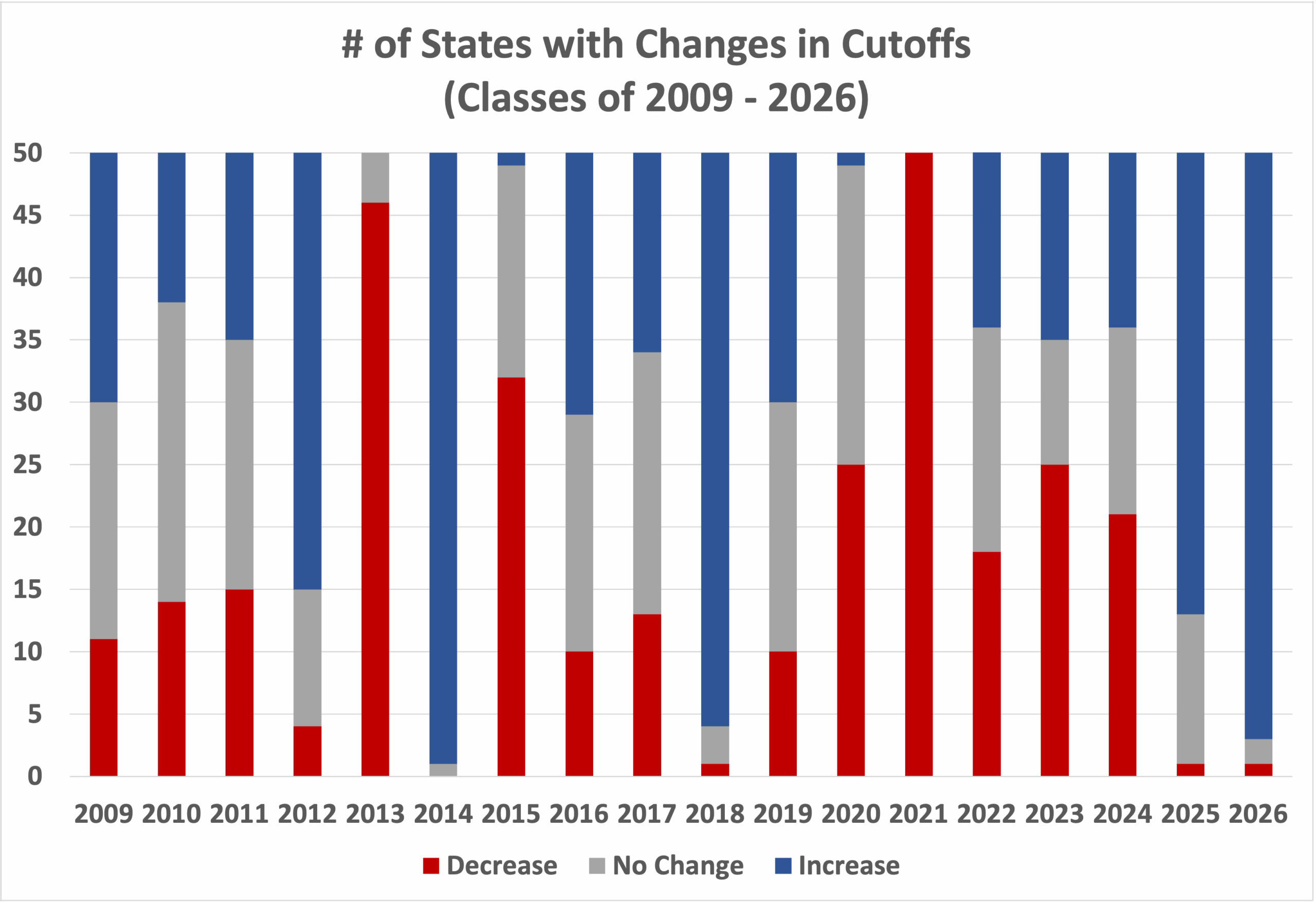
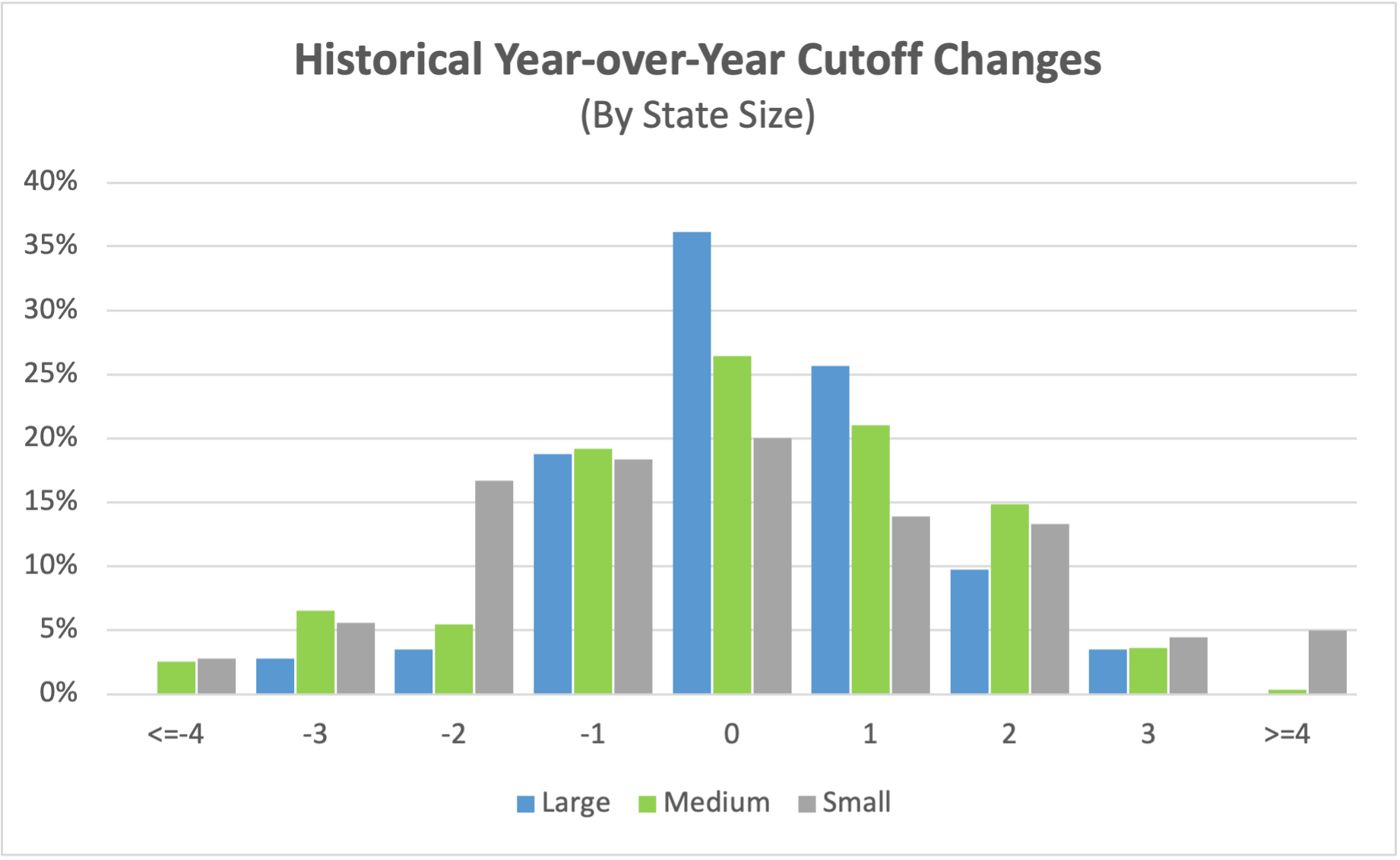
Cutoffs are particularly bumpy in states with smaller pools of test takers and National Merit Semifinalists. Over the last dozen years, cutoffs in the 12 largest states have remain unchanged 36% of the time, while the cutoffs in the smallest states have remain unchanged only 1 time out of every 5. No large state’s cutoff has jumped by more than 3 points in a year, whereas 6-point changes have occurred in the pool of smaller states.
When are National Merit Semifinalists announced?
The lists of Semifinalists will not be distributed to high schools until the end of August 2026. With the exception of homeschoolers, students do not receive direct notification. NMSC asks that schools not share the results publicly until the end of the press embargo in mid-September, but schools are allowed to notify students privately before that date. NMSC does not send Commended Student letters to high schools until mid-September. Compass will keep students updated on developments as the dates approach.
Do state and national percentiles indicate whether a student will be a National Merit Semifinalist?
No! Approximately 1% of test takers qualify as Semifinalists each year, so it is tempting to view a 99th percentile score as indicating a high enough score — especially now that College Board provides students with percentiles by state. There are any number of flaws that rule out using percentiles as a quick way of determining National Merit status.
- Percentiles are based on section scores or total score, not Selection Index
- Percentiles are rounded. There is a large difference, from a National Merit perspective, between the top 0.51% and the top 1.49%
- Percentiles reveal the percentage of students at or below a certain score, but the “at” part is important when NMSC is determining cutoffs.
- The number of Semifinalists is based on the number of high school graduates in a state, not the number of PSAT takers. Percentiles are based on PSAT takers. States have widely varying participation rates.
- Most definitive of all: Percentiles do not reflect the current year’s scores! They are based on the prior 3 years’ performance. They are set even before the test is given. And if you are going to use prior history, why not use the record of prior National Merit cutoffs rather than the highly suspect percentiles?
Entry requirements for National Merit versus qualifying for National Merit.
Your PSAT/NMSQT score report tells you whether you meet the eligibility requirements for the NMSP. In general, juniors taking the October PSAT are eligible. If you have an asterisk next to your Selection Index, it means that your answers to the entrance questions have made you ineligible. Your answers are conveniently noted on your score report. If you think there is an error, you will also find instructions on how to contact NMSC. Meeting the eligibility requirements simply means that your score will be considered. Approximately 1.4 million students enter the competition each year. Only about 55,000 students will be named as Commended Students, Semifinalists, Finalists, or Scholars. See National Merit Explained for more information.

What are your thoughts on a score released today of 1470/118 (in Fl)? Likely or hard to say if scores are much higher this year overall?
TK,
I’m going to assume that you meant to type 218 for the Selection Index. I don’t want to get too far ahead of the data. If the second set of scores is like the first, then it’s likely cutoffs will go up. It doesn’t mean that they’ll go up in the same way in all states. In what I think of as the “high” years (Classes of 2018, 2019, and 2020) Florida saw cutoffs of 219. In those years, the Commended cutoff fell at 211, 211, and 212. In the “low” years, when the Commended cutoff has been under 210, the Florida cutoff fell at 216 and 217. Hopefully we have a better idea in the coming weeks which way things are leaning.
Thank you for your quick reply. Yes , I mistyped. I meant 218. Great article by the way! Well fingers crossed then. Hopefully it will not jump to 219.
Hello!
I got a 1450 and 214 index on the PSAT, and I was wondering if you think that’s good enough for National Merit in Oklahoma. The only reason I feel the need to reply is because I’m a bit uncertain since my score report says that I am in the 98th percentile, and I don’t know if that is an indicator of whether I got it or not. I know you have to be in the top 1% of testers to get NMS, but I wanted to confirm with you to see if this statistic definitively confirms that I’m out of the running. Thanks!
Josh,
You don’t actually have to be in the top 1% to get NMSF. It’s often used as a shorthand, because about 1% of all test takers make Semifinalist, but that neglects the fact that Semifinalist cutoffs are determined state by state. In the last 8 years (dating to the last major overhaul), a 214 would have qualified in 6 of those years. Last year, Oklahoma’s cutoff dropped to 208! Do we know your 214 is high enough? No. But I am certain that you are in the running.
Thank you. I also forgot to clarify that I am in the 98th percentile for my state. Does that change anything and mean I’m out of the running?
No, it doesn’t change anything. Percentiles are based on scores from prior years, so it doesn’t tell us how your score stacks up this year. Still not out of the running!
This may seem confusing, because there are a number of states where even the 99th percentile in the state won’t be enough. The difference is that only about 15% of Oklahoma students take the PSAT. That contrasts with about 75% of students in Connecticut, for example. Since the pool of PSAT takers is smaller, a larger proportion of them will be Semifinalists.
Thank you so much Art! I really appreciate all the effort you’ve put into this!
Hi Art,
My daughter has a an index of 222, do you think the index will be 223 this year for California. Very worried because everyone is saying the scores were inflated this year.
Paul,
I’ve been through a lot of high years and low years when it comes to cutoffs, and this is feeling like a high year. I hope to have more numbers next week. Only once — class of 2019 — has California’s cutoff reached 223. That class had the highest set of cutoffs ever across the country.
Even with the full set of numbers, I don’t expect to be able to completely rule out a 223 cutoff. I’d reframe it as that you should be cautiously optimistic at 222 rather than worried! Good luck to your daughter.
Hi Art,
Thank you for the great blog!
Many of my daughter’s friends found that this year’s digital PSAT was a lot easier than the practice tests. It looks like the cut-offs are going to be high this year. Is the 222 index good enough to make National Merit Semifinalist in Illinois for the Class of 2025? Her score is 1490 (730 in English and 760 in Math)
Also, next to 99th percentile, there is a ‘>’ sign (>99th). What does that mean?
Thanks!
Megan,
I’ll take the easy part first. The >99th percentile is also sometimes expressed as 99+. It means that your daughter’s score was in the top 0.5% of scores. Which is fabulous! It just doesn’t tell us anything about whether your daughter’s score will qualify for NMSF. Percentiles are based on the previous 3 class years (for my full screed about percentiles, see the bottom of my post). We’ve had years where cutoffs skewed high — specifically, the classes of 2018, 2019, and 2020. The good news is that IL’s cutoff never went above 221. I think there is little chance that it would jump to 223 this year.
Hi, I got a 1420 on the PSAT with an index score of 218. It says that my score is in the top 99% for my state– would this be a good indication that I would qualify? And does the established score range account for how the cutoff estimates might increase if the scores you get on November 16 are also inflated? I know that 218 has always qualified for Idaho, but I’m nervous that everyone’s score will be so high that the cutoff will shoot up in unexpected ways.
Desiree,
Before I launch into an explanation, let me say, “Great score!” The 99th percentile, though, doesn’t tell us anything useful about whether or not you will qualify as a Semifinalist in Idaho. The percentiles are based on the 3 prior class years. In other words, if there is inflation — and we are not certain that there is — the percentiles wouldn’t show it at all. Scores can indeed shoot up in unexpected ways. But even the unexpected has its limits. We’ve never seen a state cutoff change by more than 6 points. Idaho’s would have to go up 8 points. Idaho’s highest historical cutoff is 216. I can’t recall a new record high that has ever been 3 points above the old record. I really like your odds.
I’m in CA and got 219 selection index, 1430 PSAT. I think i’m probably out of the running, but is there any chance of a cutoff of 219 this year? Trying to hope for the best 🙁
Liza,
We’d only see a 219 cutoff if something were driving scores lower this year. It seems like we may be seeing the opposite. I don’t think we will see a 2-point drop this year.
Hi Art
Is there any chance the California cutoff for semifinalist could drop to 220 now that all scores are in?
Thanks for all the info
DJ,
A number of things would need to come together. We’d need to see declining participation in CA and need a very weak year overall. So far we don’t have evidence of either of those 2 things. In the last 8 years, California has been at 220 only once, and that was in a year with a Commended level of 207.
Hey Art,
Do you think Florida could rise past 220? And is there like a guarantee within your range that it won’t go past 219? I’m at 220 and a little but worried that I got close but not close enough.
Thanks!
Ella,
Keep in mind that my guarantees come with a money-back offer only because they are free to begin with. I don’t see any way in which a state as large as Florida could jump from 216 to 221. Could it go past 219? I think it is extremely unlikely. Jumping another point beyond that? No.
Hi Art. What are your thoughts on 1470/218 in Texas? Is there any chance the cut-off score in Texas could drop to 218 this year?
CM,
You may want to come back at then end of next week to see my thoughts after all the data is in. Texas has become more competitive since the last time it’s cutoff hit 218 in the class of 2013. We’re likely only going to see it again in a year when overall scores are way down.
Hi I got a 760 math 660 reading with a final of a 1420 and a 208 index in New York. I’m also Latina idk if that would help but could I qualify?
Anonymous,
A 208, I’m afraid, will miss the Semifinalist cutoff in New York. You are likely to receive an invitation this winter to apply for the National Hispanic Recognition Program, which is a separate program run by College Board rather than by National Merit.
How likely do you think it is that we will have a state go above 224? I keep hearing of kids who got a perfect score. Do you think CB has calibrated the scoring correctly?
Students with perfect scores tend to make it known that they got perfect scores. And I don’t begrudge them that at all! But it can make it seem like “everyone” is scoring through the roof. I haven’t yet seen evidence that the calibration could be so off that we’d see a 225. We’ve had years where the calibration was off and we’ve only hit 223 (I discount Maryland’s 224 because it was attributable to alternate entry during the pandemic).
Hello!
My son got a 1480 and 220 index on the PSAT, and I was wondering if you think that’s good enough for National Merit in Texas? I feel this will be a high cutoff year.
Howard,
I’d recommend checking back next week to see if this year is going to be a “high” year or a “low” year (or something in the middle, I suppose). Realistically, you are going to be waiting until September to find out. A 220 is certainly in the running. It’s more of a question about which score is “most likely.”
Hi Art,
Do you think CA’s might go upto 223 this year? My daughter has a 222 and we are in a nail biting suspense, thank you!
Paul,
I can’t say that it is impossible. The switch to the digital PSAT makes me leery of setting narrow bands for cutoffs. I think your daughter has a good chance with 222 (CA has only ever hit 223 once), but I’d try to keep those nails intact. They’ll need to last until September!
Could we see Maryland reach 226 or even 227 this year?
Derek,
No.
I’m tempted to leave my answer at 1 word, because it sums it up nicely. No state will ever have a 226 or 227 cutoff as long as the PSAT tops out at 228. There is no math that makes it work.
Am I misunderstanding how to calculate? I see the following scores could give you a selection index of 226 or 227:
760 English + 750 Math = 227
750 English + 760 Math = 226
760 English + 740 Math = 226
Jane,
Yes, you have it right. If I said otherwise, I was in a fog.
Hi Art, my daughter got 1430 /215 in Michigan. The chart says most likely the cut off would be 217, so I’m wondering if there’s still any slim chance for her to be in the running.
Marrie,
I have 215 included in my range of possible scores because it is possible. I’ll be honest: if the next set of scores comes out strong, then that possibility takes a hit. We’ll know more next week.
Hi Art,
My daughter has an Index score of 220 in Texas. Last year the cut off was 219. Since Texas is a big state in terms population, how much is the chance for the cut off to go up by 2 points in Texas, looking at the current trend of the 1st phase of results published this week. Thanks for your comments and advice.
Sayan,
I like to look at the history for these types of questions. The only times Texas’s cutoff has gone to 221 are when the Commended cutoff has been high (211 and 212). We’ll have a better estimate of the Commended level next week. If next week was like this week, then the Commended cutoff might be 210 or so. I don’t think that’s definitive enough to rule out 221, although I’d like your chances. If we saw signs that the Commended level had jumped to 212, then 221 takes over from 220 as the most likely. Even then, I would not count out a 220.
I got a 1460 (720 for RW and 740 for Math) and 218 index score. I also live in Minnesota and the cutoff is 217. Do you think I will be a semifinalist?
Caleb,
I think we’ll know more once we see how the full set of students did nationally. A big shift in the Commended cutoff will often flow through to the state cutoffs (although not uniformly). If you look at Minnesota during the yeears where we had high Commended cutoffs (classes of 2018, 2019, and 2020), Minnesota had cutoffs of 220, 220, and 219. So the concern is about how much jump we see in the Commended, because that’s the best indicator we have on how much “inflation” there might be in the system this year. I think a 218 is going to at least be in the running.
Hi Art – I’m curious, if one got a 760 on one of the sections, does that mean they got every answer correct? If not, how many can one get wrong and still receive a 760?
Thank you for this incredibly helpful site!
Jane,
The new scaling methodology for the digital tests makes that difficult to answer. The adaptive nature of the test allows the College Board to define high scores (and low ones) with more accuracy with fewer questions. Still, the low number of questions means that it’s unlikely many students will receive a 760 without answering all questions correctly. I’d say that it’s practically impossible that a student could miss 2 questions and still get a 760. TL;dr 760 usually means perfect. It could rarely mean 1 wrong. It will never mean 2 wrong.
I’m from utah and got a 214 index score. Do you think I’ll cut it for National Merit, or will there be a big increase in the cutoff since this last psat was digital. Thanks
Jameson,
I don’t think we can chalk up any change just to the switch to digital. There is a long history of score variability. It’s difficult to make a test that does a good job of differentiating among students scoring at the highest levels, because they just miss so few questions! Sometimes test makers don’t have it dialed in perfectly, which is why we have seen the Commended level go from as low as 207 to as high as 212 over the last 8 years. Utah has been even more unpredictable — it hit a low of 209 this year, but was 216 for the class of 2018. We’ll have a better estimate of the Commended level next week. I’d say that you are in good shape if the Commended cutoff comes in at 207-208, ok shape at 209-210, and things get iffy at 211-212.
Hey Art,
I am sitting at a 1470 (710 ebrw/760 math) with an index of 218. I live in Georgia and I am very nervous about changes in the cutoff even though a jump of 2 points seems unlikely it would be devestating. I’ve found that people I know generally scored lower than they expected considering how many points may be taken off for a question or two. I also wonder if c/o 2025 is still in the COVID downturn with scores. Finally, wouldn’t College Board have done plenty of testing to ensure this year isn’t too volatile especially in a larger state like Georgia? Perhaps I’m just trying to give myself hope but I may be waiting until next September with my fingers crossed the whole time.
Bennett,
We’ll know more next week, I think. I suspect that we’ll see less COVID learning loss for the class of 2025 than we saw for 2023 and 2024.
College Board does do a lot of testing, and I think the digital PSAT will have a good record. But it’s hard to get things perfect each year, which is what the history shows. Georgia has gone as high as 220 over the last 8 years. I like the plan of giving yourself hope and keeping your fingers crossed. No matter what we see at the national level, a 218 is going to be in the running, so you might as well stay positive. It makes the wait feel shorter. Good luck!
Hi Art,
My daughter in Oklahoma scored a 215. I don’t see a year in Oklahoma that this score would not qualify. Principal believes cut-off will be 210. What do you think cut-off in Oklahoma will be and do you believe the 215 score is safely in?
Rob,
She has an excellent shot. There was a 216 cutoff back in the class of 2018. But an 8-point jump would be a record. My guess is that it will be above 210 (Oklahoma’s only year below 210 was last year), but 216 would be a stretch.
Your principal’s take is interesting. Presumably they are used to a certain number of Semifinalists and are looking at where that would fall this year. It’s just one school’s data, so it’s far from definitive. It’s nice to get multiple perspectives on the data.
Thank you for a great information. My son got 1470/219 and I see NJ state cutoff is around 223 projected . I hope he will be able to make the list.
Kalpana,
If he does not make Semifinalist, he will at least be named a Commended Student with his 219.
Hi, I got a 1480/220 on the PSAT this year. Is this good enough for semifinalist in Illinois? I know this is very close to the cutoff, so I am scared.
Rey,
I don’t think we are going to know with enough accuracy to say whether or not 220 will qualify until results are announced in September (IL has had some 221 years). The best thing you can do is stay positive and focus on all of the things under your control. If you are named a Semifinalist, then the Finalist stage involves your GPA and SAT/ACT score and recommendations, etc. So concentrate on the forward looking things that also happen to be crucial for admission! Good luck.
Hi Art,
Can you speak to your thoughts on Wisconsin? Cutoff has been 213 the past two years and it appears you believe it will stay at 213 for 2025. If you believe this is a “high” year, why do you believe the Wisconsin index will not rise? My student is right on 213, so of course, we are cautiously optimistic.
KJ,
There are some signs that it could be a high year, and I’ve certainly speculated about it in the comments. But my estimates do not account for it. That’s because I don’t feel that we should move much off the baseline until there is more data (and there should be more data next week). I assumed a mild increase in the Commended level when working up my initial state estimates (207 -> 208 Commended). Wisconsin would be most likely to fall at 213 or 214 with a 208 Commended, and I gave the tip to 213. If we see the Commended go as high as 211, on the other hand, then I think that it is more likely that we’d see something in the 214-216 range for WI.
Hi,
I’m from Missouri and got a 215 index score. Do you think Is this good enough for semifinalist in Missouri? Thanks
krishna,
You may want to refresh the site, as I just updated the table based on the second round of student scores. I have my Missouri “most likely” as at 215 exactly. We can usually expect two-thirds of state cutoffs to fall at or below the most likely figure.
Hey Art,
I commented on here a few days ago about Georgia because I am sitting at a 218 index with a 1470. What are the chances that I get national merit? I know the estimate is one point higher but how often are the estimates wrong?
Bennett,
Frequently! As I show, even the “most likely” estimate is only right about 1/3 of the time. It’s quite possible that Georgia will be at 218. I looked closely — although not exclusively — at the classes of 2017 and 2021 when setting my estimates, because I think the number of top scorers approximates those years (the class of 2021 most of all). In both of those years, the GA cutoff was 219. I’d stay optimistic. I like being wrong when it cuts that way.